Entries close 30 September 2026. Open to undergraduate and graduate students enrolled at accredited colleges and universities in India. Essays of 3,000–3,500 words, submitted in MS Word format to info@ceners-k.com. Winners are notified in October 2026.
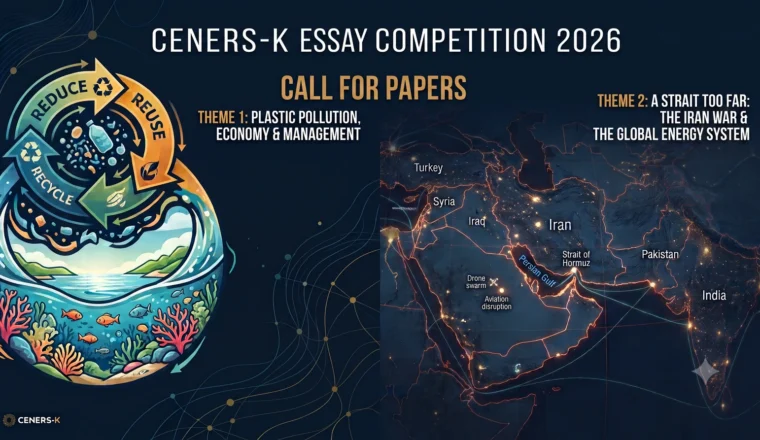
CENERS-K invites students to enter its 2026 Essay Competition. The purpose of the contest is to give undergraduate and graduate students the opportunity to write and circulate scholarly work on questions that matter to policy. There are two themes this year, and an entrant may write on either.
Theme 1 — Plastic Pollution, Economy and Management
Challenges and Opportunities to Mitigate Effective Plastic Pollution, Economy and Management: Designing Out Waste from Life to Line.
An estimated 8 million metric tons of plastic waste enter the oceans every year. If production and use grow as currently planned, plastic-related emissions could reach 56 gigatons of carbon dioxide by 2050 — between 10 and 13 per cent of the entire remaining carbon budget. The theme asks how the shift from a “take-make-dispose” model to one of continuous reuse, recycling or natural decomposition can be achieved, bridging daily lifestyle choices and manufacturing processes.
Suggested topics:
- A comprehensive analysis of global plastic waste generation and its effect on land and marine environment
- Understanding the plastic waste crisis: an overview
- Environmental regulations and their impact on plastic manufacturing
- Strategies for reducing the environmental footprint of plastic production
- Innovations in recycling technologies for plastic waste
- Alternative materials to plastic: prospects and limitations
- Corporate social responsibility in the plastic manufacturing industry
- The role of consumers in addressing the plastic crisis
- Modern technologies for waste-to-energy and waste-to-production conversion
- Potential challenges and a way forward for sustainable management technologies
Theme 2 — A Strait Too Far: the Iran War and the Global Energy System
A Strait Too Far: Strategic Calculus of Iran War — Geopolitics and the Weaponization of the Global Energy System.
What began on 28 February 2026 as a calibrated effort at regime decapitation and counter-proliferation has, within weeks, become a struggle over the sinews of the global energy order. Price spikes, supply disruption and cascading effects from aviation to agriculture show how regional instability triggers systemic shocks. The theme asks entrants to treat the conflict as a stress test of the regional order, under conditions already shaped by deterrence erosion, fragile energy security and intensifying great-power competition.
Suggested topics:
- Operation Epic Fury: strategic analysis of the initial joint U.S.–Israel strike strategy
- The transition from shadow war to open conflict
- Asymmetric warfare in 2026: the role of hypersonic missiles and drone swarms
- Targeting the “brain”: the impact of leadership strikes on Iranian command and control
- The future of naval power: securing the Strait of Hormuz in a high-intensity conflict
- Energy shockwaves: how the 2026 Iran war disrupted global supply chains
- The 2026 nuclear non-proliferation regime: when diplomacy fails
- The Tehran paradox: rewriting the rules of international law and intervention
- A view from Delhi: India’s strategic tightrope and energy security
- Russia and China’s role in a regionalized Middle East war
- The fall of a regime? Analysing potential Iranian post-war scenarios
- Post-2026 Middle East: rebuilding regional security architecture
- The new normal: the enduring impact of the 2026 crisis on global energy policy
Who may enter
Entrants must be students currently enrolled at a fully accredited college or university in India. There are two categories:
- Undergraduate — students pursuing a bachelor’s degree at the time of submission
- Graduate — candidates pursuing master’s, doctoral or equivalent degrees, along with practising professionals
Submissions from all disciplines and perspectives are welcome.
How to submit
- E-mail your essay to info@ceners-k.com in MS Word format.
- Include your name, college or university, the degree being sought and your expected graduation date.
- Each paper requires an author, three tags, a title and an abstract. Abstracts are limited to 200 words and titles to 50 words. List all co-authors.
- Essays may be inspirational, analytical or pedagogical in nature.
- Essays must be original and unpublished, and not under review elsewhere.
- Essays must be a maximum of 3,000 to 3,500 words.
A note on authorship. Essays must be written in the applicant’s own authentic voice, reflecting their own thoughts and insights. Submissions are inspected to detect the percentage of AI-generated content, and the result is considered in the evaluation.
Timeline
- 30 September 2026 — last date for submission
- October 2026 — winners notified
Awards
- One undergraduate essay, one graduate essay and one doctoral candidate may be selected as award recipients.
- A prize and a certificate are awarded for each winning essay.
- Winning essays may be published on the CENERS-K website at the discretion of the Article Review Committee.
- Winning essays may be published in the Calcutta Journal of Global Affairs at the discretion of the editor.
Download the concept notes
Each theme has a full concept note setting out the background, the topic list and the rules in detail.
- Theme 1 — Plastic Pollution, Economy and Management (PDF, 268 KB)
- Theme 2 — A Strait Too Far: the Iran War and Global Energy (PDF, 324 KB)
Questions
Write to info@ceners-k.com. CENERS-K is at Second Floor, 3 Lovelock Place, Kolkata — 700017, West Bengal, India.