
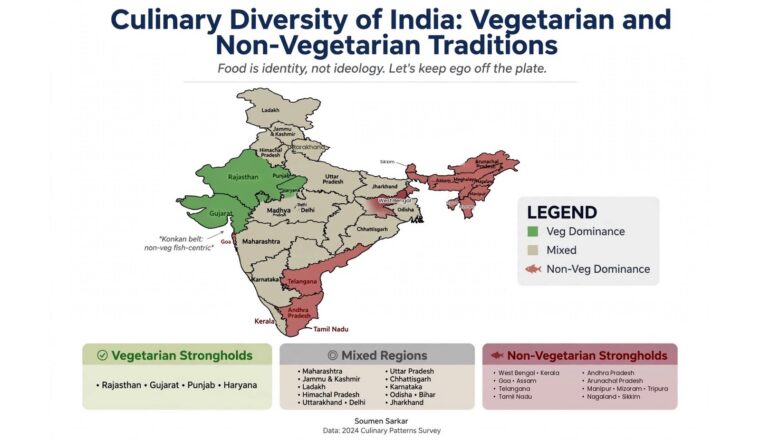
By Dr Soumen Sarkar
Food is identity, not ideology. Let’s keep ego off the plate.
Where we grow up, what our land produces, what our rivers carry, what our grandparents cooked and what our festivals traditionally served — all of this quietly shapes what we eat. Over generations, everyday eating becomes tradition, tradition becomes culture, and culture becomes identity.
Food habits, in other words, are shaped by three grounded realities: the economic condition of a community, the climatic condition of a place, and the availability of ingredients. A community eats what its ecology allows it to grow, catch, preserve and trade. This lived practice is later blended with ritual, memory and faith to ensure continuity. It is not the other way around.
This is why in India, geography and food are inseparable. The cuisine of Kashmir cannot be understood without its winter and its history of Wazwan. Kerala’s cuisine reflects its coastline, coconut and centuries of spice trade. Rajasthan’s food evolved around aridity, millet and preservation. Bengal’s identity is inseparable from its rivers, wetlands, paddy fields, mustard and fish. To assume one Indian food habit is to miss India entirely.
Food, therefore, must never become a source of pride, a test of purity, or an instrument of hegemony. It is meant to nourish and to host, not to dominate.
I. Eastern and North-Eastern India: Where Ecology is Culture
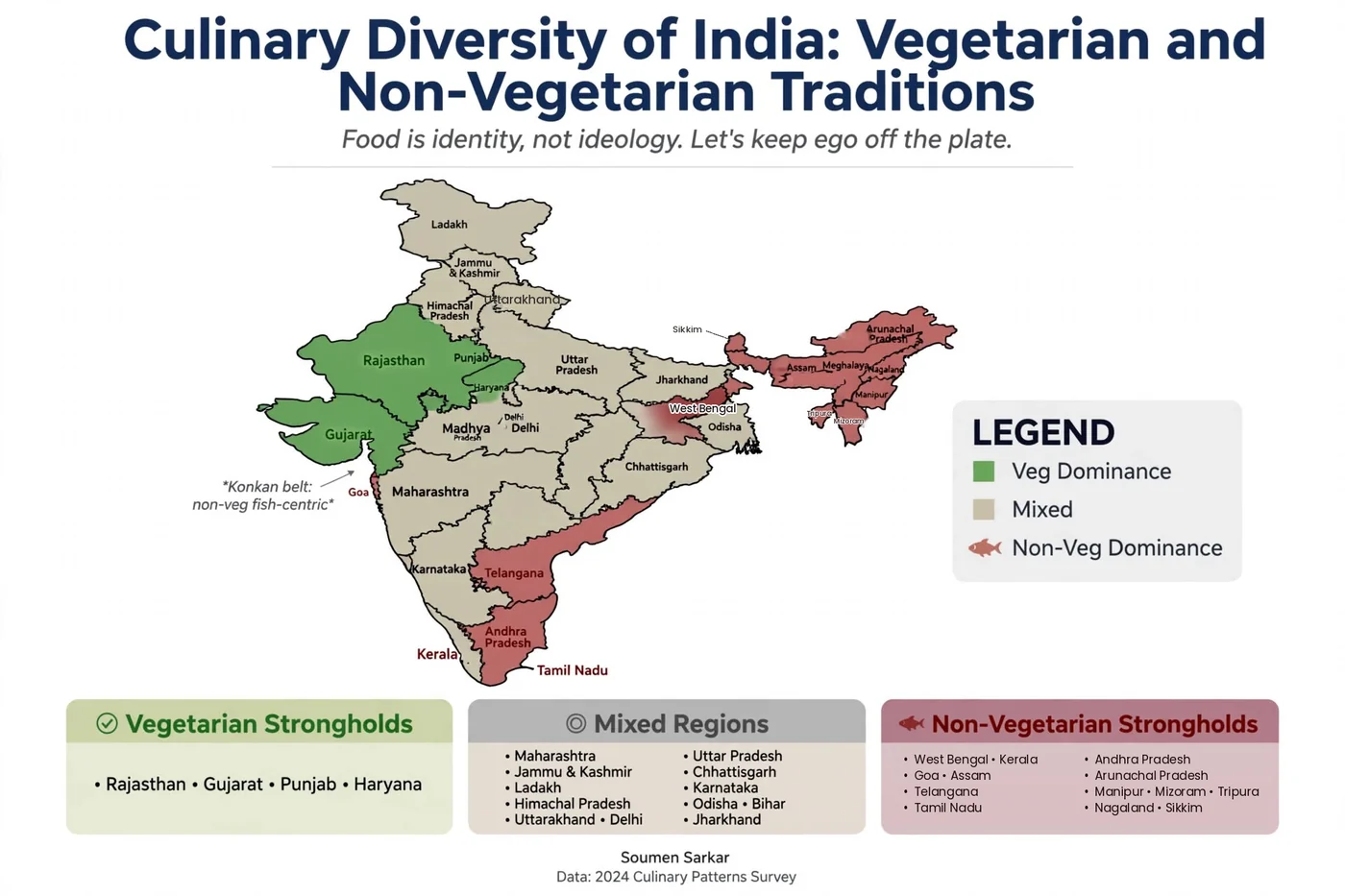
If we place Eastern and North-Eastern India at the centre of India’s gastronomic story, the ecological logic becomes self-evident.
Bengal lives by rice and machh. From ilish bhapa, shorshe ilish, chingri malai curry to kosha mangsho and mutton curry are not indulgences; they are the grammar of everyday life and festivity. Even in worship, fish bhog at Kalighat and Tarapith, including fish head and fried fish, is considered auspicious. For a Bengali, celebration without fish is incomplete.
Cross the Brahmaputra and the same logic holds with different ingredients. The Northeast, often peripheral in India’s gastronomic imagination, holds some of the country’s most sophisticated food cultures, each precisely adapted to its landscape: Assam offers masor tenga, a light, tangy fish curry tempered with elephant apple, and duck with ash gourd. Nagaland is known for smoked pork with bamboo shoot — smoking as preservation in high humidity. Meghalaya has jadoh, red rice cooked with pork. Manipur has iromba, seasonal vegetables pounded with fermented fish ngari and chillies. Sikkim has phagshapa, pork with radish and dried chillies. Arunachal cooks with bamboo shoot, wild herbs and minimal oil.
The ecology is different, so the food is different. That is not rebellion. That is culture.
Add the rest of India and the picture is complete — Lucknow’s galouti kebab, Rajasthan’s laal maas, Goa’s pork vindaloo, Chettinad chicken, Kerala’s karimeen pollichathu. India has a rich vegetarian tradition that deserves to be celebrated globally. It has an equally extraordinary non-vegetarian tradition. To showcase one and hide the other is to present only half the story.
II. The Essential Distinction: Spirituality is Not on the Plate
Religious practice can influence diet, but it does not define regional cuisine. One is a matter of faith, the other a matter of geography, history and ecology. That distinction is crucial.
Spirituality at its core is about self-discipline, compassion, detachment and the search for truth. Food habit is about climate, livelihood and custom. Conflating the two reduces a vast philosophical tradition to what is on a plate.
The recent debate around appeals for a purely vegetarian Durga Puja in Bengal illustrates this confusion. For many Bengalis, fish during Puja is not a violation of faith; it is part of faith. Faith travels, but food remains rooted in place. If the same preacher had been born in Nagaland, pork might have been his staple. In a Maithil Brahmin household in Bihar, fish is part of ritual. Among Kashmiri Pandits, mutton has long been part of festive tradition.
Dietary practices in India vary enormously by region, caste, community, family and individual. It is absurd to speak of a single Indian food culture.
III. What Does Our Own Tradition Actually Say?
If we are serious about Sanatan Dharma, we must learn it from authentic sources rather than from food taboos that actually depend on factors discussed above.
First, the biology. Human beings are biologically omnivorous. We are created with dentition, enzymes and a digestive system capable of digesting both vegetarian and non-vegetarian food. Our long evolutionary history as hunter-gatherers attests to this. Agriculture itself is a relatively recent technology in human history — barely ten to twelve thousand years old. For lakhs of years before that, humans survived on what nature provided, including meat and fish. If we are created with the ability to digest non-vegetarian food, on what logic do we act against that creation by declaring it inherently impure?
Second, the tradition. Many old Hindu temples in India have rituals of offering non-vegetarian food as bhog for centuries. At Kalighat and Tarapith in Bengal, at Kamakhya in Assam, at many Shakti Peethas across the country, fish, mutton and other offerings are sacred prasad. Bali-dan is still continuing across the country, where offerings are made and then distributed as prasad among devotees.
Third, the texts. Hindu mythology and literature have clear references to the consumption of meat — hunting and meat-eating among Kshatriyas, references in the Ramayana, Mahabharata and Puranas, and the offering of meat during shraddha and yajnas. These are not aberrations; they are part of the documented diversity of practice.
Therefore, there is no logical basis to link vegetarian food exclusively with Sanatan Dharma. Sanatan has never been about uniformity of the plate. It has been about unity in diversity — the truth is one, sages call it by many names. That includes many plates.
IV. Unity in Diversity Begins at the Table
There is a simple principle of hospitality our grandmothers understood: food should be palatable to the guest. When I invite someone home, I ask what he would prefer — roti with chicken kosa, vegetable kurma, or rice with posto and mutton curry, or a traditional fish preparation? I do not expect my guest to adopt my practices for the evening. Accepting food graciously can itself be an act of courtesy.
My mother often says cooking for a non-vegetarian is easier — one good fish preparation can make a meal. For a vegetarian accustomed to variety, you need several dishes to satisfy. Both require skill. Both deserve respect.
India’s culinary map is as complex as its linguistic map. Vegetarian India does not represent all of India. Non-vegetarian India does not either. Both exist. They coexist, often within the same family.
The central question, then, is not which is superior. The question is whether we are confident enough, and rooted enough in our own dharma, to learn our religion from its authentic philosophical sources — the Upanishads, the Gita, and the practices of inquiry, restraint and compassion — rather than from inherited taboos, and to present the whole of India without ego on the plate, and without confusing spirituality with food habits.
Food is meant to feed and unite — not to divide, dominate, or dictate purity.
About Dr Soumen Sarkar

Dr Soumen Sarkar has more than eighteen years in the banking industry, academia, research and training, with expertise in public policy, compliance, institutional governance and internal control. He writes from Mumbai.