
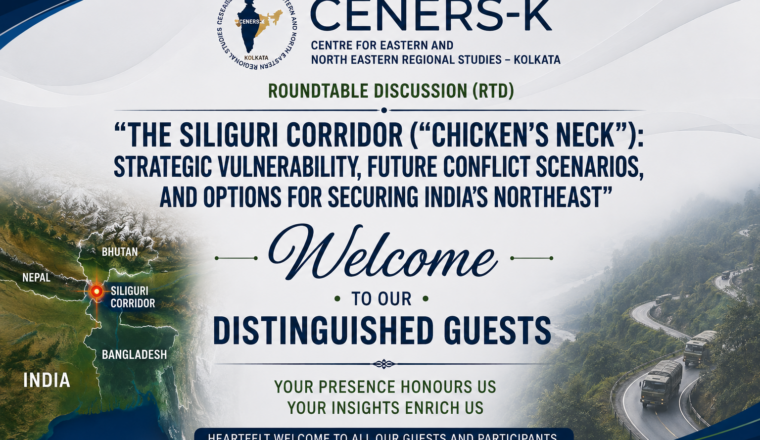
On 16 August 2026, at The Legacy Room of The Lalit Great Eastern Hotel in Kolkata, CENERS-K convened a Roundtable Discussion on a question that has troubled Indian strategic planners for decades: what happens to the Northeast if the Siliguri Corridor is squeezed?
The Corridor, widely known as the Chicken’s Neck, is the narrow land bridge connecting mainland India with the eight North Eastern states. At its slimmest it is barely twenty kilometres across, hemmed in by Nepal, Bhutan, Bangladesh and the Chinese frontier beyond. Every road, railway line, pipeline and fibre-optic cable that sustains forty-five million citizens of the Northeast passes through it. That geography makes it, in one phrase, India’s most consequential single point of vulnerability.
The proceedings have now been published in full on the CENERS-K YouTube channel as an eleven-part series, and the complete playlist is embedded below.
Why this discussion, and why now
The Roundtable was deliberately framed to look past the familiar formulation of “defending the Chicken’s Neck”. Defence of the Corridor is a tactical problem. The strategic problem is larger: if the Corridor comes under severe military or multidomain pressure, how does India ensure that the Northeast remains connected, supplied, resilient and capable of effective defence and governance?
That reframing shaped the entire day. Contemporary conflict does not confine itself to the battlefield. It reaches into supply chains, power grids, financial systems, telecommunications networks and public opinion. A corridor can be rendered ineffective without a shot being fired across it. The speakers were therefore asked to examine the question from their own domains and let the picture assemble itself.
The speakers
The series brought together senior military leaders, strategic practitioners and subject specialists:
- Air Chief Marshal Arup Raha (Retd), former Chief of the Indian Air Force, on air operations, missiles, drones and space-based systems
- Lt Gen J. R. Mukherjee (Retd) on terrain, opponent force levels and likely patterns of operations
- Maj Gen Arun Roye (Retd), President, CENERS-K, on ground operations and the military significance of Bhutan
- Maj Gen Shib Nath Mukherjee (Retd) on infrastructure as an instrument of national security
- Brig N. S. Mukherjee (Retd), co-moderating the concluding session
- Col T. S. Sarkar on political, economic, psychological, cyber and electronic operations
- Col Shantanu Roy on combat support and logistics
- Shri Ashwal Varma on naval operations in the Bay of Bengal
- Mr Rohinton Babaycon on the responsibilities of the North Eastern State Governments
Watch the complete series
Eleven parts, beginning with an introduction and running through to the concluding question and answer session. The playlist plays them in order.
Open the full playlist on YouTube
The eleven sessions
- Introduction to the seminar series – the Corridor, its geography and why it matters
- Scenario Building: Why Sever the Siliguri Corridor? – motivations, actors and the possible shapes a crisis could take
- Likely Pattern of Ground Operations, Including Bhutan – Maj Gen Arun Roye (Retd)
- Terrain, Opponent Force Levels and Pattern of Operations – Lt Gen J. R. Mukherjee (Retd)
- Air Operations: Missiles, Drones and Space-Based Systems – Air Chief Marshal Arup Raha (Retd)
- Pattern of Naval Operations in the Bay of Bengal – Shri Ashwal Varma
- Political, Economic, Psychological, Cyber and Electronic Operations – Col T. S. Sarkar
- Development of Infrastructure by India to Counter Enemy Operations – Maj Gen Shib Nath Mukherjee (Retd)
- Combat Support Layout for Logistical Operations – Col Shantanu Roy
- Actions Required by Governments of the North Eastern States – Mr Rohinton Babaycon
- Summing Up: Securing India’s Northeast, with Question and Answer Session – Maj Gen Arun Roye (Retd) and Brig N. S. Mukherjee (Retd)
Themes that ran through the day
Geography sets the terms
Terrain does not negotiate. The Corridor’s width, the Himalayan approaches above it and the riverine plains below shape what any force can attempt and what India must be prepared to hold. Several speakers returned to the point that Bhutan’s position gives the ground problem a dimension that cannot be considered in isolation from diplomacy.
The battlefield now extends well beyond the battlefield
Cyber intrusion, information operations, economic pressure and electronic warfare can degrade a nation’s capacity to act long before conventional forces are committed. The central question posed in the sixth session deserves repeating: how does India maintain national cohesion and decision-making capacity when a conflict is being waged across every domain at once?
Redundancy is a form of defence
Infrastructure and logistics received sustained attention, and rightly. Alternative routes, sustainable supply chains, resilient communications and the ability to move and support forces under disruption are not support functions in this scenario. They are the substance of the problem.
Preparedness is not the military’s alone
The role of the North Eastern State Governments emerged as a serious strand rather than an afterthought. Civil administration, continuity of essential services and community resilience determine whether a region under pressure holds together or fragments.
The conclusion
Taken together, the eleven sessions converge on a proposition that is uncomfortable but clarifying. Securing the Siliguri Corridor is not principally a matter of defending twenty kilometres of ground. It requires national resilience, military preparedness, infrastructure redundancy, logistical depth, technological capability, political coordination and multidomain awareness, developed together and in advance.
CENERS-K publishes these proceedings in full rather than as edited highlights, because a question of this weight deserves the time it takes to understand it. We invite scholars, practitioners and interested citizens to watch, to disagree and to write to us.
The Roundtable Discussion was organised by CENERS-K, the Centre for Eastern and North Eastern Regional Studies, Kolkata, an autonomous and apolitical think tank established in 2007. Further seminars, roundtables and the peer-reviewed CJGA Journal are available on this website. Subscribe to the CENERS-K YouTube channel for future proceedings.