
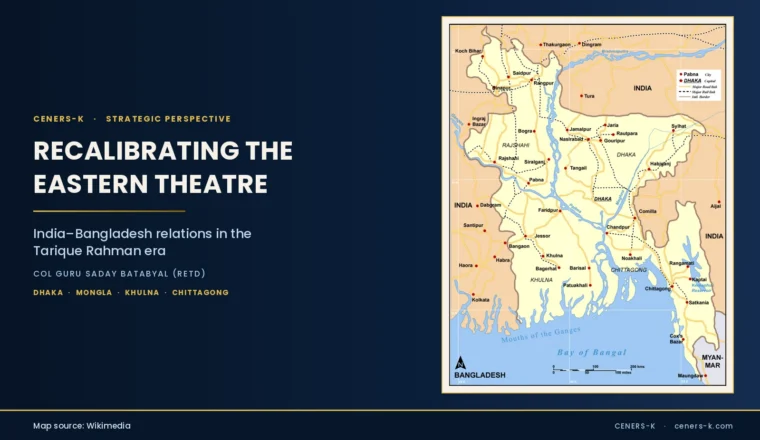
The fall of Sheikh Hasina ended a decade of unusual closeness between New Delhi and Dhaka. Under Tarique Rahman, Bangladesh is widening its diplomatic aperture towards China and Pakistan while India answers with patience rather than pressure. This assessment traces the recalibration and asks what equilibrium might replace the old intimacy.
Introduction: a strategic relationship in flux
The collapse of Sheikh Hasina’s government in August 2024 abruptly ended one of India’s most stable and strategically aligned bilateral relationships. For over a decade, New Delhi and Dhaka had sustained a partnership marked by political warmth, dense institutional cooperation, and a shared sense of regional purpose. Counterterrorism coordination flourished, connectivity projects advanced, and India’s Act East vision found in Bangladesh a dependable anchor. That architecture dissolved with startling speed once Hasina exited the scene, leaving behind a vacuum filled not by overt hostility, but by a deliberate cooling of ties.
The interim administration under Dr Mohammad Yunus presided over this chill. What began as administrative caution soon hardened into a perceptible freeze. Visa suspensions narrowed communication channels, and a surge in public sentiment critical of India created an atmosphere of unease. Even minor bureaucratic lapses — such as delays faced by Bangladeshi officials at Indian airports — acquired disproportionate political meaning. Dhaka’s repeated calls for Hasina’s repatriation introduced a sensitive irritant, driven by domestic imperatives but interpreted in New Delhi as a pressure tactic. The relationship did not rupture, but it drifted into a zone of discomfort where neither side possessed a clear roadmap for restoration.
It is into this unsettled landscape that Tarique Rahman stepped, inheriting a relationship suspended between past intimacy and present ambiguity.
Tarique Rahman’s arrival: recalibration through symbolism and strategy
Tarique Rahman’s ascent to power in early 2026 introduced a new grammar of engagement. His rhetoric avoided confrontation with India, emphasising governance reform, institutional renewal, and economic modernisation. Yet beneath this moderation lay a deliberate recalibration of Bangladesh’s external priorities.
The choreography of his early foreign travel was the first unmistakable signal. Breaking decisively with the Hasina-era convention of visiting New Delhi first — a symbolic reaffirmation of India’s primacy — Rahman chose instead to travel to Malaysia and China. The sequencing was not accidental. It was a message to domestic constituencies that Bangladesh’s foreign policy would no longer be tethered to inherited alignments, and a message to India that Dhaka intended to widen its diplomatic aperture.
This widening soon acquired sharper contours. Rahman revived high-level exchanges with Pakistan, signalling a willingness to reopen channels that had remained dormant under Hasina. Defence-level contacts, cultural engagements, and exploratory discussions on trade diversification indicated a subtle but unmistakable shift. The outreach was calibrated — not confrontational, but suggestive of a Bangladesh seeking strategic space beyond the India-centric framework of the previous decade. Simultaneously, Rahman deepened engagement with China. His Beijing visit produced a series of agreements that expanded Chinese infrastructural and economic presence in Bangladesh.
Rahman’s messaging attempted to frame these moves as part of a broader neutrality: Bangladesh would diversify partnerships without antagonising India. Yet the cumulative effect of his early decisions suggested a tilt — subtle, deliberate, and strategically consequential.
The BRICS episode: a diplomatic signal of cold vibes
One recent episode captured the delicate choreography of the evolving relationship: Bangladesh’s invitation to the 2026 BRICS Summit. Tarique Rahman was invited in his capacity as the current Chair of BIMSTEC, the Bay of Bengal Initiative for Multi-Sectoral Technical and Economic Cooperation, rather than as a bilateral guest or as the leader of an individual member state. India clarified that this regional-outfit invitation was separate from a standing bilateral invitation extended earlier.
Tarique Rahman did not attend.
The silence was widely interpreted as indicative of a lingering cold vibe between the two capitals. For India, the invitation was a gesture of continuity within a multilateral framework; for Bangladesh, the lack of response signalled caution, distance, and a desire to avoid premature alignment at a moment of domestic flux. In a relationship already marked by ambiguity, the episode deepened the sense of drift.
China and Pakistan: the twin axes of Dhaka’s diversification
Bangladesh’s external diversification under Rahman is driven by both strategic ambition and economic necessity.
China: the expanding economic and maritime footprint
Chinese financing has become central to Bangladesh’s infrastructure landscape. Outstanding debt to China is substantial, and cumulative loan commitments are significantly higher. The structure of these loans — shorter repayment periods and tighter terms — adds long-term pressure on Bangladesh’s foreign exchange reserves. Yet in a period of economic fragility, Chinese capital remains attractive.
China’s entry into Mongla Port’s expansion and the development of a Chinese-backed economic zone on land earlier allocated to India mark a decisive shift in Dhaka’s strategic calculus. Modern ports are inherently dual-use: deep berths, logistics networks, and digital systems that enable commerce can also support surveillance and naval replenishment. Mongla’s proximity to India’s eastern seaboard sharpens these risks, adding a maritime dimension to China’s presence in the Bay of Bengal.
Pakistan: the political and symbolic reopening
Rahman’s outreach to Pakistan carries symbolic weight. High-level exchanges and defence contacts mark a departure from the distant stance that prevailed under Hasina. For segments of the BNP and Jamaat-e-Islami — now influential actors in Dhaka’s political landscape — Pakistan remains a historical and ideological reference point. The outreach is calibrated, but it signals a willingness to reopen channels that India views with caution.
Together, these axes — China’s economic footprint and Pakistan’s political warmth — create a more crowded strategic environment for India.
Connectivity setbacks: the Mongla rail link and the MoU review
India’s connectivity investments in Bangladesh have faced setbacks in the post-Hasina period. The 65 km Khulna–Mongla railway line, financed through Indian concessional funding, was completed as a critical component of India’s eastern connectivity architecture. For India, this marks both an economic and strategic setback. Mongla was integral to the ‘Look East’ vision of regional connectivity and alternative maritime access; its dilution weakens that framework. The Yunus administration, citing inadequate progress on the further development of Mongla Port by India, terminated the agreement unilaterally. India, for its part, ought to have accorded due attention to the terms of the agreement to complete the project.
This setback was compounded by Dhaka’s recent announcement, made only days ago, that it will review 101 Memoranda of Understanding signed with India by the previous government. The decision reflects Dhaka’s desire to reassess inherited commitments, but it also introduces uncertainty into the future trajectory of bilateral cooperation. For India, the review signals both administrative caution and political recalibration in Dhaka.
India’s response: cautious, measured, and incrementally restorative
India’s recalibration has been deliberate rather than reactive. New Delhi recognises that Bangladesh’s domestic fragility, economic stress, and political realignments require a nuanced approach rather than assertive diplomacy.
A pivotal element in India’s strategy has been the appointment of Dinesh Trivedi as High Commissioner to Bangladesh, with Cabinet-rank protocol status. His political experience, cross-party rapport, and ability to navigate Dhaka’s complex political terrain have lent a new tone to India’s outreach. Under Trivedi, several confidence-building measures have been revived:
- Restoration of tourist visas for Bangladeshi nationals
- Revival of bureaucratic and security-level communication channels
- Commitment to reopening suspended rail and bus links, including routes critical for India’s north-eastern connectivity
- Quiet engagement with political actors across the spectrum, reducing friction without appearing intrusive
These moves signal India’s desire for stability and predictability. They also reflect New Delhi’s recognition that geography imposes structural constraints: India’s north-eastern lifelines run through Bangladesh, and Bangladesh’s economic arteries remain intertwined with Indian markets. India’s approach is thus far measured — firm where necessary, patient where prudent.
Conclusion
The Teesta dispute is only one strand in a larger tapestry of unresolved India–Bangladesh frictions: even in an era of unprecedented political warmth between Delhi and Dhaka, certain structural irritants have persisted, and they cluster around three domains — water, borders, and security.
India–Bangladesh relations after the Hasina era stand at an inflection point. They are no longer buoyed by the political intimacy of the past, yet not imperilled enough to invite talk of rupture. They inhabit a corridor between past certainties and emerging possibilities, where caution is the prevailing instinct and strategic autonomy the animating impulse.
Bangladesh seeks room to manoeuvre: to diversify partnerships, rebalance inherited alignments, and consolidate a fragile domestic order. India seeks stability, predictability, and insulation from external encroachments. China seeks access, influence, and maritime reach. Pakistan seeks renewed relevance in Dhaka’s strategic imagination.
The challenge is not to restore an earlier era of warmth — an era shaped by personalities and political alignments that no longer exist — but to craft a new equilibrium suited to the complexities of the present. If both sides can transform caution into coherence, and recalibration into a durable framework of mutual respect, the relationship may yet evolve into a mature partnership: less dependent on personalities, more anchored in structural interests, and better suited to the demands of a changing regional order.
The search for this equilibrium has begun. Its outcome will shape the geopolitics of the eastern subcontinent for years to come.
About the author
Colonel Guru Saday Batabyal (Retd), PhD, FRHistS, FRAS is a veteran of the 4th Gorkha Rifles and former Commander of India’s first Peacekeeping Contingent in Lebanon (UNIFIL, 1998–99). He later represented India in the UN–USA strategic project End State – Exit Strategy in Manila (2003), served as CEO in the IT sector, advised the Prime Minister and Government of Fiji on e-governance, and taught Strategy and International Relations as Visiting Professor at universities in India and abroad.
He writes regularly for edited volumes, academic journals and leading dailies. His Routledge book Politico-Military Strategy of Bangladesh Liberation War, 1971 (2020) is widely regarded as a significant contribution to the field. He is a Fellow of both the Royal Historical Society (UK) and the Royal Asiatic Society (Great Britain & Ireland) — a rare dual distinction.