
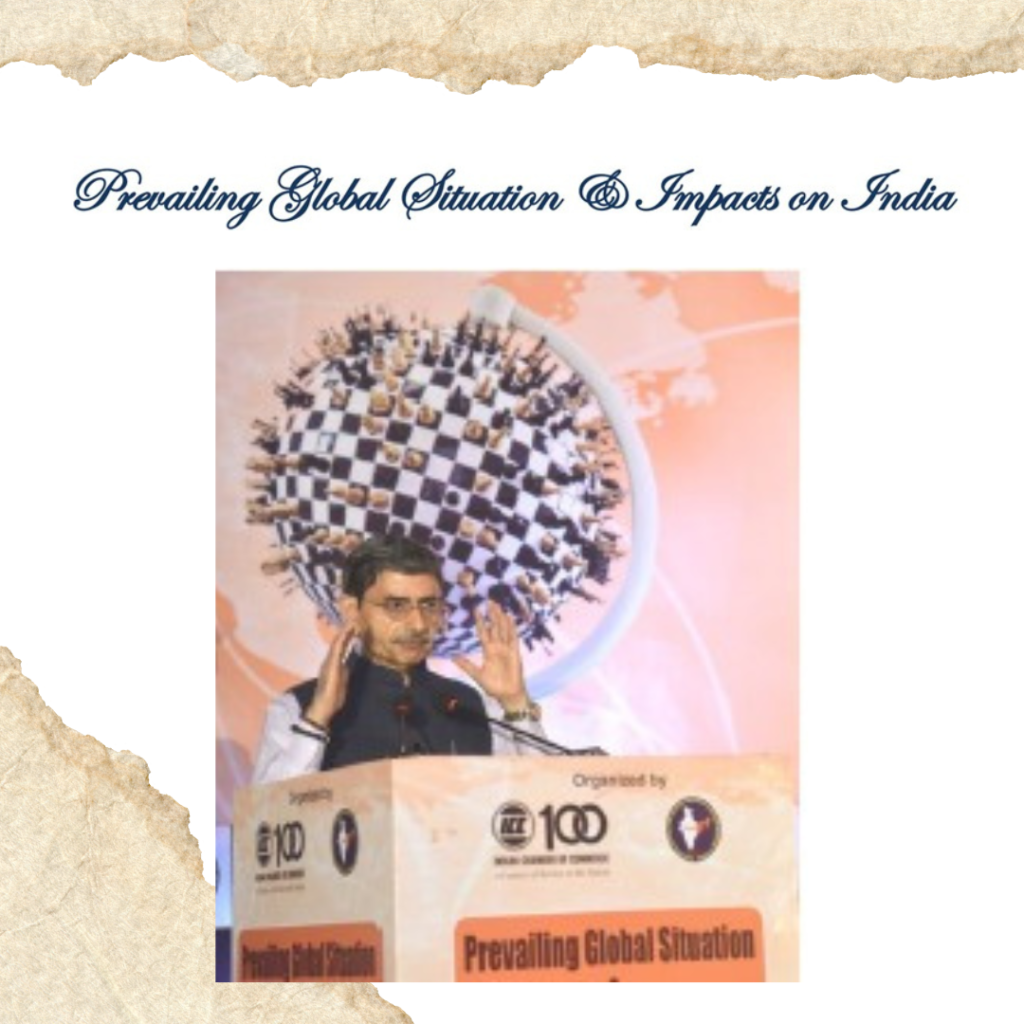
Addressing as Chief Guest in a distinguished gathering of policymakers, industry leaders, defence experts, academicians and researchers, Hon’ble Governor of West Bengal, Shri R.N. Ravi, underscored the importance of national vision, technological self-reliance and civilization confidence in achieving the goal of Viksit Bharat 2047.
Speaking at a strategic dialogue jointly hosted by Indian Chamber of Commerce and Ceners-K, the Governor said that India’s rapid transformation over the past decade has been driven by a clear national vision and collective resolve. He observed that the country has emerged as one of the world’s fastest-growing major economies and has made significant strides in poverty reduction, innovation and inclusive development.
Highlighting the need to sustain this momentum, Shri Ravi emphasized that economic growth must be broad-based and equitable while strengthening India’s resilience against evolving global challenges. He stressed that science, technology and indigenous innovation will be central to India’s future, noting the country’s remarkable progress in research, startups, intellectual property creation, artificial intelligence, semiconductors and emerging technologies.
The Governor also called for greater self-reliance in defence production and strategic capabilities, pointing to the rapid expansion of domestic manufacturing and defence exports. He remarked that a strong military and technological base is essential for safeguarding national interests and ensuring long-term security.
Discussing demographic and societal priorities, Shri Ravi highlighted the importance of preserving India’s youthful population through supportive, family-friendly policies while fostering entrepreneurship and citizen-led development. He praised initiatives that have empowered millions of individuals, particularly through access to finance and innovation-driven opportunities.
In his address, the Governor further emphasized India’s unique civilization identity, describing the country as a timeless cultural and philosophical entity rooted in the ideals of unity, inclusiveness and Vasudhaiva Kutumbakam—the belief that the world is one family. He argued that these values position India to play a constructive role in shaping an equitable and sustainable global order.
Referring to contemporary geopolitical and economic shifts, Shri Ravi said that while global developments present significant challenges, they also offer India unprecedented opportunities to emerge as a leader in creating a more inclusive and balanced international framework. Hecited India’s contributions in areas such as renewable energy, digital public infrastructure and global cooperation as examples of responsible leadership.
Concludinghisaddress,theHon’bleGovernorurgedexperts,institutions and citizens alike to contribute actively toward building awareness, fostering innovation and strengthening national capabilities so that India can successfully realise its vision of becoming a fully developed nationby 2047.
The event brought together eminent thought leaders from government, industry, defence and academia for deliberations on the implications of global developments for India’s strategic, economic and technological future.
IndiaisShapingtheFuturethroughInnovation,UnityandGlobalLeadership:ICCPresident
Welcoming delegates and dignitaries, Mr. Brij Bhushan Agarwal,President, Indian Chamber of Commerce (ICC) and Chairman & Managing Director, Shyam Metalics & Energy Ltd., highlighted India’s remarkable transformation into a leading global economic and innovation powerhouse.
In his address, Mr. Agarwal observed that the world is witnessing an unprecedented technological revolution driven by artificial intelligence, digital innovation and emerging technologies that are reshaping industries and societies. He noted that India is not merely adapting to these changes but is actively contributing to shaping the future through innovation, entrepreneurship and policy leadership.
EmphasizingIndia’sgrowingstatureontheglobalstage,hesaidthecountry has emerged as one of the world’s fastest-growing major economies and is widely regarded as a trusted international partner. India continues to strengthen its engagement with advanced economies as well as the Global South while maintaining its strategic independence and balanced approach to international cooperation.
Mr. Agarwal pointed out that India’s economic progress hasearned worldwide recognition. Backed by robust domestic demand, infrastructure expansion, a thriving services sector and rapid digitalization, the country has become the world’s fifth-largest economy. He also highlighted significant advances in poverty reduction and improved access to essential services as milestones in India’s development journey.
Addressing the business community, he said the evolving global supply chain landscape presents a historic opportunity for India. Flagship initiatives such as Make in India, PM Gati Shakti, the Production Linked Incentive (PLI) Scheme, and the National Logistics Policy are strengthening manufacturing capabilities, improving logistics efficiencyand enhancing India’s attractiveness as a destination for global investment, innovation and enterprise.
He further underscored that India’s greatest strength lies in its people. With one of the world’s largest consumer markets and a dynamic demographic profile, the nation represents immense economic potential. Drawing an analogy, he remarked that just as a bundle of wood burns brighter than a single piece, the true strength of a nation lies in the unity, cooperation and collective efforts of its citizens.
“As India navigates a rapidly changing global landscape, our resilience, shared vision and collaborative spirit enable us to transform challenges into opportunities and build a stronger future for generations to come,” he said. Expressing confidence in the deliberations of the gathering, Mr. Agarwal concluded that the discussions would generate valuable insights and meaningful recommendations that would contribute to a stronger, more secure and more prosperous India.
AirChiefMarshalArupRahacallsforStrategicPreparednessamidGlobalUncertainty
Addressing as Opening remarks of the seminar jointly organized by the Indian Chamber of Commerce (ICC) and Ceners-K, Air Chief Marshal (Retd.) Arup Raha, PVSM, AVSM, VM, former Chief of the Indian Air Force, underscored the need for India to proactively strengthen itsnational resilience in the face of an increasingly volatile global environment.
Welcoming theHon’bleGovernorofWest Bengal,distinguishedspeakers, panelists and delegates, Air Chief Marshal Raha described the seminar asa compact yet highly impactful platform featuring eminent experts with deep domain knowledge. He emphasized that informed dialogue and strategic thinking are essential to understanding the evolving geopolitical and economic landscape.
Reflecting on history, he observed that global instability has been a recurring phenomenon, shaped by wars, colonial rivalries, trade disputes, sanctions, and competition for resources. He noted that the pursuit of power and economic dominance has repeatedly altered the course of civilizations, making it imperative for nations to study these patterns and formulate effective responses.
Highlighting India’spositionas—an oasisofstability‖amidwidespreadpolitical,economicandmilitaryupheavals,hestressedthatthecountry must identifyemergingvulnerabilitiesand devisepractical solutions to safeguardits long-term interests. Theseminar,hesaid,aims tofacilitate such strategic deliberations.
Drawing lessons fromongoing conflicts in West Asia, Air Chief Marshal Raha emphasized the growing significance of controlling strategic maritime choke points over merely possessing large territories. He advocated accelerated development ofthe Andaman and Nicobar Islands as a major internationalshippinghuband strategic military base to strengthen India’s presence across the Indian Ocean Region and monitor key passages such as the Malacca, Sunda and Lombok Straits.
On energy security, he called for reducing India’s dependenceonimported
energy by investing in thorium-based nuclear
technologies, expanding renewable energy capacity, and significantly increasing strategic reserves of oil and naturalgastowithstandfuture disruptions.
He also stressed the importance of preparing for next-generation warfare through enhanced capabilities in drones, missile systems, integrated air defence, network-centric operations, and space-based assets for intelligence gathering and precisiontargeting.According tohim,thesetechnologieswill serve both civilian and militaryapplicationsandare
critical to future national security.
Addressing technological competitiveness, Air Chief Marshal Raha urged India to bridge the gap with leading nations by attracting talented members of the Indian diaspora and leveraging their expertise in critical and emerging technologies. He further advocated comprehensive reforms in higher education with a stronger emphasis onresearch, innovation and advanced scientific development.
While acknowledging that Indiamissedthefirsttwo
industrial revolutions, he asserted that the country is well positioned to lead inareas such as digital technologies, information technology,cybercapabilities, artificial intelligence, robotics and space. He also called for expanding indigenous capabilities in commercial aircraft manufacturing by leveraging existing expertise in military aviation and dual-use technologies.
Emphasizing the need to strengthen India’s military-industrial ecosystem, he recommended expanding production capacities to support sustained defence preparedness during
prolonged conflicts. He concluded by highlighting the importance of enhancing India’s Comprehensive NationalPowerbyintegrating
both hard and soft power to effectively engage with friendly nations, strategic partnersand adversaries alike.
Concluding his address, Air Chief Marshal Raha reiterated that strategic foresight, technological advancement, self-relianceandnational
preparedness will be vital in enabling India to navigate an increasingly uncertain global order and secure its long-term interests
VoteofThanks&HighlightsofIndia’sResilience,VisionforViksitBharat,andWestBengal’sGrowthAspirations
DeliveringtheVoteofThanks at the conclusion of the seminar, Dr. Rajeev Singh, Director General, Indian Chamber of Commerce (ICC), reflected on therapidly evolving global landscape and India’s remarkable ability to convert challenges into opportunities through decisive leadership and strategic vision.
Dr. Singh observed that the worldhasundergone
profound transformation since 2019, requiring nations to navigate increasing geopolitical, economic, and technological uncertainties. Describing India as a vast and diverse nation akin to a large ship sailing through turbulent waters, he noted that the country has demonstrated resilience in responding to external shocks while maintaining its growth trajectory.
He credited the leadership of Prime Minister Narendra Modi for adopting a proactive approach to crises, emphasizing the philosophyofturningeveryadversityinto an opportunity. Citing India’s response to the COVID-19 pandemic, expansion of domestic capabilities, strengthening of global partnerships, and the signing of multiple Free Trade Agreements with developed economies,Dr.Singhsaid
these initiatives haveenhanced India’s competitiveness and reinforced its position in global supply chains.
Highlighting the national aspiration of becoming a developed nation by 2047, he remarked that every stakeholder—including industry, institutions, and citizens—has an important roletoplayinachievingthe visionofViksitBharat.He
also noted that the Prime Minister’s global engagement has significantly elevated the imageof—BrandIndia‖onthe international stage while fostering a renewed sense of national pride.
Turning to West Bengal, Dr. Singh expressed appreciation for the guidance and leadership of the Hon’ble Governor, describing him as a statesman with deep expertise across constitutional, security, and governance matters. He commended the Governor’s activeengagementwith issues concerning the state and expressedoptimismabout
West Bengal’s future development trajectory.
Dr. Singh further observedthat while India continues to register strong economic progress, West Bengal has the potential to accelerate its own growth and aspire to reclaim itshistoricalpositionasoneof the country’s leading economic centers. He suggested that raising the state’s per capita income substantially over the coming years should be a shared objective and reiterated the IndianChamber of Commerce’s commitment to partnering with the state in its development journey.
Inviting the Governor’s continued guidance and mentorship; Dr. Singh affirmed ICC’s willingness to contribute meaningfully toward West Bengal’s economic transformation and inclusive progress. He also conveyed gratitude to Air Chief Marshal (Retd.) Arup Rahaforhisinsightfuladdress and concluded by requesting the audience to accord the Hon’ble Governor a standing ovation in recognition of his inspiring keynote address and distinguished public service.
India’sStrategicAutonomyremainsthecornerstoneofitsGlobalEngagement:Gen.M.M.Naravane(Retd.)
Addressing the gathering, Gen. M. M. Naravane, PVSM, AVSM, VSM, SM (Retd.), Former Chief of the Army Staff, underscored that strategic autonomy continues to be the defining principle of India’s foreign and security policy in an increasingly complex geopolitical landscape.
Expressing his gratitude to the Indian Chamber of Commerce (ICC) and the Ceners-K for convening the forum, Gen. Naravane said that India has consistently adopted a principled and independent approach to international affairs, making decisions based solely on its national interest rather than aligning itself permanently with any geopolitical bloc.
He explained that India’s participation in multilateral groupings—whether the Quad, BRICS, or other international platforms—should be viewed through the lens of strategic autonomy. Such engagements, he noted, are guided by what the Government of India considers to be in the country’s best interests at a particular point in time, taking into account prevailing global realities and national priorities.
Gen. Naravane observed that policy decisions must remain dynamic and responsive to changing circumstances. What appears to be the most appropriate course of action today may evolve with time, and future developments often provide a clearer perspective on the effectiveness of those choices. Emphasizing the importance of pragmatic decision-making,heremarkedthathistory
ultimately judges policies with the benefit of hindsight.
His address reinforced the view thatIndia’s independent strategic outlook enables it to navigate an increasingly multipolar world with flexibility, balance and confidence, while safeguarding its long-term national interests and preserving decision-making sovereignty.
Mr.BharatKarnadcallsforPragmaticStrategicAutonomyrootedinNationalInterest
Addressing the gathering, distinguished strategic thinker and author Mr. Bharat Karnad underscored the importance of viewing India’s strategic choices through the lens of geopolitical realities rather than idealistic aspirations. He argued that while discussions on civilizational values and heritagearesignificant,policymakersmust remain firmly anchored in the practical challenges of an increasingly competitive and coercive international order.
Emphasizing that the global environmentis shaped by power dynamics, deterrence, and national interests, Mr. Karnad cautioned against complacencyor strategic illusions. He observed that nations must recognize the realities of coercion and compellence in world affairs and prepare accordingly, rather than relying on normative assumptions about international conduct.
Reflecting on India’s foreign policy trajectory, he expressed concern that despite the country’s longstanding commitmenttostrategicautonomy,thereis a growing tendency to place excessive reliance on partnerships with the West, particularly the United States. He stressed that genuine strategic autonomy requires confidence in India’s own capabilities and independent decision-making.
Drawing attention to contemporary geopolitical developments, Mr. Karnad referred to recent discussions surrounding U.S. policyin the Indo-Pacific and highlighted the uncertainty that can accompany alliances driven primarily by shifting national interests. Using the exampleof Taiwan, he cautioned against overdependence on externalsecurityassurances,
noting that great powers invariably prioritize their own strategic calculations.
Having spent significant time in the United States, Mr. Karnad remarked that American foreign policy is fundamentally guided by a realist interpretation of national interest rather than broader civilizational considerations.Inthis context,
he urged India to avoid strategicdelusionsandinstead pursue policies grounded in realism, self-reliance, and a clear understanding of its long-term interests.
While acknowledging the value of promoting India’s civilizational ethos and cultural influence globally, he concluded that such aspirationsmustbe
complemented by a hard-headed assessment of present-day geopolitical realities. India, he asserted, should continue strengthening itsown strategic capabilities and preserve the independence of its decision-making in an increasingly uncertain global landscape.
India’sStrategicSilenceReflectsActiveDiplomacyandNationalInterest:Dr.SrikantKondapalli
Addressing the seminar, Dr. Srikant Kondapalli, Professor of China Studies at Jawaharlal Nehru University, underscored that India’s measuredresponse to the ongoing conflicts in West Asia should not be viewed as passive silence but as a deliberate strategy rooted in national interests, humanitarian considerations, and principled diplomacy.
Referring to the developmentsfollowing the October 7, 2023 attacks,Dr.Kondapalli noted that India unequivocallycondemned the killing
and abduction of Israeli civilians, consistent with itslongstandingpolicyof zero tolerance towards terrorism. At the same time, India has remained deeplyconcernedabout
the humanitarian consequences of the conflict in Gaza and has extendedsubstantial
assistance, including medicines and relief supplies,tosupport
affected Palestinian civilians through appropriate channels.
HeexplainedthatIndia’sbalancedapproachreflectsits commitment to both combating terrorism and addressing humanitarian crises. Rather than remaining inactive,Indiahaspursuedwhathedescribedasan
—active silence‖ byengaging through relief efforts and calibrated diplomacy.
Highlighting another critical dimension, Dr. Kondapalli drew attention to the nearly10 million Indians residing across the Gulf region, whose welfare remains a key national priority. These overseas
communities contribute significantly to India’s economy through
remittances, making regionalstabilityanissue of direct strategic importance. Should the conflict escalate further, Indiamayberequiredto
undertake large-scale evacuation operations similar to previousrescue missions conducted during international crises.
He also emphasized the importance of safeguarding India’s energy security and maritime interests. With disruptions affecting vital shipping routes, including concerns around the Strait of Hormuz and attacks on vessels in the Red Sea, India has taken measures to secure sea lanes and protect the uninterrupted flow of energy supplies. Such actions are essential to insulating the Indian economy from volatility in global oil markets and ensuring sustained economic growth.
Concluding his remarks, Dr. Kondapalli asserted that India’s restrained public posture is,in reality, an active and carefully calibrated policy that balances strategic autonomy, humanitarian responsibility, protection of its diaspora, and long-term national interests in an increasingly uncertain geopolitical environment.
Address by Mr. Nitin Gokhale, Eminent Defence Analyst, Media Entrepreneur,Author, StrategicAffairs Commentator, and CEO &Editor-in-Chief of BharatShakti.in
| Speakingduringthe | and | proved | Mr. Gokhale also | can | undermine | interpreted | as | a |
| seminar, Mr. Nitin | embarrassing | forthe | reflected on the | strategic | cooperation | strategic | setback | or |
Gokhale offered a nuancedassessmentof India’s approach to evolving geopolitical challenges, emphasizing the importanceofethics, strategic communication, and national interest in foreign policy decision-making.
Referring to the maritime episode
partiesinvolved,better coordination between strategic partners could have helped avoid misunderstandings.He suggested that prior consultation and information-sharing between the United StatesandIndiawould havebeenappropriate, particularlyconsidering India’s role in extending
conceptofIndiaasa
—netsecurityprovider‖ intheIndianOcean Region, noting that with the emergence of the Indo-Pacific framework there appeared to be an informalunderstanding regarding security responsibilities betweenIndiaandthe United States. However,hepointed
and leave regional partners sidelined.
Turning to theongoing West Asian crisis, he highlighted that while Indialargely maintained a position of strategic silence, Pakistan, with Chinese backing, attempted to project itself as a facilitatorfor negotiations and ceasefireefforts.He
whether it reflected a deliberate policy choice consistent with its long-standing approach to regional conflicts.
Responding to this concern, Mr. Gokhale argued that India has never traditionally sought a mediatory role in major international conflicts andhasinstead
| discussed | duringthe | assistance | andharbor | out that unilateral | questioned whether | prioritized | |||
| session, | heobserved | facilities | to foreign | actions by major | India’sabsencefrom | safeguarding | its | ||
| thatwhilethesituation | vesselsin the region. | powers | without | such | diplomatic | nationalinterests.He | |||
| raisedethicalconcerns | adequate | consultation | initiatives | should be | remarked that | ||||
Pakistan’sinvolvement in the processappeared more akin to that of a conduit or host rather than a genuine mediator with the ability to shape outcomes, which were ultimately determined by the principal stakeholders.
He further underlined theimportanceof
India’sbalancingactin West Asia,
particularly given the presence of nearly 9.8 million members ofthe Indian diasporas acrosstheGulfregion. Insuchcircumstances, he suggested that maintaining strategic ambiguity and measured silence was more prudent than takingovertpositions
that could complicate India’s diplomatic and economic interests.
Commenting on the current geopolitical climate, Mr. Gokhale observed that the evolving nature of India’s relationship with the present administration in Washington and the unpredictability
surrounding global developments make caution a sensible course of action. He concluded that India was justified in refraining from inserting itself into uncertain mediation efforts and should instead continue to pursueapolicyguided bystrategicautonomy, pragmatism,andthe
protectionofitslong-termnationalinterests.
Moderator’sOpeningRemarksbyMaj.Gen. ArunRoye,AVSM,VSM(Retd.),President,Ceners-K
Settingthetoneforthe security affairs panel, Maj. Gen. Arun Roye (Retd.) observed that while technology has emergedasadefining
pillar of national power,recentconflicts demonstrate that technological superiorityalonedoes notguaranteedecisive
military success.
Referring to
contemporaryconflicts involving Hamas,Ukraine,Iran, Israel,Russiaandthe
United States, he remarked that
relatively less powerful actors have repeatedly challenged strongeradversaries,
raisingquestionsabout traditionalassumptionsofpower and deterrence.
Henotedthatdespite rapid advances in military technology, thenatureofwarfare appearstobereverting to prolonged battles of attritionreminiscentof theFirstWorldWar. Modernconflictsare increasingly characterized by trench warfare, incrementalterritorial gainsandtheabsence ofclearvictoriesor decisive conclusions, making —conflict termination‖ a more relevantconceptthan conventional conflict resolution.
Highlighting the changing geopolitical
landscape,Maj.Gen. Roye suggested that the notion of uncontested superpowersisunder strain and that the global security environment is undergoingaprofound transformation. He emphasizedthatthese aremomentoustimes in which the very character of conflict and international power equations is being reshaped.
Using strategic maps to illustrate his points, he underscored the immense significance of the maritime domainstretching
from the eastern coast ofAfricatothePacific Ocean. He pointed out that disruption of critical sea lanes of communication could severelyimpact global trade, energy supplies and national interests, with potentially far-reachingconsequences for economies around the world.
Turning to thepolitical map of the region, he remarked that the traditional Westphalia concept of sovereignnation-states and inviolable borders is facing
unprecedented challenges as states
increasingly disregard establishedboundaries in pursuit of strategic objectives. Focusing on India’s geopolitical position, he observed that the country’s neighborhood has become progressively more complex and demanding.
In this evolving environment, he echoed the importance of resilience and self-reliance as key pillars for India’s future strategic posture. He invited the panelists to engage in concise and accessible discussions that would help the audience better
understand these
emerging global realities.
Introducing the first discussiontheme,Maj. Gen. Roye referred to India’s measured responsefollowingthe U.S.-Israeli strikes on Tehran and posed a key strategic question: how should India balance its expanding partnership with
Washingtonwhile
preserving its longstandinghistorical ties with Iran? He framed the issue as an examination of the Modi government’s carefulnavigation
betweenstrategic
partnerships, intelligence-driven diplomacy and the
imperativesofnational interest.
Dr. Ajitava Raychaudhuri highlights short-term Economic Challenges and long-term Growth Imperatives amid Global Uncertainty
Addressing the seminar, Dr. Ajitava Raychaudhuri, Former Professor and Head of the Department of Economics, Jadavpur University, expressed his gratitude to the organizers, CENERS and the Indian Chamber of Commerce, and offered a concise yet insightful assessment of India’s economic outlook in the context of evolving global developments.
Dr. Raychaudhuri explained that every economy operates along two dimensions: the short-term challenge of maintaining macroeconomic stability and the long-term objective of sustaining growth. In the immediate term, he noted, policymakers must ensure price stability, protect employment, and safeguard the welfare of lower-income groups, all of which directly affect the broader population.
Reflecting on the post-pandemic period, he observed that economic management initially centered on stimulating demand as governments sought to revive consumptionandcounterrisinginventories.Private
consumption gradually recovered, government expenditure supported economic activity, and exports remained
relatively resilient despite disruptions arising from the Ukraine conflict.
However, he pointed out that the present situation has shifted significantly. The ongoing tensions involving Iran have heightenedconcernsover supply-side disruptions, resulting in rising prices of petroleum products, natural gas, and fertilizers. These
developments, he warned, are likely to increase transportation costs and further aggravate food inflation, particularlyinvegetables and other essential commodities that have already been major contributors to inflation over the past year.
Dr. Raychaudhuri stressed that while demand managementwas the principalconcernimmediately
after COVID-19, policymakers must now addressbothdemandand supply constraints
simultaneously.Measures such as diversifying export markets and pursuing trade agreements with regions including the European Union and Canada could help offset uncertainties arising from evolving global tradepoliciesandtariff-related challenges.
Turning to the long-term outlook, he emphasized that sustained economic growth depends fundamentally on investment,whichinturn is driven by savings. India’sdomesticsavings
rate, currently around 30 percent, remains below thatof several East and Southeast Asian economies where savings approach 40 percent. Structural factors such as income inequality and relatively low per capita incomes contribute to this gap.
Given these limitations, he argued that India must continue to attract foreign capital through foreigndirect investment and portfolio investment. Yet global financial volatility has made these capital flows increasinglyuncertain.Theconflict-drivenfluctuations
incurrencymarkets,gold prices, equity markets, and international bond yields have prompted investors to seek safer assets, resulting incapital outflows from emerging markets, including India.
Concluding his remarks, Dr. Raychaudhuri underscored that
maintaining India’s growth trajectory will require careful management of both immediate macroeconomicpressures and longer-termstructuralissues.He
indicated that broader topicssuchas
manufacturing and industrial development would merit further discussion as the deliberations progressed.
Prof.PrabhatPatnaikhighlightsStructuralChallengesfacingtheGlobalEconomyandIndia
Delivering his address virtually, Prof. Prabhat Patnaik, formerly of the Centre for Economic Studies and Planning, Jawaharlal Nehru University, argued that the current global economic situationshouldnotbeviewed merely through the lens of ongoing conflicts and wars. Instead, he contended that many of these conflicts are themselves symptoms of deeper structural weaknesses embedded in the world economy.
Prof. Patnaik identified two major long-term structural concerns shaping the global economic landscape. The first
is the sustained slowdown in global growth, which predates the COVID-19 pandemic and recent geopolitical conflicts. He noted that the 2010s witnessed the slowest decade of global economic growth since the Second World War, attributing much of this slowdown to rising income inequalities both within nations and across the world economy. According to him, increasing concentration of wealth suppresses aggregate demand, as income shiftsfrom lower-income groups with higher consumption propensity to wealthier sections that save a larger share of their earnings.
The second concern, he observed, is the paradoxical position of the United Statesas both the world’s most powerful capitalist economy and its most indebted nation. Referring to decades of persistent current account deficits financed through dollar-denominated assets, he cautioned that the international financial system remains vulnerable to any erosion of confidence in the US dollar. Even if investorsdo not switch to another currency, he suggested that movement into commodities such as oil could fuel inflationary pressures, trigger austerity measures, and
ultimately depress global economic activity.
Placing recent US policy developments in this broader context, Prof. Patnaik argued that measures associated with President Donald Trump—including encouraging higher defence spending among European allies, pursuingtradearrangementsthatfavour the United States, and seeking greater control over strategic resources in the Global South—should be understood as attempts to address America’s structural economic challenges. He characterised these developmentsaspartofa
widerprocessofeconomic
—recolonisation,‖ whereby advanced economies seek renewed control over markets and resources in developing nations.
Discussing India’s position, Prof. Patnaik warned that the country could face an increasingly adverse internationalenvironment
under such circumstances. He pointed to the long-term depreciation of the Indian rupee, noting that its decline has been a persistent trend since the currencywas floated in the early 1990s rather than merely a consequence of recentgeopoliticaltensions.In his view, countries with chronic trade deficits and freelyfloatingexchangerates
remain susceptible tosustained currency depreciation, particularlywhen speculative capital movements amplify market expectations.
Concluding his remarks, Prof. Patnaik emphasised that India’s economic challenges must be analysed within the contextoftheseenduring
structural shifts in the global economy. He suggested that policymakers should recognise the deeper forces shaping international finance and trade while considering the country’s future economic strategy in an increasingly uncertain and competitive global order.
Mr.KoushikChatterjeehighlightsstructuralshiftsintheGlobalEconomyandIndia’sStrategicImperatives
Addressing the session virtually, Mr. Koushik Chatterjee, Executive Director & Chief Financial Officer and Member of the Board, Tata Steel Limited, shared a practitioner’s perspective on the rapidly evolving global economic landscape. Referring to observations made by the preceding speakers, he emphasized that the world economy has undergone a profound structural transformation rather than a temporary cyclical shift.
Mr. Chatterjee observed that the period from the 1990s onward was characterized by decliningtradebarriers,
increasing global collaboration, and growing economic interdependence. However, this era has given way to one of deliberate fragmentation, marked by geopolitical tensions, supply chain disruptions, and the strategic use of economic instruments by nation states. He noted that trade access, payment systems, semiconductor supply chains, critical minerals, and technology controls have increasingly become tools of statecraft, a trend that is unlikely to reverse in the near future.
He identified three major theatresofongoingglobal
disruption: the prolonged conflictinWestAsiaaffecting the world’s energy arteries,the Russia–Ukraine war and its sanctions-driven economic consequences, and the strategic competition between the United States and China, which is reshaping global manufacturing, capital flows, export controls, and technology access. According to him, these developments represent long-term structural changes with significant implications for the global economy.
While acknowledging therisks posed by this fractured environment, Mr. Chatterjee alsohighlightedthe
opportunities it presents for India. Supply chain diversification, enhanced energy security, and the country’s potential emergence as an indispensable manufacturing hub within global production networks could position India advantageously if appropriate strategies are pursued.
Drawing attention to India’s vulnerabilities, he pointed out the nation’s heavy dependence on imported energy,withapproximately85 percent of its oil requirements sourced from abroad and a substantial share transiting through the Strait of Hormuz. Hecautionedthatdisruptions
in energy supplies, rising crude prices, freight costs, capital outflows, and currency pressures could significantly affect India’s current account deficit, fiscal balance, and inflation outlook. He further notedthatdepreciationofthe
rupee coupled with higher dollar-denominated oil prices could intensify fiscal and macroeconomic challenges.
Concluding his remarks, Mr. Chatterjee stressed that the duration of current
geopolitical shocks would bea critical determinant of India’s economic trajectory. He underscored the need to strengthen financial stability and policy resilience to mitigate vulnerabilities while sustaininggrowthamidan
increasinglyuncertainglobal environment.
Prof.AlokRay,FormerProfessor,UniversityofCalcutta&IIMCalcutta
| Prof.AlokRayemphasized | economiesandthecontinued | proportion | of | international | selling Indian | equities, |
| that India’s economic | outflow of foreign capital. | investment | flows. | domesticretail | participation |
ambitions must be accompanied by fiscal prudence and sustained structural reforms. Referring to the Prime Minister’s callfor austerity measures, he observed that the countryfaces challenges such as relatively low domestic savings, making foreign capital an important component of investment and growth.
A key issue highlighted in his address was the apparent contradiction between India’s status as one of the world’s fastest-growing major
Prof. Ray explained that this trend reflects several global and domestic factors rather than a simple assessment of India’s growth prospects.
First, he noted that a significant share of global investment is currently being directed towards artificial intelligence and
semiconductor industries, sectors where economies such as Taiwan, South Korea, the United States, and, through Hong Kong, mainland China have established stronger positions. As a result, these markets are attracting a larger
Second, he pointed out that Indian equity markets have been relatively expensive compared to several other emerging markets, making alternative destinations more attractive for investors. While valuations in countries like Taiwan and South Korea have also risen due to technology-driven investments, he suggested that pricing considerations continue to influence capital allocation decisions.
Prof. Ray further observedthat despite foreign investors
through mutual funds and Systematic Investment Plans (SIPs) has remained robust. This steady domestic demand has absorbed much of the selling pressure, preventing significant declines in stock prices and thereby reducing the usual market disincentive associated with capital outflows.
On debt investments, he explainedthatalthoughIndian interest rates are generally higher than those in theUnited States, the advantageis often offset by depreciation oftheIndianrupeeorbythe
cost of hedging currency risk. Consequently, the expected returns for foreign investors may not be sufficiently attractive.
He also highlighted changing investmentpreferencesamong Indian business families and high-net-worth individuals, many of whom are increasingly seeking geographically diversified portfolios and holding assets acrossmultiplecurrencies and jurisdictions.
Addressing foreign direct investment (FDI), Prof. Ray argued that India continues to face structural impediments relatedtotheeaseofdoing
business. He cited bureaucratic procedures,
regulatory uncertainty, concerns over taxation policies, and delays in judicial dispute resolution as factors that can discourage long-term foreign investment despite India’s strong growth prospects.
Respondingtoadiscussionon economic power as the foundation of comprehensive national power, Prof. Ray acknowledged India’s impressive position as one of the world’s largest economies by GDP and its distinction as the fastest-growing major economy. However, he stressedthataggregateGDP
alone does not fully capture economic development, particularly given India’slarge population.
He noted that India’s large domestic market remains a significant strategic advantage, but cautioned that the country’s per capita income still lags substantially behindthatofChinaandother advanced Asian economies such as Japan and South Korea. To achieve a more comparable standard of living and strengthen its long-term economic position, he argued that India would need to sustain annual growth rates of over 9 percent for more than two decades.
In conclusion, Prof. Ray underscored that
strengthening India’s comprehensivenationalpower requires not only maintaining high growth but also addressing structural constraints, improving the investment climate, and ensuring sustained increasesin productivity and per capita income.
MEDIA COVERAGE
UNI
- UNI…………………………. https://www.uniindia.com/strong-military-indigenous-weapon-systems-key-to-a-developed-india-west-bengal-
governor-rn-ravi/east/news/3868106.html
ANI
- ANI………………………….. https://www.aninews.in/news/national/politics/ex-army-chief-gen-naravane-stresses-adaptability-amid-global-flux-
hails-2b-drone-procurement20260606173054/
- ANI………………………….. https://www.instagram.com/reels/DZPnDdjCT7q/
ANIFlash
- AsianetNews……………. https://newsable.asianetnews.com/india/naravane-stresses-adaptability-drone-procurement-for-modern-
- Latest…………………………….. https://www.latestly.com/agency-news/india-news-ex-army-chief-gen-naravane-stresses-adaptability-amid-
global-flux-hails-2b-drone-procurement-7461871.html/amp
IANS
- IANS……………………….. https://x.com/ians_india/status/2063136863456760070?s=48
- IANS……………………….https://x.com/ians_india/status/2063177662185758778
IANSFlash
courier-service-ex-army-chief-naravane
IBNS
- ……………………….. Bengal GovernorRNRavihighlightsIndia’s recorddefenceexports,pushesformilitarystrengthby
2047https://www.indiablooms.com/news/bengal-governor-rn-ravi-highlights-indias-record-defence-exports-pushes-for-military-strength-by-2047/details
- IBNS………………………. https://www.indiablooms.com/photo-gallery/in-images-icc-hosts-session-on-global-developments-governor-rn-ravi-
military-strength-by-2047/details
IBNS Flash
- New………………………………. https://neherald.com/national/india-always-followed-policy-of-strategic-autonomy-ex-indian-army-chief-
- New……………………………….. https://neherald.com/national/bengal-governor-rn-ravi-highlights-india-x27-s-record-defence-exports-
pushes-for-military-strength-by-2047
- HTDSContent………………. https://htsyndication.com/india-blooms/article/india-always-followed-policy-of-strategic-autonomy%3A-
ex-indian-army-chief-m.m.-naravane/101037959
- SangbadPratidin……………………………………………… Pg02
- Uttarbanga…………………………………………. Pg05
- Sanmarg………………………………………………………… Pg04
- ………………………………………………………….. Pg07
- Dainik…………………………………………… Pg02
- Prabhat………………………………………………. Pg10
- MillenniumPost………………………………………………… Pg09
- MorningIndia…………………………………………………… Pg03
- Rajasthan……………………………………………. Pg04
- Aro……………………………………………………. Pg06
- ……………………………………………………………. Pg02
Electronic
Online
- DD………………………………………. https://www.youtube.com/watch?v=BIrY8eKpMmQ
- ………………………………………….https://www.youtube.com/live/yjfCvlkF-E0
- …………………………………………….. https://www.ndtv.com/india-news/us-iran-war-peace-talks-just-courier-service-ex-army-chief-on-
pakistans-role-in-us-iran-talks-11599930
- ……………………………………………...https://x.com/ndtv/status/2063217569100939448
- NewsArena ……………………………..https://x.com/NewsArenaIndia/status/2063182048295370763
- Argus News……………………………………...https://www.facebook.com/story.php?story_fbid=1570842368420452&id=100064841104305&rdid=F7AD06TEq1vZZws7#
- Connectedto………………………….. https://www.connectedtoindia.com/india-has-always-pursued-strategic-autonomy-says-former-army-
- AmarUjala……………………………………… https://www.amarujala.com/india-news/general-naravane-slams-pakistan-courier-service-us-iran-war-
- Dainik………………………………. https://www.bhaskarhindi.com/other/3-pramukh-tez-gendabaz-nitish-dube-bhi-maujood-ireland-
england-series-mein-prince-ko-kaise-milegi-playing-eleven-mein-jagah-1310326
- BusinessNewsthis………………….. https://businessnewsthisweek.com/business/icc-hosts-session-on-prevailing-global-situation-impacts-
on-india-featuring-governor-r-n-ravi-and-defence-leaders/
- BusinessNewsFor Profit…………………. https://businessnewsforprofit.com/business/icc-hosts-session-on-prevailing-global-situation-impacts-
on-india-featuring-governor-r-n-ravi-and-defence-leaders/
- ……………………………… https://busineshour9.com/business/icc-hosts-session-on-prevailing-global-situation-impacts-on-india-
featuring-governor-r-n-ravi-and-defence-leaders/
- BusinessNews………………………. https://businessnewsbyte.com/business/icc-hosts-session-on-prevailing-global-situation-impacts-on-
india-featuring-governor-r-n-ravi-and-defence-leaders/
- StartupBusiness……………….. https://startupbusinessstories.com/business/icc-hosts-session-on-prevailing-global-situation-impacts-on-
india-featuring-governor-r-n-ravi-and-defence-leaders/
- TheChronicle……………………. https://thechronicleexpress.com/icc-hosts-session-on-prevailing-global-situation-impacts-on-india-
featuring-governor-r-n-ravi-and-defence-leaders/
- VastavKatha………………………………… https://vastabkatha.com/icc-hosts-session-on-prevailing-global-situation-impacts-on-india-featuring-
governor-r-n-ravi-and-defense-leaders/
a6%bf-icc-%e0%a6%95%e0%a6%b0%e0%a7%8d%e0%a6%a4%e0%a7%83%e0%a6%95-
%e0%a6%ac%e0%a6%b0%e0%a7%8d%e0%a6%a4%e0%a6%ae%e0%a6%be%e0%a6%a8-%e0%a6%ac/