
Harbinger Politics in Tripura of Peace and Security? The Transition from Tribal Insurgency to Democratic
Abstract:Post-insurgencyTripura has been marked by the burgeoning salience of tribalpolitical parties as a platform for articulation of tribal rights and interests. Though a major step forward, this transition to formal democratic politics does not necessarily promise durable peace, stability, or democratic consolidation.For, realising such a promise is contingent upon addressing the underlying issues—such as, inter alia, land alienation, demographic influx, and autonomy demands—that led to tribal insurgency in the first place.Post-conflict societies are fraught with the risk of groups reverting to violent means if the shift to democratic politics fails to yield the anticipated outcomes. It is, therefore, imperative for the Indian state to leverage the currentreceptivity of the tribals for pursuit of demands via institutional democratic politics, lend them agency, and work towards meaningful resolution of their issues and concerns. Such an engagement, when driven by the weight of the tribals’ grievances and not by their electoral weight, holds promise not only for ushering in durable peace and stability in the delicate border state but also for the country’s long-term strategic interests.
Keywords: Conflict, Immigration, Insurgency, Land, Political Parties, Tribal, Peace
Introduction
One of the marked distinguishing features of Tripura’s recent political history is the ebbing of violent tribal insurgenciesand the attendant rise of tribal-centric political parties. Some of these tribal political parties have been formed by former insurgent leaders, following their signing of peace accords with the Indian state. In general, it is fairly common for former insurgent leaders to throw their hats into the electoral ring following peace accords.[1] In the context of Tripura, within the scholarly, media, and policy circles, this transition from violent insurgency to formal democratic political processes has been viewed as underscoring the growing faith in India’s democracy—and also as having the potential to usher in an era of peace, political stability, and democratic consolidation in the state.This sanguinity primarily emanates from the monochromatic view that trading violence with democraticpolitics, whatever its challenges and limitations, is a legitimate or more effective pathway for pursuing political goals.[2]
The extant literature is ambivalent towards the linkage between durable peace and the transition from violent insurgency to democratic politics. The transition from violent mobilisation to democratic political politics is commonly acclaimed as providing the space for the democratic resolution of conflicts. Rebel groups turned political parties are viewedas giving the conduits for “interest articulation” and democratic engagement, thus contributing to “sustainable peace, stability, and democracy”.[3]Political parties representing marginal groups are deemed as affirming the promise of democracyand ensuring political equality and visibility in the public sphere for marginal groups.[4]
The catch however is thatthe transition from violent mobilisation to a formal political process may not necessarily hold promise for durable peace even though it may bolster the chances of resolving contentious political issues. The durability or sustainability of peace brought about by such a transition is contingent upon a host offactors,particularly the achievement of political goals.Indeed, there have been cases wherein political parties, after trading violence with the political process, have backpedalled, splintered, or relapsed into violence after failing to achieve political goals.[5] Put differently, achieving a measure of success vis-à-vis goals is essential for ethnic political parties to retaintheir support base and to convince them of the rationality of trading violence fora formal democratic process.Further, what complicates matters in a polarised multi-ethnic society is that the formation of political parties along ethnic lines reinforces the extant ethnic divide and can become the harbinger of violent conflict or, for that matter, a relapse into ethnic insurgency. From this vantage point, ethnic political parties mobilising their ethnic constituents is viewed as having the effect of eroding the democratic process.[6]
In the context of these nuanced debates, this paper seeks to critically examine the promises andchallenges of the ascendance of tribal political parties in Tripura, following the end of tribal insurgencies.It argues that the promises and hopes raised by such a transition are contingent upon how committed the Indian stateis to addressing the longstanding political demands and grievances of the tribals. The transition from insurgency to a formal political process has only been about a change in the means of achieving political goals, i.e., from violent mobilisation to a non-violent democratic electoral process. The longstanding ethnonationalist demand of the tribals for a separate tribal state, Tipraland, and their insecurities over land and identity, among others, remain the same or unaddressed. Given this, ushering in durable peace, stability, and democratic consolidation in the state requires cooperative engagement with the newly emerging tribal political partiestowardan amicable resolution of the longstanding issues and concerns of the tribals. Any failure to redress their demands and grievances, the paper red flags, is fraught with dangers of a relapse into violent recourse.
Rise and Declineof Tribal Insurgency in Tripura
Conflicts and insurgencies in Tripura were rooted primarily in demographics. Once primarily the abode of the tribals, the state is also now home to non-tribal communities, predominantly of Bengali ethnicity.As per the 2011 Census, the state has a total population of about 3.6 million—non-tribals and tribals constituting about 68.2 percent and 31.8 percent respectively. What is noteworthy here is that tribal population in the state has declined from 52.8 percent in 1901 to 31.8 percent in 2011.[7] This demographic shift is primarily rooted in the unabated influx of Bengali refugees from the then East Pakistan (now Bangladesh) in the aftermath of India’s partition into India and Pakistan and, subsequently, the Bangladesh liberation War (1971).
This drastic demographic change has produced an asymmetry of power between the non-tribals (Bengalis) and the tribals in the state. In the sixty-member state legislature, the non-tribals, for instance, are represented by forty members, while the remaining 20 seats are reserved for the tribals. The non-tribals’domination of the state legislature translates into near complete domination of all institutions of the state, including, inter alia, the political executive, bureaucracy, and coercive institutions, underlining the existence of the tribals at the margins. In Tripura, as is the case elsewhere, life at the margins is invariably marked by deprivation, inequitable access to state resources,limited opportunities for upward social mobility, and victimisations. The tribals havesuffered massive land alienationand indebtedness. Large tracts of land/forests were cleared for resettlement of refugees from Bangladesh under various schemes of the government.[8]The increasing number of “refugee colonies” in the hills, coupled with state policy to regulate jhum cultivation, undermined the traditional economic base of the tribals.[9]
This socio-economic and political marginalisation set the stage for the subsequent spells of violent tribal insurgency movements. Beginning from the late 1960s, several ethnonationalist armed organisations have emerged, championing the cause of the tribals. They include, among others, Tripura Upajati Juba Samit (TUJS),Tripura National Volunteer (TNV), Sengrak (Clinched Fist), National Liberation Front of Tripura (NLFT), All Tripura Tiger Force (ATTF), and Tripura Resurrection Army (TRA). They voiced anti-immigration sentiments and articulated varying demands, such as, inter alia, repatriation of refugees, restoration of alienated tribal land, political autonomy within the Indian constitution, and the creation of a separate tribal state, i.e., Tipraland. They sought to legitimise their demands by terming the Indian state as an “occupying nation”, entailinga “radical reinterpretation” of the histories “in which the Indian state is considered an external agent and, often, a colonial power”.[10]Further, the ethnonationalist narratives of the tribals also portrayed the past as the glorious days of the tribals—notwithstanding the exploitative, repressive, feudalistic facets of the monarchy.[11]
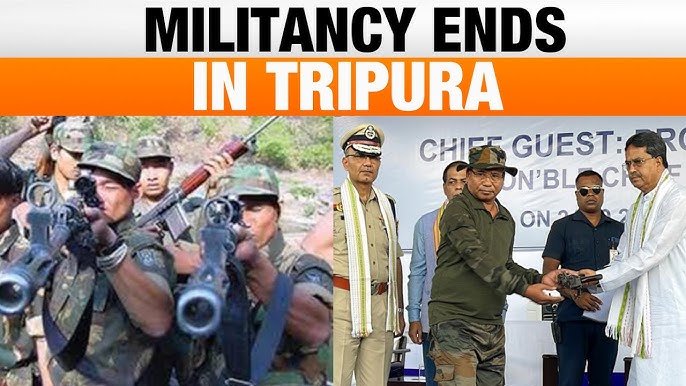
For more than three decades (1980s to 2000s), Tripura became a theatre of intense conflict, insurgency, counter-insurgency, andpolitical struggle. Marked by increasing polarisation between the tribals and non-tribals, the period also witnessed episodic bouts of communal conflicts. Insurgency, ethnic enmity, and conflicts in Tripura however saw their rapid decline from the late-2000s onwards, which could be majorly attributed to the counter-insurgency measures of the Indian state. The counter-insurgency measures, which include a combination of security operations and a political approach, gradually proved effective in bringing down the conflict to manageable levels, if not to a grinding halt. After getting them weakened, the Indian state entered into peace negotiations with thevarious tribal insurgent groups that culminated in the signing of the Memorandum of Understandings (MoUs), thereby paving the way for various tribal insurgent groups to surrender or join the mainstream.[12]
Except for the demand for Tipraland, the MoUs concluded with the various tribal insurgent groups—such as the TNV, ATTF, and NLFT—contained, inter alia, agreements on the following: (i) proper/suitable rehabilitation of cadres; (ii) restoration of alienated tribal land; (iii) redrawing of the territorial jurisdictions of the Tripura Tribal Areas Autonomous District Council (TTAADC) by including the tribal majority areas under it and exclusion of no-tribal majority; (iv) implementation of policies and programmes for the socio-economic and cultural development of the tribals; and (v) protection and promotion of Kokboroklanguage (the major tribal language in the state). These are issues that constitute the core concerns and grievances of the tribals.[13]
Tribal Political Parties and Electoral Mobilisation
Through a mixture of both political and militaristic approaches, as noted above, the Indian state has been able to surmount the menace of insurgency in Tripura. The complete removal of the Armed Forces Special Powers Act (AFSPA), which provides legal immunity to the armed forces engaged in counterinsurgency operations, from Tripura in 2015 bears testimony to the decline of insurgency in the state.[14]This provided the political opportunity structure for various tribal leaders to form tribal-centric political parties (see table 1). In fact, some of the erstwhile tribal insurgent leaders have formed their own political parties. The most prominent of them is the former TNV militant leader turn politician BK Hrangkhawl, who founded the political party, namely the Indigenous Nationalist Party of Twipra (INPT), in 2002.
Table 1 Tribal Political Parties in Tripura
| Name of Party | Year of Formation | Founder/Leader |
| Indigenous Peoples Front of Tripura (IPFT) | 1996 | Harinath Debbarma |
| Indigenous Nationalist Party of Twipra (INPT) | 2002 | BK Hrangkhwal |
| National Conference of Tripura (NCT) | 2005 | Animesh Debbarma |
| Indigenous Peoples Front of Tripura (NC) | 2009 | NC Debbarma |
| Tipraland State Party | 2015 | CR Debbarma |
| Tipra Motha Party (TMP) | 2021 | Pradyot Bikram Manikya Deb Barma |
What is to be noted here is that majority of the political parties noted above have either become defunct or inactive or merged together to form a new party. For instance, The Tipra Motha Party (TMP) was formed in 2021 through the merger of INPT, TSP, and IPFT. It is currently led by Bikram Manikya Deb Barma, the titular king of Tripura.
Almost all the above noted tribal political parties in Tripura have championed the cause of the Tipraland demand, i.e., the creation of a new tribal state under Article 2 & 3 of the Indian Constitution, which would cover the present Sixth Schedule or TTAADCareas.Other common demands include, among others, (a) the inclusion of Kokborok(tribal language) in the Eight Schedule; (b) repatriation of all foreign immigrants; (c) more political and financial autonomy for TTAADC; and (d) release of necessary funds and necessary oversight institutional measures for the socio-economic, cultural, and language developments of the tribals.[15]
Since their inceptions, tribal political parties have been using a variety of strategies in pursuit of their demands. They include, among others, a combination of submission of memorandums to the authorities of Indian state, demonstrations, blockades, hartals, public processions, and campaigning and mobilising the masses, among others. In August 23, 2022, the IPFT submitted a memorandum to the Prime Minister of India with a clear demand for creation of a full-fledged statehood Tipraland. The premise of its demand for Tipraland is stated as follows:
The indigenous peoples of Tripura [tribals] have been facing crisis of identity for the last 75 years as they have been reduced to minority in their own homeland Tripura due to demographic explosion of foreign nationals in the state. In order to protect the crisis of identity of the indigenous people of Tripura, creation of a full-fledged statehood ‘Tipraland’ based on scheduled areas of Tripura is the utmost necessity.[16]
In July 2017, the IPFT organised public processions demanding the creation of Tipraland and for the resolution of socio-economic grievances of the tribals. They also launched railway blockades and blockading of National Highway No. 44, the surface road which connects Tripura to the rest of the country.[17] Similarly, on 12 February, 2024, the TIPRA Motha party and its student-wing launched an indefinite blockade, which severely affected train and vehicular movement, demanding for urgent fulfilment of their political demands for Tipraland.[18] Further, as a part of their broader efforts to impress upon the Government of India for creating Tipraland and for examining the issues and challenges confronting the tribals in Tripura, the tribal political parties have also visited Delhi and met leaders of various political parties and the GoI. For instance, On 27 November, 2023, the leadership of TIPRA Motha visited New Delhi to put pressure on the GoI for the creation of Tipraland.[19]
Based on the advocacy of this idea of separate tribal homeland, protection of tribal identity and land rights, the tribal political parties have gained traction among their tribal constituents. This is evident in TIPRA Motha winning eighteen seats (out of the total twenty-eight seats) in the 2021 TTAADC elections, while other parties, including the BJP and CPI (M),managed to wrest the remaining ten seats.[20]The same was also replicated in the 2023 state assembly elections. In the 20 assembly seats dominated by the tribals, the TIPRA Motha won thirteen seats and became the single largest opposition party, while the Bharatiya Janata Party (BJP) formed the government by winning thirty-two seats out of the sixty assembly seats.[21]However, in March 2024, the TIPRA Motha joined the BJP-led state government. With this, the TIPRA Motha is now in power both in the TTAADC and the state.[22]
What is noteworthy here is that the emergence of tribal political parties, their political demands and strategies, and electoral successes drive home the point that the mobilisational agendas of the tribals have not undergone any change. They remain the same with that of the agendas and demands of the erstwhile tribal insurgency movements. The only conspicuous change is the discarding of violent means and the adoption of non-violent democratic political mobilisation toward achieving political goals. Further, the success of the tribal political parties in tribal dominated constituencies—be it in TTAADC or assembly elections—underscores, at least for the moment, the effective challenge they pose to the established electoral holds of national political parties, such as the Congress, and the Communist parties. In the past, these twonational parties had predominantly represented the tribals in the ballot box. But would this translate into an effective remedy for the longstanding grievances of the tribals and, thereby,become a harbinger of peace? The next section examines this question by placing it in the broader context of the extant ethnic dynamics in the state and how the state and dominant societies respond to the electoral mobilisation of the tribals.
Limitations and Challenges of Tribal Political Parties
The electoral success of the tribal political parties, as discussed above, underscores the overwhelming support of their tribal constituents. The question, however, is how and whether tribal political parties could leverage their newfound position to deliver on their mobilisational planks of Tipraland, or for that matter, securing tribal identity and land rights, among others. The demographic reality and the ethnic and political equations in Tripura—be it in the past or contemporaneously—is that the influence or spread of tribal political parties is unlikely to move beyond their tribal constituents. The failure of TIPRA Motha tosecure a single seat in constituencies outside the tribal belt during the 2023 assembly elections, despite fielding its candidates in twenty-two general seats, is a pointer to its practical limitations.
As noted above, TIPRA Motha’s electoral successes—be it in the TTAADC or state assembly elections—were confined to reserved tribal constituencies. Even if the tribal political parties, hypothetically put, win all the 20 reserved assembly seats for tribals, it would be insufficient for them to form the government on their own. To form the government on their own, tribal political parties need to secure more than 50 percent of the total 60 seats in the state assembly – which means winning a minimum of 31 seats, out of the total 60 seats. Given this, tribal political parties can only form government either asa coalition partneror with the support of other political parties, or by winning sufficient seats in general assembly constituencies. This implies that tribal political parties face formidable challenges in carving out a political space wherein they would be in a pole position to control, form, or dominate the state government. As such, the prospect of delivering on their poll promises/planksis contingent upon the support, cooperation, or the political will of the government of the day.
This leads to, a further, pertinent question: Would the government of the day (both thecentral andstate government) readily support and deliver on the aspirations of the tribals? A realistic assessment points tothe remoteness of such a possibility, given the nature of ethnic equations,marked by the enduring divide between the tribals and the non-tribals, which constrains the elected members of the state legislature to cater to the sentiments of their own ethnic constituents. Further, the political executive of the day is more likely to wary of acting against the ethnic sensitivities of the majority community, whose electoral support political parties rely upon to be in power. The dominant non-tribal communities are generally opposed to any state policies and practices that are seen as anti-thetical to their interests. As MyronWeiner notes, the allocation of socio-economic and political resources based on group identities, whether ethnic or religious, fosters severe inter-group competition and can lead to violent conflicts.[23]The situation is no different in Tripura, wherein even state’s affirmative action for tribals, designed to address historical injustices or enduring structural inequalities, is subjected to severe censure and contestations from the dominant communities.
Moreover, within the discourse of majoritarian nationalists, which frequently intersects with state policy and behaviour, the provision of political autonomy to politically aware minority community is commonly derided as promoting division or resulting in incessant demands for increased autonomy until secession becomes unavoidable.[24] In such a context, state institutions are rather instrumentally used for incorporating minority identities into the broader majoritarian national identity.[25] In Tripura, this is exemplified by the strident opposition of the majority non-tribal community, or for that matter, the state government, to the persisting tribals’ demand for more political autonomy.
Consider, for instance, the case of the natures of the responses of the state government or non-tribal communities to the tribals’ demand for Tipraland. This contentious demand, which forms the core ideology of the tribal political parties, as noted already, has been stoutly opposed by the dominant, non-tribal communities. Opposing the TIPRA Motha’s Tipralanddemand, Amra Bengali, a Bengali organisation, says: “The move of Greater Tipraland is purely to divide the state which is a land of Bengali people. This is to term that we the Bengalis as outsiders, whereas the main Adivasis of the state of Tripura are the Bengalis”.[26]Predictably, the response of the state government is no different either. In tune with the stated position of the Bengalis or their frontal organisations, successive state governments have been persistent in their opposition to the Tipraland demand. The current chief minister (CM) Mani Saha, in his public speech in February 2023, for instance, outrightly dismissed the demand for Tipraland as “impossible to fulfil”, adding further that it will only accentuate the “divide between tribals and non-tribals”.[27]
Let alone Tipraland demand, the state government has also been dithering or failing to remedy other grievances of the tribals related to, inter alia, the limited devolution of powers to the TTAADC and tribal land alienation,as briefly examined hereunder. First, the TTAADC was created in 1979, and subsequently upgraded under the Sixth Schedule in 1985 to grant a measure of political autonomy to the tribals. The main grievance with the TTAADC, or for that matter, the Autonomous District Councils (ADCs) under the Sixth Schedule in other states, is their complete dependence upon the state government for funds, legislative or executive powers. For instance, to have the force of law, all legislations passed by the ADCs need the assent of the Governor, which in effect means the state government.[28] Further, budgets approved by the ADCs are not binding upon the state government.Funds meant for the ADCs are also routinely delayed,denied or curtailed.
The limited powers endowed to the ADCs has been one of the major grievances of the tribals and their leaders. For instance, in its 2018 memorandum to the Prime Minister of India, the IPFT demanded that the annual budget recommendations of the TTAADC should be “binding upon the State government to accept the budget so received from district council except when there is cut in the State budget due to resource constraints”.[29] Arguing along a similar line, Binoy Reang, a tribal politician, calls for the endowment of more autonomy to the TTAADC:
The TTAADC or, for that matter, any ADCs under the Sixth Schedule, does not enjoy political autonomy in a real sense. There is a need for an amendment to further empower it. Under the extant arrangement, the governor is seen as the ultimate authority. However, in actual functioning, the governor operates or functions on the aid and advice of the chief minister of the state. As such, it is inappropriate to use the term “autonomy” in the context of the ADCs. If an amendment can be done wherein a governor is not bound by the aid and advice of the chief minister, it would then be appropriate to associate the term “autonomy”withthe ADCs. In reality, the ADCs have neither functional autonomy nor executive autonomy.[30]
Second, the legal restriction on the transfer of tribal land to non-tribals under Section 187 (1) of the Tripura Land Revenue and Land Reforms Act (TLR&LRA), 1960, has not made much differencein mitigating tribal land alienation. This is primarily because,under the same Act,the land transfer is permissible if done with the concurrence of the district administration. Given the fact that the district administration is under the control of the state government, and the tribals hardly have a say or influence in its functioning, it is hardly difficult for an influential non-tribal community to obtain permission from the district administration. Further, non-tribals can simply form cooperative societies to legally acquire tribal land. The strategy hereis to form a cooperative society, persuade a tribal to mortgage his land to the society, and then transfer the society’s land to any individual.[31] In Tripura, land cooperatives (for example, Swasti Samity) have managed to acquire large swathes of tribal land/reserves with the tacit support of unscrupulous bureaucrats.[32]
The extent of tribal land alienation can be gauged from the fact that the tribals have lost more than 60 percent of their land to the refugees,[33]many of whom were allotted land by the state for their settlement. The Gumti Hydel Project, constructed in the 1970s, had submerged more than 23,500 acres of tribal land, displacing more than 8,000 families.[34]This was further exacerbated by the entry of money lenders and businessmen in the tribal areas. Loans with exorbitant interest rates were given to the tribals against the mortgage of their lands. When the tribals failed to pay interest within the allotted time, the moneylenders were able to take permanent control of the mortgaged lands. All these processes have collectively contributed to tribal land alienation and their consequent pauperisation.[35] For instance, the percentage of tribal landless labourers saw a sharp jump from 20 percent in 1971 to 29 percent in 1981.[36]
Further, taking cognizance of the unabated land alienation of the tribals and their growing assertions, the TLR&LRA, 1960 was amended in 1974 wherein a provision was inserted for restoration of all lands transferred on or after January 1969 in violation of Section 187 (1) of the Principal Act of 1960, a provision noted above. However, this provision has also failed to assuage the fears and anger of the tribals. According to Khakchang Debbarma, “By keeping the lands transferred before 1 January 1969 outside the scope of the Land Reforms Act, legal recognition was given to the transfer of lands made before that date”.[37] Further, the provision has also failed miserably in restoring tribal land that had been alienated after January 1969. As of March 31, 1980, only 4300 petitions out of 100, 000 petitions have been disposed of in favour of the restoration of alienated land,[38] underlining the fact thatthe execution of the law remains weak even at best. Thus, in a nutshell, all these legal and institutional measures for the protection of, or restoration of alienated, tribal land have not made much difference and the marginalised tribals continue to suffer land alienation.
The forgoing analysis underscores theformidable challenges that remain in addressing the grievances of the tribals. For long, the tribal civil society organisations and political parties have been demanding for more autonomy for TTAADC and for effective redressal of their longstanding grievances, including restoration of alienated tribal land. What is pertinent to underline here is that addressing these demands or grievances also constituted the common thread that links the Indian state’s peace agreements with the various tribal insurgent groups, a point noted already. All these notwithstanding, little or no tangible progress has been made on the ground thus far concerning the redress of the tribals’ demands and grievances. This state’s inaction or hesitation towards addressing the existential issues of the tribals underlines the reality of the functioning of the state or, for that matter, the formidable challenges faced by the tribals and their political parties.
In a democratic multi-ethnic northeastern state, including Tripura, the functioning of the state is largely constrained or shaped by competing ethnic politics. Ethnic competition for political power, territorial control, and access to state resources in the region is a realitythat cannot be simply conjured away. And the trend has been that, when faced with minority mobilisation, dominant communities tend to respond with counter-mobilisation.During elections, this stimulates bloc voting, which in effect marginalises the space for marginal political parties to access state power. As such, the government of the day or dominant political parties can hardly ignore majoritarian sensitivities orundermine extant privileged status vis-à-vis other communities at no electoral cost. Further, in general,the dominant communities are less susceptible to political comprise as they are better aligned, networked, or less wary of possiblestate retribution.[39]On the other hand, ethnic parties,given their marginal position, are more susceptible to compromising their agenda or being sidelined. These have the cumulative effect of relegating to the periphery, or the stonewalling of any attempt to address, the issues and concerns of the marginal groups.
This being the reality, tribal political parties in Tripura may serve as an important vehicle for articulation of tribal interests but not necessarily be an effective vehicle for delivering their hopes and aspirations. Relying for their core electoral support on the marginal tribal community, and given the competing nature of ethnic politics in the state, tribal parties face formidable challenges towards becoming a governing party and fulfilling their mobilisation goals. They can deliver on their mobilisation agendas only through the involvement and cooperative engagement with the government of the day or the wider political parties that become the governing parties. Thus, the trading of violent mobilisation with democratic political processes, or the electoral successes of post-conflict political parties, per se, need not necessarily become a harbinger of peace and stability. In the event of failing to deliver political goals,tribal political parties risk losing electoral relevance and support of their tribal constituents. Such a circumstance is fraught with the risk of tribal communities losing faith in democratic political processes and seeing incentives in reverting to violent mobilisation.
Concluding Remarks
In Tripura,the post-insurgency period has seen the rise of tribal political parties, providing a new avenue for the marginalised tribals to assert their political agency andarticulate their interests. Using their constituents’ ethnonationalist demand for Tipralandand the need for resolution of their longstanding socio-economic grievances as election campaign planks, tribal political parties, particularly the TIPRA Motha and IPFT, have managed to attain a measure of electoral success and access to state power. As already noted, this has been exemplified by their unprecedented electoral successduring the 2021 TTAADC elections and the 2023 state assembly elections. Reflecting their newfound political weight,the demands and grievances of the tribals have in recent years received the attention of the Indian state.
The Government of India, for instance, on 27 September 2018, constituted a High-Level Committee to look into social-economic grievances of the “indigenous population in the state of Tripura”.[40] Further, on March 2, 2024, a tripartite agreement was signed between the Government of India, state government, and the TIPRA Motha in New Delhi “to amicably resolve all issues” of the tribals relating to history, land, economic development, and cultural identity.[41]These initiatives gave a ray of hope to the tribals that their demands and grievances would finally find a settlement. However, the past experiences of the tribals vis-à-vis state policy and practices,compulsions of electoral politics, and the prevailing ethnic dynamics in the state, among others, offer a cautionary tale,for it is one thing forgovernments to make promises for short-term electoral gain and another to deliver on them.As such, it remains to be seen whether these newfound state initiatives will translate into reality.
Surely, the ascendance of tribal political parties, following the end of the insurgency, is a key development, for it signifies the newfound faith in legitimate democratic politics (instead of violent mobilisation) as a medium of articulating their demands.Yet, the mere transition from insurgency to a democratic political process in no waypromises either peace or democratic consolidation.To hold such a promise, such a transition should yield tangible results, i.e., it should lead to redress of longstanding grievances, which would in turn consolidate faith in democratic politics as an effective alternative avenue for achieving goals. In post-conflict societies, the failure of democratic politics as a medium for achieving collective political goals invariably carries the risk of collectives reverting to violent means to pursue their goals. The case of Tripura’s tribals is no different, given the fact that the historical and structural conditions that had triggered tribal insurgency in the first place remain unresolved. Given this, it is imperative that Indian state empathetically engages with the tribal political parties towards finding amicable resolutions to the longstanding grievances and demands of the tribals. Such an engagement, when driven by the weight of the tribals’ grievances and not by their electoral weight, holds promise not only for ushering in durable peace and stability in the delicate border state but also for the country’s long-term strategic interests.
[1]Jeroen de Zeeuw,‘‘Understanding the Political Transformation of Rebel Movements.’’ In From Soldiers to Politicians: Transforming Rebel Movements after Civil War. ed. Jeroen De Zeeuw (Boulder: Lynne Rienner Publishers: Boulder, 2008), 1-32.
[2] Maria J. Stephen andErica Chenoweth. “Why Civil Resistance Works: The Strategic Logic of Nonviolent Conflict,” International Security 33, no. 1 (2008): 7-44.
[3]John Ishiyaima, “Introduction to the Special Issue ‘From Bullets to Ballots’: The transformation of rebel groups into political parties,”Democratization, 23, no. 6 (2016): 969.
[4]Ashutosh Varshney, “Is India Becoming More Democratic?” Journal of Asian Studies59, no. 1 (2000): 3– 25; Donna Lee Van Cott, From Movements to Parties in Latin America: The Evolution of Ethnic Politics (Cambridge: Cambridge University Press,2005).
[5] Mila Bloom. Dying to Kill: The Allure of Suicide Terror (New York: Columbia University Press, 2005); David L. Phillips, From Bullets to Ballots: Violent Muslim Movements in Transition (New Jersey: Transaction Publishers, 2009).
[6]Dara Z. Strolovitch, Affirmative Advocacy: Race, Class, and Gender in Interest Group Politics (Chicago:University ofChicago Press, 2007).
[7]Mousami Debbarma, “Tripura’s Nuanced History to the Present,” in Northeast India Through the ages: A Transdisciplinary Perspective on Prehistory, History, and Oral History, ed., Rituparna Bhattacharyya (London: Routledge, 2023), 332-354.
[8] SubirBhaumik, “Just Development: A Strategy for Ethnic Reconciliation in Tripura,” in Beyond Counter-insurgency: Breaking the impasse in Northeast India (p. 293-307), ed., Sanjib Baruah (New Delhi: Oxford University Press, 2011), 293-307.
[9]Ghoshal Anindita, “Tripura: A Chronicle of Politicisation of the Refugeesand Ethnic Tribals,”Social Change and Development XIV (2017): 27-41
[10] Samir Kumar Das, Conflict and Peace in India’s Northeast: The Role of Civil Society (Washington, East-West Center, 2007), 4.
[11]R.K. Debbarma, Heroes and Histories: The Making of Rival Geographies of Tripura(New Delhi: Nehru Memorial Museum and Library, 2013).
[12]Kuldeep Kumar, Police and Counter-Insurgency: The Untold Story of Tripura’s COIN Campaign (New Delhi: Sage Publications, 2016).
[13]For further details, see Sukhendu Debbarma, “Peace Accords in Tripura: Background and Analysis”, in Peace in India’s Northeast, ed. Joshua C. Thomas (New Delhi: Regency Publication, 2006), 405-424.
[14]Syed Sajjad Ali, “Big win for TIPRA in Tripura tribal council election,” The Hindu, April 10, 2021, Accessed August 12, 2024, https://www.thehindu.com/news/national/other-states/big-win-for-tipra-in-tripura-tribal-council-election/article34291128.ece
[15]See, Joint Press Statement of tribal political parties (INPT, TIPRA, and TPF), October 3, 2020 (in authors’ possession).
[16]Indigenous Peoples Front of Tripura (IPFT) to Home Minister of India, memorandum, August 23, 2022 (in Authors’ possession).
[17]Syed Sajjad Ali, “IPFT ends highway blockade,” The Hindu, July 20, 2017, Accessed August 20, 2024, https://www.thehindu.com/news/national/ipft-withdraws-agitation/article19316828.ece
[18]“Tripura tribal party to block highway for Constitutional solution,” The Hindu, February 27, 2024. Accessed August 19, 2024, https://www.thehindu.com/news/national/other-states/tripura-tribal-party-to-block-highway-for-constitutional-solution/article67891891.ece
[19]Sumir Karmakar, “Tipra Motha leaders meet MHA advisor, demand Greater Tipraland state,” Deccan Herald, November 28, 2023, Accessed September 4, 2024, https://www.deccanherald.com/india/tripura/tipra-motha-meets-mha-advisor-says-greater-tipraland-is-final-solution-2787897
[20]Syed Sajjad Ali, “Big win for TIPRA in Tripura tribal council election”,The Hindu, April 10, 2021, Accessed September 5, 2024, https://www.thehindu.com/news/national/other-states/big-win-for-tipra-in-tripura-tribal-council-election/article34291128.ece
[21]Sourav Roy Barman,“TIPRA Motha pulls ahead of CPM in Tripura, wins 13 seats,” The Indian Express, March 3, 2023, Accessed August 27, 2024,https://indianexpress.com/article/political-pulse/tripura-assembly-election-results-2023-bjp-simple-majority-tipra-motha-kingmaker-8475678/
[22]“Opposition Tipra Motha to join BJP-led govt in Tripura,” The Hindu, March 6, 2024, Accessed August 24, 2024,https://www.thehindu.com/news/national/other-states/opposition-tipra-motha-to-join-bjp-led-govt-in-tripura/article67920860.ece
[23]Myron Weiner. Sons of the Soil: Migration and Ethnic Conflict in India (Princeton: Princeton University Press, 1978).
[24]Wayne Norman, Negotiating nationalism: nation-building, federalism and secession in multinational state (Oxford: Oxford University Press, 2006).
[25]Carles Ferreira, “Challenging Majority Nationalism: The Renaming of Streets in Catalonia,” https://dialnet.unirioja.es/descarga/articulo/7040814.pdf
[26]“Tripura Times, Greater Tipraland’ demand aims at dividing Tripura: Amra Bangali,” Tripura Times, December 10, 2022, Accessed September 3, 2024, https://www.tripuratimes.com/ttimes/greater-tipraland%E2%80%99-demand-aims-at-dividing-tripura-amra-bangali-4801.html
[27]“Greater Tipraland not possible, says Tripura CM Manik Saha,” Economic Times, February 5, 2023, Accessed August 26, 2024, https://economictimes.indiatimes.com/news/politics-and-nation/greater-tipraland-not-possible-says-tripura-cm-manik-saha/articleshow/97610474.cms?from=mdr
[28] Harsha S. and Antiarbum Ranglong, “Decentralized governance in Northeast India: a comparative study of Bodoland Territorial Council and Tripura Tribal Areas Autonomous”, in Democratic Decentralizationin India: Experiences, Issues and Challenges, ed.,E. Venkatesu (New York, Routledge, 2016, Routledge), 138-155.
[29]Indigenous Peoples Front of Tripura (IPFT) to Prime Minister of India, memorandum, August 25, 2018 (in authors’ possession).
[30] Binoy Reang (tribal politician), in discussion with the authors, Agartala, June 12, 2022.
[31]C. Ashokvardhan, Tribal Land Rights in India (Mussoorie:Lal Bahadur Shastri National Academy of Administration, 2006).
[32] Subir Bhaumik, Tripura: Ethnic Conflict, Militancy, and Counterinsurgency (Kolkata: Mahanirban Calcutta Research Group, 2012).
[33]Sukhendu Debbarma, “Refugee Rehabilitation and Land Alienation in Tripura”. In Land, People and Politics: Contest over Tribal Land in Northeast India, eds., Walter Fernandes & Sanjay Barbora (Guwahati: North Eastern Social Research Centre & International Work Group for Indigenous Affairs, 2009), 113-127.
[34]Bhaumik, “Just Development”.
[35] Sambhuti Ranjan Bhattacharjee. Tribal Insurgency in Tripura: A Study in Exploration of Causes (New Delhi: Inter-India Publications, 1989).
[36]Bhaumik, Tripura: Ethnic Conflict.
[37]KhakchangDebbarma, “Politics of land alienation and the problem of its restoration in Tripura”. In Northeast India: A Reader, eds., Bhagat Oinam & Dhiren A. Sadokpam (New Delhi: Routledge, 2018), 144.
[38]Gayatri Bhattacharyya.Refugee rehabilitation and its impact on Tripura’s economy (New Delhi: Omsons Publications, 1988).
[39]Amit Ahuja,Mobilizing the Marginalized: Ethnic Parties without Ethnic Movements(New Delhi:Oxford University Press, 2019).
[40]Ministry of Home Affairs, Government of India, Officer Order, September 27, 2018,Accessed September 5, 2024, https://www.mha.gov.in/sites/default/files/filefield_paths/HLC_Tripura.PDF
[41]See, Ministry of Home Affairs, Government of India, Press Release,March 2, 2024,Accessed September 5, 2024, https://pib.gov.in/PressReleasePage.aspx?PRID=2010880