
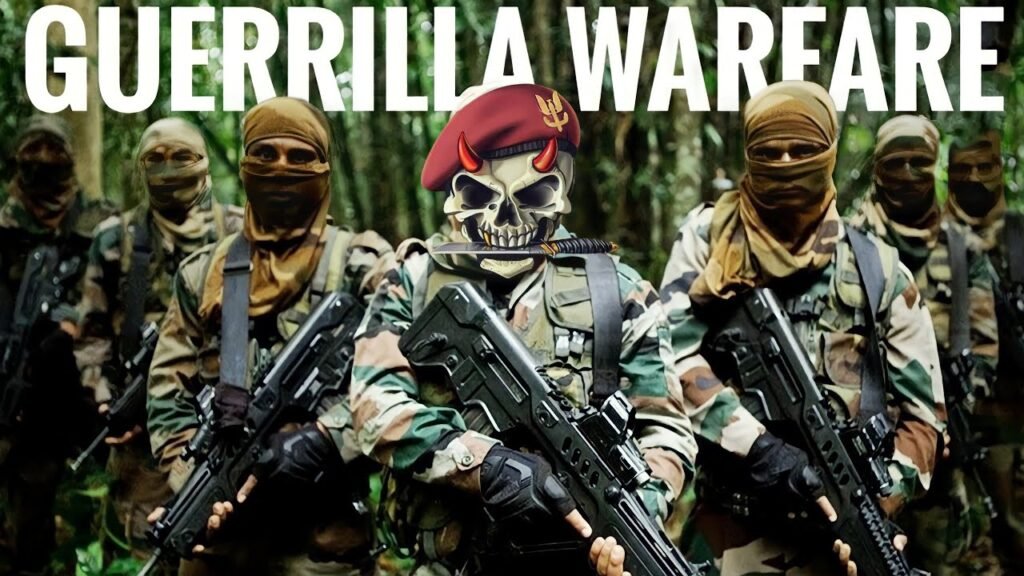
Guerilla Warfare: lesson for India
P J Khache[1]
ABSTRACT
In the studies of guerilla warfare,we still continue to pursue the vexed question on why do much militarily weaker groupsdefeat the much stronger nations in guerrilla warfare? If war is a game, a bloody event, then why do irregular forces survive against the regular forces? What is so unique about the guerrilla that they could execute their tactics and strategy with inferior weapons against much superior weapons? Likewise, in the armed conflictin Vietnam, between 1945 to 1975, how did the Viet Minh triumph against the two world’s great powers- France and US? Despite the experiences of fighting against the guerrillas for a very long time, why arethese irregularforcesstill able to cause serious internal security threats to India? There are fascinating questions in guerrilla warfare which continue to pose serious questionsin militarystudies. In the case of India, guerrilla warfare has been there for centuries- tribe against tribes, ruler against rulers, even todayIndia facesserious security challenges from the guerrillas. To counter them, the state respondedthrough the use offorces and with other political and economic tools. One of the largest armed forces in the world withmilitarilywell equipped for any challenges coming from conventional warfare still strugglesin countering the guerrilla, as in this warfare the outcome of the war doesn’tusuallydepend on the investments of conventional forces alone. Even the strategic weapons and superior weaponsthatdeterred the adversaries and avoided conventional war could not apply much of its doctrine in guerrilla warfare.Today,war is designed to fight through limited warhowever guerrilla war is able to execute the same old style of unconventional way of using irregular forces. In this article the author explores some of the historical practices of guerrilla warfare, analyzing what has changedto draw lessons for Indiawhile engagingin fighting against theguerillas.
Keywords: Guerrilla warfare, Guerrilla tactics & strategy, India
INTRODUCTION
If the war is all about triumphing over the enemy then there is no ‘can do’ or ‘cannot do’, ‘fair’ or ‘unfair’. Historically, guerrilla warfare mostly fought between the strong against the weak and the weak could triumph over the stronger forces.Samuel Huntington attempted defining guerilla warfare as a form of warfare by which the strategically weaker side assumes the tactical offensive in selected forms, times and places. It is employed only when and where the regular warfare has been foreclosed guerrilla warfare and avoid regular warfare hence, he considered guerilla warfare as weapon of the weak.[1]The study of guerrilla warfare is worthwhile because much of the world we live in was shaped by guerrilla warfare- the Russian revolution, Bolsheviks, the Czech Legion, Rift War and its impact on Muslims in North Africa and Middle East, Mao’s ‘protracted war’, Fidel Castro in Cuba and Vo Nguyen Giap in Vietnam.[2]
Guerilla warfare is not a new subject in the history of warfare. It is as old as human history.Mao Zedong may have concepted the theory of ‘fish and water’ but this principle of guerrilla warfare has been there for thousands of years even before he was even born.In most of the cases, they were employed by the weaker side of the forces against the strong. They are irregular forcesand they can tear down great nations, for instance like the Huns pillaged much of Europe and are also blamed for the fall of Rome. In ancient times, this warfare was employed by a tribe against another or a small group of militias against the ruler orits adversaries.Even in the modern time the tactics and strategy of guerrilla warfare continue to be effectively employed mostly by revolutionary leaders at different parts of the world.That is why there is a profound impact to study how a militarily weaker triumph over the superior using guerrilla tactics and strategy.The success story of the guerillas in China, Cuba and Vietnam ignited how such warfare can be employed by insurgency movements or by the militant against the state. Mao’s influence on several communists’ leaders in the some of Southeast Asia countries, Che Guevara’s revolutionary movement in South America (Bolivia) and Africa (Congo) are some of the examples. In India, several militants in the Northeast and the Naxalite movement can be ascribed to the guerilla movement in China or Southeast Asia.
The tactics and strategy of guerillas has not greatly changed. With the advancement of technology guerilla warfare has impacted the tactics and strategy, like that of conventional warfare. The guerrilla leaders used different approaches to wage war- in waging, some failed and some succeeded. In the campaign against the guerrillas, many powerful states/governments underestimated their strength hence leading to great losses. The much superior in terms of military resources failed tounderstandand recognize their core strength. India’s approach in fighting these irregular forcesgoes through similar trends- failing to identify or recognize their core strength. In many cases military combat was the solution to resolve the armed conflict with the guerrilla. Finding a military solution has further escalated the conflict. Although several modern guerrilla fighters gave great emphasis on ‘winning the hearts and minds of the local population’,most of the countering strategies overlook such core factors and continue to rely on military might.
WHO ARE THE GUERRILLAS?
The US used the term low-intensity conflict during their armed conflict in the Vietnam war, referring to the military-political confrontation between them against the Viet Cong. The US considered that the event of the war was below the intensity of a conventional war. Like the US loosely refer to the Viet Cong (the opposing military group) as guerrilla, the separatist and other militants or militarized non-state actors are generalized as ‘the guerilla’. The guerrilla is often a synonym with a member/group of an unofficial military group, an irregular force. These groups employed guerrilla tactics and strategy.
Guerrilla Forces
Guerrilla forces used an offensive approach. Theyconsist of small units, lightly armed irregularlyequipped to fight small-scale, using tactics characterized by surprise, rapid movement, deception, secrecy, stealth, intelligence and improvisation.
Guerrilla tactics and strategy
The Fabian strategy used by Quintus Fabius MaximustVerrucosusin Italy or Gamini Kava used in India by Chhatrapati Shivaji are nothing but Guerrilla tactics and strategy. In order to win the attack/war the guerrilla must possess the following:
- Geographical knowledge:the guerrilla fightermust have well-versed about the geographical conditions like the terrain, weatheretc. Successful guerrilla operationsare localised, fighting in their own territory and are able to exploit the terrain and its environment.
- Small unit:guerrilla operates in small groups. The core objectives are to minimise casualties, to wear down the enemy and, hit the enemy and disappear from the place of attack.
- Study the enemy’s strength and weakness:they must know the strength of their adversary and attack on the weaknesses.
- Superior Intelligence: one of the most important elements of any guerrilla operation is that the information must be superior and advantage over the enemy.
- Concealment: guerrillas must never compromise the information about the location and the plan.
- Mobility: guerrilla is popularly known for ‘hit-and-run’ tactics. They must strike swiftly and unexpectedly.
- People’s support: the survival of the guerrilla depends on the local support. In modern times, the victory of the guerrilla is mainly due to the support of ‘the people’.Whether in obtaining information from the sympathizer, the supply of food and other resources or to hide the guerrilla after the attack the local population played a vital role.
Effectiveness of hit-and-run
- To achieve hit-and-run tactics, the guerrilla must operate in familiar surroundings. The point of attack and cognizant of escape routes or even alternative passages in case the opponent disrupted their initial plan.
- The operation must be carried out by the highly skilled in small numbers. This small unit must concentrate at the point of attack, execute the strike and disperse before the adversary respond back. After the attack, to disappear among the civilian population makes the enemy extremely difficult to capture.
- To achieve hit-and-run tactics the guerrillas must gain at least temporary superiority (like intelligence) at the point of attack and the guerrillas must have several essential elements in their favour, for example it is more advantageous to operate in difficult terrain as the mobility of the enemy will be difficult.
ORIGIN OF GUERILLA WARFARE
The word ‘guerrilla’ is derived from guerrilleros, which means little war to the Spanish and Portuguese. The term was used as an irregular operation against French occupation armies in the Peninsular War (1808-14). It is alsoreferred to as ‘petite guerre’ or ‘small warfare’.The context took it from the Spanish civilian who resisted against the French to avoid direct combat and conduct raids and ambushes.[3]German’s Kleiner Krieg, which translates to ‘petty warfare’ is considered as a type of guerrilla warfare.Chhatrapati Shivaji’s Gamini Kavais a popular guerrilla tactic in Indian military history. There are different names of guerrillas at different places. And different guerrilla leaders used different guerrilla tactics and strategy as per time and circumstances. The past study on guerrilla war indicates that it is affected by the specific geographical, technological, culture, social and political conditions under which the war is fought.[4]
Interestingly, even many animals practice guerrilla tactics to catch its prey. The predator would employ several tactics like, operate in small units/individuals, attack swiftly, target the weak point, deceived its prey with superior intelligence, and at familiar geography. Guerrilla warfare likewise existed a very long time ago, as Max Boot sum up;
Throughout most of our species’ long and bloody slog, both before the development of urban civilization and since, warfare has been carried out primarily by bands of loosely organized, ill-disciplined, lightly armed volunteers who disdain open battle. They prefer to employ stealth, surprise, and rapid movement to harass, ambush, massacre, and terrorize their enemies while trying to minimize their own casualties through rapid retreat when confronted by equal or stronger forces. These are the primary features both of modern guerrilla warfare and of primitive, pre-state warfare whose origins are lost in the mists of prehistoric time and which has only recently been extinguished in the remote jungles of Amazonia and the highlands of Papua New Guinea. Guerrillas therefore may be said to engage in the world’s second-oldest profession, behind only hunting, which draws on the same skill set.[5]
In the history of guerrilla,one of the oldest tactics used in guerrilla warfare is raiding. Ross Hassig examines raids does not result in conquest or territorial acquisition but a surprise hit-and-run attacks that are generally limited in scale and impact.[6] David Friedel, define raiding as ‘brief battle aimed at surprise attack and quick defeat rather than at total conquest and subjugation’.[7]Guerilla warfare has developed into new tactics with the changes of time, so does the lethality. For example, the event back to antiquity scorched earth policy was commonly used to weaken the enemy.
In the Indian history of guerrilla warfare, one of the outstanding figures who contributed to the effectiveness of guerrilla tactics and strategy was the pioneer of Ganimi Kava(Marathi) by Chhatrapati Shivaji Maharaj. The Maratha ruler utilized knowledge of the local terrain and superior mobility.[8]Shivaji triumphs over his adversaries who are superior in numbers by using surprise attacks, ambushes and raids. He would mobilize his military in small units to surprise attack and would retreat, due to this kind of tactics his enemy gave him ‘contemptuousnames such as mountain rat’[9]. The major factor for the success of Ganimi Kavawas due to Shivaji’s well-verse of the geographical region and the local support. Another renowned military leader who employed guerrilla tactics is Pazhasi Raja who fought against much superior military forces like the British. The Raja, with geographical knowledge of the hilly and jungle terrain of Wayanad, employed hit and run tactics.
Several kings, generals or war strategists used guerrilla tactics and strategy at different periods of time in different places. There is no specific account that can be traced to the origin of guerrilla warfare. In different periods of time at different places, the tactics and strategy of guerilla warfare have been employed since human history, with different names.
Building from Webster
(1976), he defines raiding as “brief battle aimed at surprise attack
and quick defeat rather than at total conquest and subjugation”
(Freidel 1986:94).
Building from Webster
(1976), he defines raiding as “brief battle aimed at surprise attack
and quick defeat rather than at total conquest and subjugation”
(Freidel 1986:94).
Building from Webster
(1976), he defines raiding as “brief battle aimed at surprise attack
and quick defeat rather than at total conquest and subjugation”
(Freidel 1986:94).
Building from Webster
(1976), he defines raiding as “brief battle aimed at surprise attack
and quick defeat rather than at total conquest and subjugation”
(Freidel 1986:94)
GUERRILLA THROUGH AGES
Through the ages of human history guerrilla warfare has played a pivotal role to weaken the superior. Different rulers or groups employed this military tactic to wear down the power/strength of their adversaries or enemy. They could provoke the mighty rulers like the Scythians, Goths and the Huns against Persia. They could resist the power influence against the powerful empires like the Celtic, Germanic and African tribes against the Roman expansion. Due to such ‘guerrilla’ attack all of the great empires of antiquity, whether in the West or East, had to devote considerable resources to combat, but many ultimately failed from the scourge.[10]
Guerrilla warfarethrough the ages have been impacted by various factors, like that of conventional warfare. The intensity of destruction, the impact of revolution that inspires at some distant land, drawing sympathisers and the amount of threatsbeyond specific geographical space.As Max observed,
Ancient guerrillas may have been primitive by modern lights— they lacked weapons such as the AK-47 capable of inflicting mass slaughter, they did not answer to a Politburo, they did not solicit funds from sympathizers abroad, and seldom did they issue bombastic communiques to justify their existence—but nevertheless they could be exceedingly effective.[11]
Many states failed to understand the power of the guerrilla. What many modern policy makers failed to understandabout the guerrilla was that theyare competentin taking down mighty empires.And some considered the warfare obsolete. Who would have imagined that the two superpowers- France and US would be defeated by the guerrilla in Vietnam? As far as India is concerned, apart from the armed forces she has a huge paramilitary force, specifically assigned to tackle guerillas yet it still received one of the greatest internal security threats. For instance,the Nagas insurgents (guerilla) is the longest/oldest conflict that India is still struggling with.What many policy makers failed to understand about the Nagas was that they underestimated the age-old practices of guerrilla warfaresince time immemorial. They are popularly known as ‘the headhunter’- the surest way to hurt their foes.Such historical accounts are found in the folksongs and folktales of the Nagas, even such practices were recordedby nearby kingdoms like Ahom and in the recent account of the British colonial rule in India. During the colonial period, there are accounts that described how Nagas raided the British, and how befriending them (Nagas-the local population) benefited the British in their war.[12]
Every age has its own adverse challenges to fight against the guerrilla. Militarily, the guerrillas refused for face-to-face combat, they operate with irregular forces, they do not have proper weapons or uniforms and they are extremely difficult to segregate from the civilian population. It is difficult to claim that the modern guerrilla is more complex to handle than the past. The viewhas been substantiated by Max that ‘no polity in the world was safe from the predations of terrifying and ruthless raiders, bound together not by political or religious ideology, like many modern-day insurgents, but simply by ties of tribe and kinship’[13].
GUERRILLA WARFARE IN RECENT TIMES
In 20th century many revolutionary leaders used guerrilla warfare, mostly anti-colonial. The revolutionary armed groups employed guerrilla warfare and they were able to assert its strategy very successfully even against the nuclear power states.What makes this guerrilla warfare so relevant even in 21st century can be investigated further.
John Arquilla in his book ‘Insurgents, Raiders, and Bandits: How Masters of Irregular Warfare have shaped our world’ explores the history of irregular warfare over the past 250 years. His book analyzes the role of ‘the masters’, those leaders behind the irregular warfare. Having surveyed the effectiveness of irregular warfare he delves into:
Who will be considered the masters of this era? And what may come next for irregular warfare? Given that the key issues raised by earlier masters- from variants of military reform to nation building, networking, and on to swarming- remains in lively paly, these questions are highly relevant.[14]
The guerrilla movement of the Chinese communistemployed protracted war. And whether Mao’s the Long March[15] was a victory or a tragedy[16], it introduces guerrilla movement not only as an armedstruggle but as a people’s movement. Che Guevara used the revolutionary movement and employed guerrilla warfare in Cuba, Ho Chi Minh and Vo Nguyen Giap in Vietnam, Abdul Haris Nasution in Indonesia. They all carry out revolutionary movementsthrough the use of forces. But they did it through the soul support of the people. The above leaders later produce literature on guerrilla warfare. Amongst them, A H Nasution’s approaches to guerrilla warfare requires further investigation, not because he was better than the other but because of his experiences with the guerrilla as well as his participation in countering the guerrilla. As also quoted by Otto Heilbrunn in the introductory note of Nasution’s book, he is the only guerrilla leader who also has practical experience in counterinsurgency operations. To dissect General A H Nasution’s book ‘Fundamental of Guerrilla Warfare’[17]:
On guerrilla:
- Guerrillas have evolved from independent, loosely disciplined, and ill-coordinated armed bands, aimed at harassing the enemy, to better organized auxiliary forces aiding a powerful ally, and even graduating into an independent force capable of creating a new political order.[18]
- Nasution opined that wars are not only fought by the armies (or guerrilla) alone but the conflict is engaged by the whole nations and peoples. His query on who the armies/guerrillas are; ‘they are like the spearpoints of the people and are directed by the people. That is why the army is now an army of the people and no longer a separate entity’.[19]
- The guerrillas are not only required to carry arms as soldiers in an ordinary war, but they are soldiers carrying an ideology. They are not only pioneers in the battle but above all pioneers of an ideology.[20]
On guerrilla movement:
- The guerrilla movement is a small group and simply armed unit of forces, and is supported, maintained and protected by the people so that it may compete with the large, fully equipped and organized army of the enemy. The fighting spirit which is burning in the heart of the guerrilla, as well as in the people he has sprouted from, inspires him with the strength to carry out penetrations of the enemy and to withstand difficult trails, such as enemy bombardments and all the cruel retaliatory measures to which his family is subjected, including the burning of villages and the torture of civilians. This spirit gives him the strength to carry those heavy burdens with a willingness which would not be possible if he fought because he was forced to, as for example by a country’s laws or rules. This willingness to suffers is only possible because of the holy call of his own heart.[21]
- Nasution opinesthe history of guerilla movement that it always precedes an ideological fight by the oppressed people, the colonized, the tyrannized people.And that the resistance was not by few but the movement involves all the people.[22]
- The guerrilla built up fanaticism through ideological stimulation, political indoctrination and the exploitation of personal desires; and its prudence is achieved through a well-planned, yet carefully and ruthlessly organization. The highest prize for the struggle, is a new political order.[23]
- The guerrilla movement is only the result, not the cause of the problem.[24]Therefore, the anti-guerrilla movement brings to the people a better ideology or at least an improvement of their fate.[25]
On guerrilla war:
- Guerrilla war is far from easy or simple but on the contrary requires or demands greater endurance and ability. It is very demanding and requires the greatest ability given voluntarily from the professional guerilla fighters, as well as from the people who assist them.[26] It means a total people’s war which has a far more intensive and extensive meaning than a total war in the ordinary sense.[27]
- Nasution reiterates that guerrilla war is people’s war. He rephrased Mao’s ‘fish and water’ concept, ‘nourished in the political and socio-economic climate/condition and the guerilla fighter ‘swims’ in it. It requires a favorable climate for the fish to swim’[28]. He further elucidated thatthe guerrilla rooted completely in the soul of the people, if the ideological foundation and roots are not there, there will be no support for a guerilla war.[29]
On guerrilla strategy:
- Guerilla strategy should not place emphasis on combat actions alone but must also consider the importance of the guerilla’s politico-psychological and socio-economic facets, including propaganda, non-cooperation policy, scorched earth policy, infiltration etc.[30]
- Nasution’s core focus was to win people’s support in order to counter guerrillas. He quoted General Imamura who stated that “the greatest defeat of the Dutch resulted from the fact that they could not win the Indonesia people as their allies.”[31]If we do not succeed in winning the people, all military and police activities, although they may be perfectly executed, will be in vain because such activities strike only the effect not the cause. [32]
- In response to the role of external support, Nasution concurred that guerilla troops cannot carry out guerilla warfare if it is out of ammunition and explosives.[33]However, he recapitulated Crosier’s statement that the external influences and intervention may be of great importance, but they cannot by themselves, initiate a successful rebellion’[34].
LESSON FOR INDIA
India’s experience of countering guerrilla insurgency with the Liberation Tigers of Tamil Eelam (LTTE) was frustrating. In the late 1980s, the Indian Peace Keeping Force (IPKF) was given responsibility in maintaining the peace process between Tamils (LTTE) and Sri Lankan Army. The LTTE reluctant to trust the Indian and Sri Lankan government has let to resume military campaign against IPKF.[35]There are claims that India set up guerrilla training in Sri Lanka, Tamil Nadu and also in Northern India during this conflict period.[36]Despite India’s long history of waging counterinsurgency operations, it failed against the LTTE.[37]The frustrating fight against the guerrilla was also due to the outnumbers of IPKF against the LTTE, which is least ten to one.[38]But such defeat is not something new, even the France, US and Soviet Union failed it, and so does the past great empires.
The best weapon against guerrilla tactics is guerrilla tactics. That must have been the reason behind the motto ‘fight the guerrilla like the guerrilla’ of Counter-Insurgency and Jungle Warfare School (CIJWS), Vairengte (Mizoram). The Warfare School has been established since 1967, particularly to fight against the insurgency and other militant groups. The other reason behind such approaches could also be from the lesson learned from past guerrilla operations whether with the domestic guerrilla experiences or the lesson fromgreat powers against unconventional (irregular) warfare. In the military aspect, to fight like the guerrilla in operational terms can be effective, as less resources are used and it can minimise casualty. But it is very risky if the state forces are fighting against those militants who are supported by the local population. One of the core reasons behind the survival of guerrillas is to use the local population to their needs and hide amongst the civilians. And to segregate the guerrillas from the population is a tremendous job. Like Nasution has opined, it isdangerous to conduct military campaignsuntil the ideology behind the guerrilla movement has been simultaneouslycounter.
Though there are pros and cons in resolving guerrilla issues, oneof the most cited examples ofcountering guerrilla warfare was the Malaya Emergency. An analysis of General Sir Harold Briggs and General Sir Gerald Templer, who have played a vital role in Malaya’s counter guerrilla strategy:
- At the start of the new responsibility during the Malaya emergency in 1950, Lt Gen Briggs stated: “You know, some brigadiers and battalion commanders aren’t going to like what I’m going to tell them…. We’ve got to look for the communists now, send small patrols after them, harass them. Flexibility of operations in the jungle must be the keynote.”[39]In tactical terms Gen Briggs instructed his forces to ‘fight the guerrilla like the guerrilla’. However, Gen Briggs is more popularly known for his ‘new establishment/new villages’. Later the new approach was called the Briggs Plan. He shifted the population, particularly the squatters, who sympathize with the guerrilla. The population was monitored closely and controlled.
- In 1952, Gen Gerald Templer took over in-chargeafterGen Briggs, who continuedthe project of new establishment/new villages. Gen Templer views that the answer is not pouring more soldiers into the jungle, but in the hearts and minds of the Malayan people. He stated that, ‘the shooting side of this business is only 25 percent of the trouble and the other 75 lies in getting the people of this country behind us.’[40]He emphasized on political reforms designed to win the ‘hearts and minds’ of the people. He went on to qualified citizenship of every person born in Malaya by 1952 (including 1.2 million Chinese population).[41]
- Both the Generals, the strategy focus was to monitor the population while fighting against the guerrillas in small units. They clearly understood that the guerrillas survived with the support of the people.
As Mao stressedthat the central aspect of guerrilla warfare basically derives from the masses and is supported by the them, it can neither exist nor flourish if it separates itself from their sympathies and cooperation.[42]Mao’s popular concept ‘fish and water’, which emphasis the difficulty in preserving its existence without the popular masses, who are like water and the red army (guerrilla) are like a fish. Another successful guerrilla commander, General Vo Nguyen Giap, the leader of Viet Minh restated that without the people they have no information, the masses hide them, protect them and tend to wounds.[43]
The question that security experts (including forces) often tries to tackle are: who is behind the guerrilla? who instigated the movement? who is behind the ideological movement? and who are these ‘bad guys’? There is no doubt that the above questions are very relevant, particularly in military operations. And through those questions countering guerrillas are carried out. What if the ‘experts’ reoriented on: why the guerrillashave to take up arms? why the local population are supporting the cause of the‘bad guys’?AsJames C. Scott observed,[44]
I spent two years (1978-80) in a Malaysian village. The village, which I call Sedaka, not its real name, was a small (seventy-household), rice- farming community in the main paddy-growing area ofKedah, which had begun double-cropping in 1972. As in so many other “green revolutions” the rich have gotten richer and the poor have remained poor or grown poorer. The introduction of huge combine-harvesters in 1976 was perhaps the coup de grace, as it eliminated two-thirds ofthe wage-earning opportunities for smallholders and landless laborers. In the course of two years I managed to collect an enormous amount ofrelevant material. My attention was directed as much to the ideological struggle in the village-which underwrites resistance-as to the practice of resistance itself.
The struggle between rich and poor in Sedaka is not merely a struggle over work, property rights, grain, and cash. It is also a struggle over the appropriation of symbols, a struggle over how the past and present shall be understood and labeled, a struggle to identify causes and assess blame, a contentious effort to give partisan meaning to local history….. the ferociousness of the argument depends on the fact that it appeals to shared values that have been, it is claimed, betrayed. What is in dispute is not values but the facts to which those values might apply: who is rich, who is poor, how rich, how poor, is so-and-so stingy, does so-and-so shirk work? Apart from the sanctioning power of mobilized social opinion, much of this struggle can also be read as an effort by the poor to resist the economic and ritual marginalization they now suffer and to insist on the minimal cultural decencies of citizenship in this small community. The perspective adopted amounts to an implicit plea for the value of a “meaning-centered” account of class relations.
CONCLUSION
Not every attempt of the same guerrilla leaders who were successful at a place or time were successful at other places or times. For instance, taking two popular guerrilla leaders like Che Guevara and Gen Vo Nguyen Giap. Che’s guerilla warfare was a success in Cuba but not in Bolivia, despite an attempt for reformation like the case of Cuba. Gen Giap was successful at the battle of Dien Bien Phu but not the Tet Offensive (1968) although both armed conflicts took place in Vietnam. There are many reasons that explain the failure of the US in Vietnam and the Soviet Union in Afghanistan, as well as the success of the Malaya Emergency. All the literature written by the guerrilla leaders, particularly post-war,concentrated on the support of ‘local population’. That without the support of the people, the guerrilla cannot exist.
Treating guerrilla warfare as merely anew type of warfare will simply lead to disaster. There are ample examples of, how great empires can beworn down by some militia who used guerilla tactics/strategy. From the above arguments, it can be clearly stated that guerrilla warfare is a warfare that the military cannot win alone. Employing military methods of waging guerrilla war may bring success in operation or battle but not war. To counter guerrilla warfare there is no one best method rather there are ways and scopes of studies that must be prudently investigated.It is an expensive job to‘win the hearts and minds’ of the local population but it is more expensive to fight against the guerrilla, especially when the guerrilla shares the same nationality/citizenship. To fight against the guerrilla who do not share the same nationality is totally a different case but to fight against the guerrillas with the same nationality is an extremely expensive job.
Countering modern guerrilla can be effective if the strategy is emphases on working with the local population and for the local population. Wagging guerrilla warfare is frustrating and will exhaust the strength and resources of the country. Hence, to look guerrilla from different lens and with different perspectives may lead to different methods of dealing with the guerrilla. Like A H Nasation observed, it is not easy or simple to fight guerrillas,it demands greater endurance and ability. To resolve conflict with the guerrillas through military combat may never bring lasting peace, an effective policy approach can be ‘fight the guerrilla with and for the local population’.
NOTES
[1] Dr. P J Khache, teaches at the Department of Defence and Strategic Studies, University of Allahabad.
[1] Franklin M. Osanka, Modern guerrilla Warfare: Fighting Communist Guerrilla Movements, New York: The Free Press, 1962, p. xvi.
[2]William Weir, Guerrilla Warfare: Irregular Warfare in the Twentieth Century, New Delhi: Pentagon Press, 2009, p.xi.
[3]Patricia D. Hoffman, Seeking Shadows in the Sky: The strategy of Air guerrilla warfare, Air university Press, ebook, 2000, pp-11-12.
[4]Ibid p- 12
[5]Max Boot, Invisible Armies: an epic history of guerrilla warfare from ancient times to the present, New York and London: Liveright, 2012, p.35.
[6]Ross Hassig, War and Society in Ancient Mesoamerica, Berkeley: University of California Press, 1992.
[7]David Friedel, ‘Maya Warfare: An example of peer Polity Interaction’, in Colin Renfrew and John Cherry (eds.)Peer Polity Interaction and the Development of Socio-Political Change, Cambridge: Cambridge University Press, 1986, pp. 93-108.
[8]Stewart N. Gordon, The Marathas 1600-1818, Cambridge: Cambridge University Press, 2007, p.81.
[9]Stanley A. Wolpert, An Introduction to India, New Delhi: Penguin 1994, p.43.
[10]Ibid. no. 5, p.33
[11]Ibid.
[12]See, Detailed Report on the Naga Hills Expedition of 1878-80 by Capt. P. J. Maitland, Achieve, University of Cambridge; John Colvin, Not Ordinary Men: the story of the battle of Kohima, London: Leo Cooper, 1994; E. T. Lambert, Nagas Loyalty During the Japanese Invasion, Man, Vol 46. November-December 1946.
[13]Ibid. no. 5. p.33.
[14] John Arquilla, Insurgents, Raiders, and Bandits: How Masters of Irregular Warfare Have Shaped Our World, Chicago: Ivan R Dee, 2011, p. 276.
[15]The Chinese Communist Party undertook a journey in 1934-1935 from the Southern region to the Northern region of China called ‘Long March’.
[16]Millions died in combat and many more millions due to starvation or disease.
[17]Abdul Haris Nasution, Fundamentals of Guerrilla Warfare, New Delhi: M.K. Sagar Publications, 1965.
[18] Ibid. p. 291
[19]Ibid. p.13
[20]Ibid. 23
[21]Ibid. p.24
[22]Ibid. p.23
[23]Ibid. p. 290
[24]Ibid. p. 73
[25]Ibid. p. 55
[26]Ibid. p.22
[27]Ibid. p. 25
[28]Ibid. p.26
[29]Ibid. p.26
[30]Ibid. p. 25
[31]Ibid. p.24
[32]Ibid. p.100
[33]Ibid. p. 39
[34]Ibid. p. 157
[35]Rajesh Rajagopalan, Fighting Like a Guerrilla: The Indian Army and Counterinsurgency, London: Routledge, 2008, p.18
[36] Shankar Bhaduri and Afsir Karim, The Sri Lankan Crisis, New Delhi: Lancer, 1990, pp.13-14.
[37]Eric Ouellet, Institutional Analysis of Counterinsurgency: the case of the IPKF in Sri Lanka,Defence Studies, Vol. 11, No. 3, 1987-1990, 470-496 https://doi.org/10.1080/14702436.2011.630173 (accessed on 11.12.24)
[38]Rajesh Rajagopalan, Fighting Like a Guerrilla: The Indian Army and Counterinsurgency, London: Routledge, 2008, p.19.
[39] David Fontaine Mitchell, The Malayan Emergency: How to Fight a Counterinsurgency war, Warfare History Network, April 2012. https://warfarehistorynetwork.com/article/the-malayan-emergency-how-to-fight-a-counterinsurgency-war/(accessed on 21.12.24)
[40] Simon C. Smith, General Templer and Counter-Insurgency in Malaya: Hearts and Minds, Intelligence and Propaganda, Intelligence and National Security, Vol. 16, No.3, Autumn 2001, p.65.
[41]Roy Kaushik and Sourish Saha, Armed Forces and Insurgents in Modern Asia, New York: Routledge 2016, p.67.
[42] Mao Tse-Tung, On Guerrilla Warfare translated by Samuel B. Griffith, New York: Dover Publications, 2005, p.44.
[43],Ibid. no. 5, p.297.
[44] James C. Scott, Weapon of the Weak: Every Forms of Peasant Resistance, New Haven and London: Yale University Press, 1985, pp. xvii-xviii.