
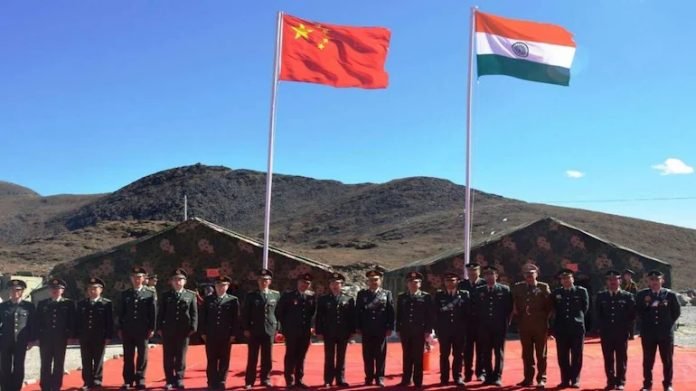
Revisiting Sino-Indian Border Dispute:Its Changing Dynamics
BY VINAY KAURA
Abstract
The Sino-Indian border dispute remains in a deadlockregardless ofplentifulof bilateral talks over the years.China and India share the longest disputed frontier in the world, extending over 4,057 kilometers, with a contentious Line of Actual Control (LAC) across the Himalayas.There has been cooperation in some fields, but conflict has been occupying commanding position in their relationship.The conflict is mainly over the western sector and eastern sector. On the western sector there is the ongoing dispute over the Aksai Chin plateau, which, on its three sides, faces Ladakh (in Indian-administered Kashmir), Tibet, and Xinjiang. India claims Aksai Chin as part of Ladakh and China claims it as part of Xinjiang. Between Bhutan and Burma lies the eastern sector which involves a dispute over the area between the pre-1914 British Outer Line and the McMahon Line. This is the Assam Himalayan region, which is claimed by India as being part of the state of Arunachal Pradesh – formerly the North-East Frontier Agency (NEFA) of Assam and claimed by China as part of Tibet. The China Government is assessing its own readiness to deal with LAC related issues. China refuses to depart from its aggression regardless of visual evidence. It indulges in acts of provocation. China had made two claims of what India deems it own territory. One claim is Aksai Chin and the other is Arunachal Pradesh. Concerns over Dalai Lama and rebellion in Tibet by the instigation of India have continued to shape China’s stance on the boundary issue. In addition, there has been infrastructure development in Tibetan plateau, force modernization and force superiority. The environment is one of strategic distrust intensified by Indian suspicion of Chinese intention. Despite a number of measures and initiatives taken, there is anunwillingness to resolve the border issue.The dynamics of the strategic and operational environment impinge on the bilateral relations to a large extent. Themajor thrust of this paper is to explore the historical legacy of the conflict, strong nationalistic sentiments of people of nations, deficit points,confidence building measures, and above all the dire necessity of perception change in the attitude of people through dialogue, consultation, reconciliatory approach and respect to each other core interests for Sino-Indian rapprochement.The political leadersof both nationsneed to understand major concerns by managingtheir differencesproperlyand seek common development and a win-win situation.
Key Words:Border,Dialogue,StrategicEnvironment,Negotiation and CBMs
Shadow of Past
It is essential to comprehend the historical perspectives that provide an insight in respect of the intricacy of the relational dynamics of the two Asian giants. The big turning point in the relationship between the two nations was Nehru’s decision to support the 1959 Lhasa uprising. The Chinese were enraged to a higher degree by India’s decision to grant asylum to the Dalai Lama.Thefact is that the rebellion was talked over in the Indian parliament and also that national newspapers openly expressed disapproval of ‘expansionist China’.
In this atmosphere of growing tension and distrust, the news of a new Chinese road in Aksai Chin (Western Sector) strengthened the Indian fears of the Chinese. With the failure to resolve the border issue on a diplomatic front, Nehru adopted a forward policy and sent troops to establish outposts along the agreed boundary between British India and Tibet as per the Shimla accord of 1914 and known as the McMahon line. The PLA attacked on October 20, 1962 and got into Indian-claimed territory in large numbers, resulting in a shaming defeat for India, followed by Chinese withdrawal. Since then, a dispute has existed with India claiming China is illegally occupying over 43,000 square kilometers in the Western Sector of Jammu and Kashmir, including 5,180 km ceded to Beijing by Islamabad in a 1963 agreement. China disputes India’s sovereigntyover 90,000 km of India’s territory, in the Eastern Sector mostly in Arunachal Pradesh.The dream of Sino-Indian solidarity and the foundations of peaceful coexistence under ‘Panchsheel’ were completely broken into pieces by the Sino Indian War of 1962. The period after the 1962 war served as a witness of complete breakdown in diplomatic relations between the two states.The two states began to join with each other’s adversaries – China with Pakistan, and India with the Soviet Union. As a result of which, they undermined each other strategically and began to support those internal forces hostile to one another.1
The Henderson- Brooks report by Lt. General Henderson-Brooks and Brig Prem Bhagat today is very sensitive and of operational value. It remains more secret in India. Another report named Himmat Singhji Report prepared after China invasion of Tibet seems to have been misplaced by the Ministry of Defense. The other five reports such as Sharda Mukherjee Report, H.M Patel Committee Report in the functioning of Ministry of Defense Expenditure Report,1990, PMS Blackett report, 1948 and Himmat Singhji Committee Report,1951 are also not available in Ministry Of Defense. While other countries are punctual to declassify the report, India is losing. The three main finding of Himmat Singhji Report are (1) Failure of the army’s higher command (2) Failure of organization of the army (3) Wrong appointment of army commander, Lt. General Brijmohan Kaul.2The Report clearly indicated that India had no scarcity of arms and stores, but the Indian soldiers were pushed into mountain snows without proper acclimatization and adequate winter clothing.
At that time, the political leadership was very weak. Prime Minister Pt. Jawaharlal Nehru and Defense Minister Krishna Menon were woefully ignorant about strategy, real politic and security, befuddled with misplaced notions about the Soviet Union. Both were mentioned as liberal Brits. The critics to India-China’s policies were described as CIA agents. Though the Government knew about the road constructed by China government in the disputed territory, but kept the parliament and nation at dark. The large chunks of Indian territories were occupied by China at that time. The depressing records of highest mistakes, crass negligence and political naivete have brought to this present state of situation.3The frequent chanting of Hindi Chini Bhai Bhai of Panchasheel was an unpardonable lack of sense of responsibility. Nehru had also ignored Menon’s interference in crucial army postings, promotions and strategic matters. There was an array of shortcomings within the army which Nehru could not rectify. Nehru was considered as naïve. The Henderson Brooks report is a serious indictment of the role of Nehru, Menon, Defense Ministry, the Army headquarters and several Generals involved in the conflict.4Nehru thought that as he had personally facilitated China’s permanent membership in UN Security Council, China would never take to arms against India.Nehru’s immature ignoranceof military realities led to the debacle of India. Nehru miscalculated the Chinese intent. The entire political establishment, the media and opposition deserve blame for it as they could not extract accountability from the Government.5
Military strategy was quite rightly the handmaiden of politics. Krishna Menon, the Defense minister and B.N Mallik, the I.B Chief exercised total control over national defense policy and disposition of troops in forward areas. Menon wasarrogant, abrasive, intolerant and politically a light weight. He wanted to change the basic defense posture of India. To reduce India’s defense in imported weapons andequipments, he created a separate Department of Research and Development in his Ministry under a Scientific Advisor. A Defense Production Planning Committee was set up. Further he wanted to change drastically the operational doctrine. He wanted to make army more closely to people participating directly in the nations building activities. For establishing indigenous weapons manufacture, money had to be found by cutting arms import. The armed forces would be short of equipment and stores for several years till the new arms factories started producing. The officer cadre was a house divided within it till the new breed fully took over. Lulled by faulty political assessment and wrong intelligence forecasts, the country got caught in a war when least prepared. Another serious mistake was the policy decision not to use air force against the Chinese. In this way, the 1962 conflict was a debacle. It only involved only a small fraction of army. The Navy and Air force remained out of it. The politico-military linkages were not sound. BrijMohan Kaul was made CGS and Thapar was selected as Army Chief instead of Thorat,availing full political support of Nehru . Since 1959, both Nehru and Menon had been interfering in the military matter. Both had no knowledge in military sphere, but they had directly supervised the placement of individual brigrades, companies and even platoons. Thapar and Kaul were often portrayed as courtier soldiers in contrast to old guard professionals they had replaced. The unnecessary interference of civilians with the military led to debacle of India in the face of China.6
China is a country which has solved border disputes with other countries except India. In accordance with Simla Agreement, 1914, the Mac Mohan line was accepted as official border between India and China denying Chinese suzerainty over outer Tibet. When India became Independent, it inherited all British territorial agreements including McMahon line as the legitimate border since 1914.The boundary question is complex left behind by history. Nehru refused to take into account the proposal for the negotiation in 1954 from the Chinese side as that issue was already settled. China did not accept it legitimate and refused to sign on Simla agreement considering it as the flagrant violation of Chinese sovereignty over Tibet.
In April 1960, both PM of China and India met in New Delhi to discuss the boundary dispute. Zhou Enlai indicated that if India accepted China’s claims in the western sector, they would adopt a reasonable stance on the McMahon line boundary in the eastern sector. But Nehru discarded Zhou’s attempt and called for sector-by-sector examination of claims. India assumed that once China acceded to India’s position in the west, it would be easier for the Indian Government to make concession for the west.
Tibet Factor
The Tibet issue is more central to the border dispute.7. Tibet was not a part of China. The imperialist rulers of China occupied it after a massive attack in 1950 and transferred its suzerainty into sovereignty. Violating the PanchasheelNeeti framed by Nehru, China built a new road across the Aksai Chin in Ladakh through which it linked Tibet within the mainland. It occupied more than 25,000 sq. miles of Indian territories which culminated a sharp corrosion of relations between two nations. It also claimed over large areas of Indian territory in Ladakh and erstwhile NEFA. The upsurge of Tibet and the consequent flight of Dalai lama to Tibet, in March 1959 created more complexity and misunderstandings. When China established new posts on the side of the border, the border dispute came to a head.
The British Indian Government and the then independent Tibetan government had signed a border treaty in 1914 ( Simla Accord) with the consent of Republic of China ( ROC). The border line separating both Tibet from India known as ‘McMahon Line’ was neither recognized by ROC nor by its successors. The Communist leaders of China were treating the Indian Government as national bourgeois of British colonial government in India .The Chinese had rejected outright the McMahan line. It argued that Tibet had no right to conclude an agreement with India.They pointed out that if they accept the McMahon Line as final, it would mean that Tibet had enjoyed some sort of independent status at that time which would bolster up the Dalai Lama’s case for an independent Tibet. In 1954, India signed an agreement recognizing Tibet as a region of China. A rebellion was broken out in Tibet by Tibetan émigrés which created suspicions in the minds of Chinese that India was conspiring together with rebels. Again India’s decision to grant asylum to Dalai Lama added further credentials to these suspicions. The Chinese were convinced that India sought to make Tibet as an independent buffer state. Concerns over Dalai Lama and rebellion in Tibet by the instigation of India continued to shape China’s stance on the boundary issue.
China is well aware of the ethnic rift between Tibetan and Han and the empathy all over the world for the distressing condition of Tibetan culture and religion. China understands the transportation problems of getting into and within Tibet. China has assumed a policy of demographic inundation of Tibet and its’ other minority areas by Han settlers. The PRC has also created networks of roads, railways and infrastructure with the intent to integrate Tibet into mainland China. China neither wanted to make Tibet a province of China nor prepared to give full autonomy andnon interference in the affairs of outer Tibet to be directly under Dalai lama. The Chinese hesitated to sign the treaty due to disagreement of the exact location of boundary separating inner from outer Tibet. Tibet was India’s neighbor for centuries, when China annexed Tibet, the problem arose. This problem can not be solved very soon because Indian and Tibetans are not ready to re-write history.India still continues to support McMahon line as final and conclusive.8
India’s Stance
By taking the advantage of unpreparedness of India’s army, China attacked India in 1962 and occupied vast areas. Chinaisprofusely a communist country. During Indo-Pak war of 1965, it helped Pakistan with arms. China opposed India for its nuclear tests and merger of Sikkim .Betraying with India; China secretly constructed a road in disputed territory. There is an adversarial trade with China that will jeopardize our national interests. China is not only supplying arms to our neighbors but also affording aid and sanctuary to separatists and insurgents operating against our nations.On the Chinese side, the Chinese Government offered support to insurgent groups like the Nagas and Mizos in India’s Northeast, as well as the Naxalbari movement in the north of West Bengal.9
China has developed a railway, an extensive road network in Tibet and Xinjiang, employing powerful forces that include armor, rocket artillery and battlefield support missiles. The Chinese have developed new airfields and conducted four military exercises in Tibet in 201210.The Chinese are not easy to understand. They have publicly claimed Arunachal Pradesh as a part of their territory, refused visas to military officials serving in J & K , issued stapled visas to the residents of J&K, objected to developmental activities undertaken by state Government and questioned the visit of Prime minister to Arunachal Pradesh.
China always wants to create an issue at the time of its domestic political uncertainty. The Chinese motivation is clearly apparent in “The Chinese Government’s Defense White Paper” that China will back its diplomacy all the way by hard military power while dealing with issues involving sovereignty.11There is PLA presence in Pakistan occupied Kashmir. It questions the legality of our possession of the Ladakh Sector and uses Pakistan as a proxy by giving nuclear related technology and conventional weapons. China opposes India’s efforts to secure permanent membership of UN Security Council. China refuses to vacate its aggression despite visual evidence. It demands that India must dismantle its apparatus near the line of actual control.In June 1967, a diplomatic crisis broke out. China announced the expulsion of two Indian diplomats from Beijing on espionage charges, and withdrew their diplomatic status, opening a public trial.
Chinese Perspective
Arguing a strong historical backward China began emphasizing its claims on Arunachal Pradesh partially Tawang area. China’s persistent demand on Tawang reflects two considerations; First, Tawang is its strongest bargaining chip for territorial adjustments. Second, in exchange of its claims to Tawang, the Chinese evidently want to provide some tangible reassurance vis-à-vis Tibet.12India’s alleged support for Khampa rebels in Tibet after 1956, provision of sanctuary to Dalai Lama and his Tibetan government in exile in Dharmasala after 1959, India’s discovery of completed Chinese road running through Askai Chin region in 1958, India’s extension of defense perimeter and forward policy of placing military outposts in disputed areas provoked China to a considerable extent. Following the conflict in 1962, the relation of both nations remainedtormented for several decades. In 1986, China built up a military and helicopter pad in the area and in 1987, India granted statehood to Arunachal Pradesh of which China claims 11 of 15 districts. This attempt caused both sides to deploy additional troops to the area.Besides this, the Indian Government deprived two Chinese diplomats of their diplomatic status and deported them. On 16 June 1967, some Chinese embassy personnel were assaulted and injured by Indian demonstrators in front of the Chinese embassy in New Delhi. In Beijing, Chinese Red Guards besieged the Indian embassy and blocked all the roads to the Indian embassy.
China claims approximately 90,000 sq. kms of Indian territory in Arunachal Pradesh and 2000 sq. kms in the middle sector of India-China boundary. The so called Arunachal Pradesh dispute is China’s most intractable border dispute. Arunachal Pradesh is only issue which has a potential for conflict between two nations. Each side continues its military and logistic capabilities in the disputed regions. When India converted Arunachal Pradesh into state, tensions began to escalate. Both sides tried to strengthen their capabilities in the area.
In 2009, the visit of Dalailama to the disputed territory of Tawang in the remote north east Indians state of Arunachal Pradesh precipitated protests from China (Southern Tibet). This incident incited to anger the nationality of both sides urging their respective governments to act tough. During Sino-Indian border war of 1962, Chinese troops seized the possession of Tawang for more than a month. Now China is validating its claims. India, in turn, is claiming more than 14,700 square miles of Chinese controlled Askai-chin, near the Kashmir border. Talks between two countries have been held frequently over the past four years bereft of resolution.The stand-off between two nations continues with Chinese troops in Ladakh, continuing to camp 10 Kms within Indian territory.
As recently as 2017 border tensions came close to war between the two rising Asian superpowers.China’s military had warned India not to assign low value to its resolve to hold a mountainous piece of land at the heart of a standoff between the two nations.The standoff surfacedafter China started erecting a road near the Bhutanese border in the strategically sensitive Doklam Plateau area, claimed by China and Bhutan.Both Bhutan and India expressed a strong objection to the road-building to China before Indian and Chinese soldiers engaged in a tense standoff along the disputed area. The troops later stood down and China ceased construction work.13
Confidence Building Measures
The evolution of confidence building measures contribute a lot in generating mutual trust on a solid ground of pragmatism between two Asian giants creating a ray of hope for peaceful solution of disputes in due course.There was a commitment on the part of both China and India that peace and tranquility on the border is a pre-condition for progress in their relationship. A positive attitude to push the talks to go forward wascalled for with great urgency. In 1978, Mr. Atal Bihari Vaypayee, the Indian External Affairs Minister, visited the PRC and officially reestablished diplomatic relations. This visit was reciprocated in 1981 by Mr. Huang Hua, the Chinese Foreign Minister.The 1988 visit of Mr. Rajiv Gandhi, the then Indian Prime Minister, commenced a real warming trend in bilateral relations. Both sides agreed to broaden bilateral relations and work towards a settlement of border disputes in a reasonable and fair manner.The Prime Ministers of the two countries agreed to settle the boundary questions through the guiding principle of “Mutual Understanding and Accommodation and Mutual Adjustment”. The two sides agreed to establish a Joint Working Group (JWG) on the boundary questions at the Vice-Foreign Ministerial level.Since 1990s, both sides have agreed to show improvement in their overall relationships. Both have pursued confidence building measures along the borders like troops reductions, advance notification of military exercises and to build force constructive and stable relations. In 1993, Narasimha Rao and his foreign Secretary J.N Dixit showed the courage to negotiate with Beijing a treaty to maintain peace and tranquility along the line of actual control in the India China border areas. But the successor government lapsed back into Nehru’s obduracy and the pacificatory potential of Rao/Dixit initiative was aborted.14
After more than thirty years of border tension and stalemate, high-level bilateral talks were held in New Delhi starting in February 1994 to foster “confidence-building measures” between the defense forces of India and China, and a new period of better relation began. In November 1995, the two sides took awaythe guard posts in close proximity to each other along the borderline in Wangdong area, making the situation in the border areas more stable. During President Jiang Zemin’s visit to India at the end of November 1996, the Governments of China and India signed the Agreement on Confidence Building Measures in the Military Field along the Line of Actual Control in the China-India Border Areas, which is an important step for the building of mutual trust between the two countries. These Agreements provide an institutional framework for the maintenance of peace and tranquility in the border areas.
During Prime Minister Vajpayee’s visit in 2003, the boundary talks were lifted up from bureaucracy to political levels. It was for the first time that India signaled its readiness to settle the disputes at pragmatic levels. Since 2003, the Special Representative of China and India on the boundary questions have conducted 15 round of talks and have signed the Agreement on political parameters and Guiding principles for the settlement of India China Boundary Question and reached 18 point consensus on resolution framework. During this period in June 2003, both inked a memorandum in expanding border trade which added Nathula as another pass in India China border for conducting border trade. Both sides carried out patrolling activity in the border areas. Transgressions of LAC were taken up though diplomatic channels.
During Chinese Premier Wen Jiabao’s visit to India in April 2005, the two sides signed an agreement on political settlement of the boundary issue, setting guidelines and principles. In the agreement, China and India affirmed their willingness to seek a fair, reasonable and mutually acceptable solution to the boundary issue through equal and friendly negotiations.In April 2005, the new framework for engagement which provided impetus was the Agreement on “Political parameters and Guiding principle for settlement of India China boundary questions” between Dr Singh and Wen Jiabao, the Chinese premier during latter’s visit .In 2006, PM Dr.Singh pointed out with the visiting President of China that India can not make any concessions in Tawang, but would look at making territorial exchange elsewhere in Arunachal Pradesh. Chinese Premier Wen Jiabao advocated sincerity and patience in resolving the border dispute ahead 11th round of talks in Beijing in September 2007.
In the former visit of Dr. Singh to China in the month of October, 2013, both India and China have inked a comprehensive border agreement to avoid any stand-off in future. Both agreed not to taileach other’s patrol along the line of actual control. The agreement also facilitated a hotline between the military headquarters of two countries.The Agreement was in fact an addition to the existing layer of confidence-building measures through flag meetings, joint military patrols, and periodic high-level interaction. Both New Delhi and Beijing accorded high priority to check hostile incidents along the Line of Actual Control. The signing of this agreement is to codify the good practices and experiences in dealing with relevant issue. The deals had sent a positive and powerful message that the two countries are committed to working together.15
India Prime Minister Narendra Modi urged visiting Chinese President Xi Jinping to resolve the boundary dispute after holding talks in New Delhi 18 September 2014 that lasted much longer than the stipulated 90 minutes. Modi said that the boundary dispute must be resolved at an early date.Both leaders agreed that peace on the border constitutes the foundation of the trust and relationship between the two nations. Modi called for an early clarification of the “line of actual control” which presently separates the two countries. He said if this happened “we can realize the potential of our relations.”
The Doklam standoff last year was seen as one of the most serious instances of tensions rising between the two countries. The discussion on the LAC was held at the 20th round of Special Representative (SR) talks on boundary dispute in Delhi, first since Doklam episode. The two sides made persistent efforts to narrow down differences over different perceptions of LAC which leads to transgressions. While the Indian side at the talks was led by AjitDoval, National Security Advisor and SR, the Chinese side was led by Yang Jiechi, State Councillor and Member of Politburo.The talks were positive by focusing on bringing out the full potential of the Closer Developmental Partnership between the two countries.The Special Representatives undertook a comprehensive review of earlier rounds of the talks and agreed that an early settlement of the boundary question serves the fundamental interests of both countries. The two nations re-emphasized their commitment to achieve a fair, reasonable and mutually acceptable solution to the India-China boundary question at an early date. The two sides agreed that pending the final resolution of the boundary question, it is necessary to maintain peace and tranquility in the border areas. In this regard, the Special Representatives exchanged ideas on various confidence building measures. The two SRs underlined the need for the two countries to build on their convergences, while seeking mutually acceptable resolutions of their differences with due respect for each other’s sensitivities, concerns and aspirations. The hotline between the two central military headquarters and the annual Army exercise was on the agenda. The Prime Minister Modi said that a strong India-China relationship assumes immense significance not only for the mutual benefit of the people of India and China, but also for the region and the world. The Wuhan meeting resulted in an understanding between the two countries to increase “strategic communications”, de-escalate borders and provide strategic guidance to their respective armies to manage the situation on the borders and enhance confidence building measures (CBMs).In Mamallapuram Summit also, boundary matters were discussed and it was decided that the Special Representatives will continue their talks to reach at a mutually-agreed framework, which will be premised upon Political Parameters and Guiding Principles that have been concurred by the two sides in 2005. And it was also agreed that work will continue on additional Confidence Building Measures to achieve this.A stable and peaceful border region was treated as the prerequisite for either party to focus on its internal socio-economic advancement. This is probably the reason why both countries have managed to set up various stabilization measures to manage effectively their border disputes through negotiations.16
What is lacking?
The strategic mistrust between the two nations, caused by the 1962 conflict, was the largest obstacle to developing their relations. The area in dispute is small and remote, but the geopolitical stakes are high.The threat to their borders was a threat to their very statehood and thus led to an identity crisis of the state.This situation provoked strong nationalist sentiments in both India and China, which, by September 1962, had stepped up to a point where military engagement from both sides was ineluctable. The 1962 border conflict was in fact a clash of nationalism over the Himalayan frontiers17.The inadequate LOCs, infrastructure and the continuous deployments along the borders have exerted financial pressure on the overall defensive readiness of both the countries.The increased war-waging potential and the demonstrated intent to use force to settle the border dispute made the situation susceptible to conflict and sudden escalation. Any conflict along the LAC has the potential to escalate into a serious major conflict and thereby lead to a second major Sino-Indian conflict.The first and foremost cause of Border dispute is the absence of a formally and mutually agreed Line of Actual Control (LAC) to separate the jurisdictions under the control of their armies. The perceptions of the LAC differ at many places. In some places it might be by just a few meters, and elsewhere by tens of kilometers. India’s decision to advocate an inflexible policy on border negotiation and China’s rejection of the McMahon line unsurprisingly led to both countries acting independently along their common frontiers, Aksai Chin and the NEFA region.Both sides are basicallysuspicious to each other. Domestic politicscounters in advance either side from making any concessions.Domestic politics plays a most important role in the dispute, and neither side would be able to make concessions without provoking their domestic audience. Although China is not a democracy like India, the Chinese Government is filled with fear of rousing a public that is already sensitive about border issues. In addition, there are still impediments to reaching a complete settlement. One impediment is India’s 1962 parliamentary resolution. At the height of the border conflict, on 14 November 1962, the Indian Parliament passed a resolution in complete accord stating that India will get back every inch of territory lost to the Chinese. Hence, the concession of Aksai Chin would mean anact of betrayal of India’s national integrity on account of this parliamentary resolution, which has been neither invoked nor repealed.Efforts on the part of the Indian Government are still in the pipelines to encourage public opinion in favour of a border settlement and to disregard the 1962 Parliamentary resolution.18
China’s nationalist tabloid Global Times said on July 5,2017, “This time we must teach New Delhi a bitter lesson.” An article on the PLA’s English-language website, China Military Online, has warned that “if a solution isn’t reached through diplomatic or military communication or the issue isn’t handled properly, another armed conflict … is not completely out of the question.” Chinese officials have also warned India that it should learn “historic lessons” from its humiliating defeat in the 1962 war that both countries fought over their border. In response, Indian Defense Minister Arun Jaitley reported that “India in 2017 is different from India in 1962,” referring to its improved military strength.19
It is a matter of irony that the two competing territorial claims have been incorporated within themselves by the public in both countries. The two countries are seized firmly by a strong fanatical devotion to a national community, bordering on jingoism, complicating for successful resolution of such vexing disputes.Discussion is plagued by an aggressive nationalism driven by social media.Both countries share that these are legacies of history and difficult to manage in the short or medium term and are best left for the future. For them,the obduracy and historical short-sightedness are stumbling blocks on path of successful resolution to the dispute.In recent years, the border issue has become relatively less important as the two countries have directed their attention on other aspects of their bilateral relations like trade, energy, and even military ties, yet an unresolved border dispute bears the potentials to upset the smooth functioning of bilateral relations. In addition, it will prevent the progress of joint efforts of counter-terrorism or military exercises in the border areas and the extension of border trade on a full-scale. The border dispute has caught worldwide attention due to its impact on the issue of regional and global power patterns as well as on great ideological debate among the communist countries.20
Changing Perspectives
India and China partake one of the world’s longest land borders, where conflict hasstarted abruptly now and again since a bloody border war occurredin 1962. The last time border tensiontook place in 2017 when troops came together in and around the disputed Doklam plateau, a thin strip of land at the tri-junction between India, China and Bhutan. Despite the fact that it is not a part of Indian Territory, the area is close to the “chicken’s neck”.It is a strategic corridor that serves as a very important artery between Delhi and its far northeastern states. Bhutan charged China with the fault of building a road inside its territory, which Beijing refused to recognize. India then interfered to aid the cause of Bhutan’s claims, culminating to a long standoff, which included live-fire drills by the People’s Liberation Army on the border.
In the last decade alone, three such episodes were found at Depsang in northern Ladakh in 2013, at Chumar in eastern Ladakh in 2014, and at Doklam on the Sino-Indian-Bhutanese border in 2017. They all engendered local crises to a larger extent demanding higher political intervention to find solution for them. The heated dispute in May,2020 which caused for eleven soldiers to be admitted to hospitals on both sides, were reported to find a solution by the next day after “dialogue and interaction at the local level”. Military reactions from the ground made the multiple face-offsresponsible to the “undemarcated” boundary. For some analysts, the reasons for the incursions were totally China-centric: its imminent economic collapse, Beijing’s problems in Hong Kong and Taiwan and President Xi’s inclination toimpress upon his domestic audience. For India, the present crisis at the China-India border is really grave, and not just because it is unlikely a routine accidental border conflict or on account of the unparalleled high levels of tension and physical violence at several locations of the disputed LAC.The standoff also makes a critical turn in China’s strategic calculations in South Asia21.
The Chinese forces are stationed in order to defend the new physical infrastructure like roads, bunkers, and barracks which are on the process of building in one instance, but in other instances they are seeking to set up a new presence across critical avenues of access to both sides. In almost all cases, the Chinese incursions are relatively not deep, on the order of 1–10 kilometers west of their routine operating areas. In fact, the new Chinese occupation likely has taken place withinthe confinements of China’s own claim line, but exactly because this border is challenged by India. New Delhi finds itself encountering fresh Chinese troops stationed on territories; the Indian government has considered as its ownup tillnow. These incursions, accordingly, cannot be turned down as trivialfor the reason that, in the polluted post-colonial politics of South Asia, all the involved states have fought acrimonious battles in the past over minor portions of territory.In view of the disputes on the subject of what the territorial boundary between the two countries should be, any permanent Chinese presence up to the limits of its own claims distinctlystates an invasion of Indian territory and as suchpicturisesas an instance of an intolerable disregardto New Delhi.
The current Chinese efforts to suddenly seek physical control over new locations in the Himalayas have been widely ascribed to the general increase in Beijing’s high spirited playfulness in the aftermath of the coronavirus pandemic. According to this, signs of new Chinese aggressiveness along the Sino-Indian border are all of a piece with the new security law. Beijing has enacted to control Hong Kong, the enunciation of new administrative structures in the South China Sea, and the new language on Taiwanese reunification used during the May 2020 National People’s Congress plenary session in Beijing.To put in other words, China is beating back fromall sidesto signal resolution when there is extensive international concern in respect of its contribution toward the spread of the pandemic. There is alurking danger, however, in fusing coincidence with causality where the current Sino-Indian crisis is concerned.
In fact, Chinese aggressiveness toward India along the LAC represents deliberate threats through the use of military force, a development with roots in events that come before the pandemic. If Beijing’s objections are anything to go along, Chinese anxieties became visible to have increased since the August 2019 when Indian decision to transform Ladakh, which had been part of the autonomous state of Jammu and Kashmir beforehand, into a union territory directly governed by New Delhi.This Indian decision was moved entirely by domestic exigencies. The only international consequence India wantedwas a gesture that encodes a message to Pakistan that the door to secession was shut in a conclusive wayand that all parties to the conflict therefore would have to accommodate themselves to the reality of Jammu and Kashmir at all times being part of the Indian Union.
Senior Indian policymakers frequently emphasized that their August decision involved only the political question of Jammu and Kashmir’s relationship with the rest of India. This action did not in any way presuppose the territorial issues concerning to the boundaries with China. Beijing, however, remained unconverted by these reassurances and, in collusion with Islamabad, directed its efforts to come together for international opposition to New Delhi. These efforts were unsuccessful terribly, in part, because the United States was supportive to India.Itwill never be known with certainty whether this failure escalated China’s desire to punish India in other ways or whether the failure only gave effectiveness to the Chinese resolve to take control of disputed territories that were long cherished but were now judged to be jeopardized by India’s domestic decisions in key international forums such as the UN Security Council.
But China’s severe opposition to the change of Ladakh’s status, something that received only passing attention up till now, set the stage for the militaristic power play that is now under way along the LAC. Other developments since have intensified China’s willpower to “fix” India: New Delhi’s criticism of Beijing’s failure to help contain the international spread of the coronavirus and the Indian decision to restrict Chinese investments at a time when similar global sentiments sharpened China’s resentment and beefed up the prospects for a counter attack when circumstances afforded opportunities.The incremental acquisition of claimed territories along the Sino-Indian borderlands exhibits similarities of the patterns Beijing’s behavior has displayed elsewhere in the world such as the South China Sea.From the early 1990s until as recently as the 2018 summit in Wuhan between Chinese President Xi Jinping and Indian Prime Minister Narendra Modi, a series of agreements and understandings have been concluded. These measures were meant to put off violent conflict at the LAC in order to provide political authorities on both sides an opportunity to decide the border dispute through negotiations, which would in turn permit the demarcation of a single common boundary between the two contenders.
Until such an outer boundary of a two-dimensional figure could be concurred upon, patrols on both sides were expected to continue in the undefined gray zone. It is especially a narrow space where neither country had a permanent presence and without threats of physical obstruction by the opposite side. While Chinese patrols often entered into new areas, although within the limits of their own claim lines, Indian forces rarely reached the limits of their own claim lines. While the negotiated agreements served intermittently to calm down tensions, they failed to produce any lasting tranquility for the simple reason that they did not specify the actual positions that each side routinely occupied relative to their claimed boundaries. As a result, Chinese patrols over time extended the sphere of their operations, extending their reach into territories that they had not patrolled before and that often have lain in areas that was without settled Indian populations. These tactics have set the stage for China to follow extensive claims when boundary negotiations finally embark on.
India is now very much trying to catch up on both counts, and its tireless efforts to improve its own road and air networks along the Himalayan borders have captured China’s notice. Beijing seeks to oppose these efforts in order to freeze its current advantages for an indefinite period. By seizing possession of new segments of Indian territory, it thus aims to change the facts on the ground either to improve its bargaining leverage in future negotiations, to simply take over spaces it desires for political or military reasons, or to put pressure on India to bring to a halt the ongoing infrastructure modernization that could be to the advantage of it in any future conflict.
The pattern of Chinese patrolling since the late 1990s suggests that Beijing seeks to ultimately control the entire Aksai Chin plateau. China has demanded this region as a rightful due since the 1950s, but as the Sino-Indian rivalry has multiplied after the Cold War, Beijing has left no stone unturned to gradually bring bits and pieces of the disputed frontier under its real authority. The term de facto authority itself is not enough in this context because, in the absence of maps that clearly define which areas each side actively controls. China’s appropriation of territory over a period of time cannot be either contested or contained with the exception of physical Indian obstruction.
On this count, Chinese actions have been singularly malicious although both countries have long committed to exchanging maps describing their presence in the disputed territories as the first step toward a boundary settlement. Beijing has thus consistently refused to follow through on its obligations. In large measure, this is because accepting any Indian map that marks an existing Indian presence would make it hard for China to ask for that territory in future negotiations. What China actually in need of is the whole of the disputed borderlands merely on the strength of its claim that it once gained control over them.
The latest Chinese intrusions in the Ladakh region left India only with awful choices. Beijing has moved into disputed territories that did not host a continual Chinese presence as recently as January 2020. China’s first-mover advantage has now locked India into the awkward position of trying to negotiate a Chinese withdrawal from these new occupations, which is an unlikely prospect especially in areas like Pangong Tso, where China isforcibly finishinga motorable road, and in the Galwan Valley, where it is allegedly building bunkers and barracks. Even if China withdraws as a result of successful Indian negotiations, the new infrastructure of it would stay alive as a ready asset to be employed in some future emergency.
The regrettable truth is that Chinacan now hold on to its new acquisitions forever unless India chooses to get out Chinese troops by force or decides to impose tit-for-tat costs on China by occupying other pockets in disputed territory in a symmetrical manner where it owns a tactical advantage. This witty comeback admittedly carries situations involving exposure to danger.because China could hindersuch Indian actions making use of its significant reserves already moved into position for military action at key locations along the front, in which case the stage would be set for perhaps a wider altercation.
The current Sino-Indian border crisis has revealed that China has little respect for India’s long-standing efforts to freeze the status quo along the two countries’ disputed frontiers or for New Delhi’s cautious efforts to avoid the appearance of balancing against Beijing. Rather, treating India’s internal actions regarding Jammu and Kashmir as an incitation, it has picked up to expand its control over new parts of the Himalayan borderlands through blatant actions that confront India with the difficult choice of either lumping its losses or escalating through force if the negotiations presently under way produce scanty returns. By doingso, it has forced India to join the rest of Asia in figuring out how to deal with the newest turn in China’s salami-slice strategy which now distinctively marks its trajectory as a rising power22.
The events in Galwan Valley need to be a wake-up call for India to re-invent it’s South and east Asia policy. This is an opportunity for India to align its interests much more strongly with the U.S. as a principal strategic partner. India should also fill more energy into its relations with Japan, Australia, and the ASEAN. Time has also come for India to reconsider its stand on joining the Regional Comprehensive Economic Partnership. To withdraw from economic involvement with China, and construct the capacities and capabilities it needs in manufacturing, and in supply chains networks closer home, India has to think in the long terms. The context of changing relations with China has compelled India to reassess the depth of its engagement with other countries. In every aspect, engagement with China calls fora re look. And that also includes an increased level of engagement in South Asian neighborhood.
In recent years, Pakistani Prime Minister Imran Khan and his predecessors have sought to expand ties with China through initiatives like the China-Pakistan Economic Corridor, coupled with Chinese funding for Gwadar Port and other economic initiatives. That has reduced any Pakistani condemnation of China’s oppression of Muslims, such as the million-plus Uighurs and other minorities sent to camps in Xinjiang. At the same time, Pakistani cooperation with the United States has beendisintegrated under pressure. In case of a new cold war, Pakistan has chosen a side.
This has in turn facilitated to strengthen the relationship between the United States and India, although there are also other factors involved therein. Since the 1990s, India has been slowly pressed on ever closer to the West. In the early 1990s, India undertook amazingly ambitious economic reforms—more radical than those required by the International Monetary Fund for desperately needed loans. The two key economic reforms dealt with conducting business in India and international commerce. Business in India between 1947 and the early 1990s was subject to the License Raj, the burdensome regulations needed to run even a small business. China, which had liberalized its economy to a degree in the 1980s, was storming ahead as a result. India choosing free markets was a notable transformation for a nation, showcasing that the country was prepared to move past failed economic policies, and a move toward the Western/American economic sphere soon came after in order. As India began to see high rates of growth, it became more of a suitable competitor with China. This occurred in conformity with India tightening relations with Chinese adversaries and American allies such as Vietnam and Japan.
Nowadays, the United States comes out asvery important to the Sino-Chinese relationship. In recent times, India has sought to beef up ties with Washington, driven by a fear of Chinese economic and political influence in the region to some extent—especially in ports in nearby oceans. As the Chinese are found to be more aggressively self assuredin the Indian Ocean, India has been endeavouring persistently to locate an ally to build updeterrence23
Need of the Hour
Now is the time to test the wisdom of the political leaders in evolving a mutually acceptable solution.There is the need of perception change in the attitude of people of both nations.An opportune moment has come for both the nations to understand that unsettled borders are not good which can turn into an apple of discordin near future. Both nations are called for to move from disputes to dialogues, receptive to arguments, sentiments and strategic concerns for other. The exact border alignment between China and Arunachal Pradesh can be decided by joint surveys and consultations. Askai Chin which is under control of Chinese government bears little sense to India geographically and economically. China also dropped the hint that it would recognize the McMahon line in return for India giving up claims over Askai Chin. It is a better option for India. If this give and take approach is accepted, there is a ray of hope of resolving the long festering border disputeensnared in the cobweb of misunderstanding of both nations. It is right time for people of both nations to take a rational and reasonable approach for long term interests.
There is a dire need to work out a common alignment and consultation mechanism of LAC in a time bound manner. This will ensure peace andborder disputes will be absolutely still and drawn down. Both sides should steadily push forward the negotiation process for maintaining peace and tranquility, not to let the border dispute affect the bilateral affinity. As long as both nations cling to the process of peaceful negotiations and well-being of two peoples, it will be easier to find reasonable, fair and mutually acceptable solution to the problem. Finding a mutually acceptable agreement requires patience and perseverance and need fora friendly and favorable atmosphere. The political leaders of both nations should comprehend and respect each other’s core national interests and major concerns, managing their differences properly. India-China relations should be seen in the Asian and global context in order to perceive the strategic opportunities in the relationship.The cooperative and constructive partnership in various fields will enable them to make the 21st century an Asian Century.Despite of misperceptions persisted, it is very important to be mindful of the problem at hand and design policies that seek to address these differences of conflicting claims. This is especially connected to the matter at hand in an age of nuclear weapons where careful thought and deliberation are keenly required to ward off potentially terrible consequences.A good China–India relationship makes both winners while a confrontational one makes both losers.The crucial basis of a healthy relationship is the enhancement of mutual trust between the two countries that can be possible only by institution-building at the bilateral and multilateral levels.A peaceful and settled boundary between the two largest neighbouring nations in Asia will indubitably bring rich dividends to their national security, political stability and economic development.
To sum up, it can be said that the border dispute between China and India cannot and should not be understood on its own. Rather, the dispute has to be inquired into carefully in tandem with many other factors defining bilateral ties. Beijing and Delhi should have sufficient incentives and political will to contain the negative impact of the border dispute, at least in the foreseeable future.24.In present world system, multilateral cooperation is of crucial significance, since both India and China are promoting multi-polarity. Their multilateral cooperation can move ahead through their contribution in multilateral regimes, especially at the regional level, such as the Association of South East Asian Nations (ASEAN), the Shanghai Cooperation Organization (SCO) or the South Asian Association for Regional Cooperation (SAARC). Multilateral regimes are best forums for dialogue among nations as well as tools for checks and balances between them. Therefore, problems of India and China arising out of border dispute which still lie unresolved through bilateral channels may be moved upwards to a multilateral level as a means of solution through the involvement of other countries. In this respect, participation in various multilateral regimes may ennoble for Sino-Indian relations. It is the need of the hour for both China and India to accommodate each other in order to thrust ahead the development of multilateral regimes, making concessions in some issues to benefit from others.Moreover, both countries acknowledge that non-traditional security issues in the region, like terrorism, transnational crime, piracy, natural disasters and other challenges, can be addressed only through application of joint efforts and regional co-operation. One glaring instance is the sub-regional co-operation between China, India, Burma and Bangladesh, which highlights on economic co-operation and non-traditional security issues, such as narcotics. On a global level, broad common interests subsist between China and India, such as reform of international financial institutions, maintenance of an open international trade system and addressing the challenge of climate change. As developing countries, both China and India can boost up coordination in global institutions to defend their national interests. Theirstrategic partnership has already gained a great impact, especially in dealing with North-South relations.Both sides must now look forward at what can be done, with lessons from the mistakes of the recent past.A complete strategy wouldinclude military, diplomatic and political levels. Diplomatic channels must go on to be open and should not be confined in any way as they are sin qua non in the current situation.
End Notes
1.Yang Lu, “Looking Beyond the Border: The Sino-Indian Border Dispute and Sino-Indian Relations”, Heidelberg Papers in South Asian and Comparative Politics, Working Paper No. 31, August 31, 2007 http://archiv.ub.uni-heidelberg.de/volltextserver/7499/1/Yang_Lu.pdf.
2.Claude.Arpi,“Declassified History”, The Statesman.November 13, 2012 http://claudearpi.blogspot.com/2012/11/declassified-history.html.
- RajinderPuri, “Remembering 1962, Failure of Political Leadership and Army Commanders”. The Statesman”, October 18, 2012.
- Subrat Mukherjee, “Twisted Truth-Lessons of the 1962 War With China, ”The Statesman, December 7, 2012.
- RajinderPuri, “The Untwisted Truth”,boloji.com, December 7, 2012, https://www.boloji.com/articles/13552/untwisted-truth-1962-india-china-war
- Neville Maxwell, China’s Aggression of 1962 and the Unresolved Border Dispute, Oxford, Court Place Books, 1999, 15
7.TseringTopgyal ,”Charting the Tibet issue in the Sino–Indian border dispute”,ChinaReport,Volume 47,P-115-131,November 10
- RajinderPuri,”The McMahon Line: Tibet Will Test Xi Jinping,”The Statesman, October 28, 2012
- Lu, “Looking Beyond the Border: The Sino-Indian Border Dispute and Sino-Indian Relations,2007
- Manoj, Joshi], “Making sense of the Depsang Incursion”. The Hindu, May 7, 2013, https://www.thehindu.com/opinion/op-ed/making-sense-of-the-depsang-incursion/article4689838.ece
- Arvind Gupta , “Lessons from ladakhstand off”, The New Indian Express, May 10,2013, https://www.newindianexpress.com/opinions/2013/may/10/Lessons-from-Ladakh-standoff-475848.html
- SrinathRaghavanan, “Resolving the Sino-Indian Boundary Dispute”, Centre for the Advanced Study of India, July 5, 2009.https://casi.sas.upenn.edu/iit/raghavan
- Dipanjan Roy Choudhury, “India, China explore CBMs for LAC stability after Doklam” ,The Economics Times, December 22, 2017,https://economictimes.indiatimes.com/news/defence/india-china-hold-border-talks-discuss-cbms-after-doklam/articleshow/62211224.cms?from=mdr
- Neville Maxwell,“Forty Years of Folly”, Critical Asian studies, March 2003
15.The Hindu , “Beyond the Border”, October 25, 2013
- HongzhouZhang andMingjiangLi,”Sino-Indian Border Disputes: An Analysis”, ISPI, No. 181, June 2013 https://www.ispionline.it/sites/default/files/pubblicazioni/analysis_181_2013.pdf
- Lu, “Looking Beyond the Border: The Sino-Indian Border Dispute and Sino-Indian Relations, 2007.
- Lu, “Looking Beyond the Border: The Sino-Indian Border Dispute and Sino-Indian Relations”, 2007.
- Mohan Guruswamy, “Why India and China’s border disputes are so difficult to resolve”,South China Morning Post, December 17, 2017https://www.scmp.com/news/china/diplomacy-defence/article/2124528/why-india-and-chinas-border-disputes-are-so-difficult.
- PurushottamPrabhakar, “TheSino-Indian Border Dispute”, International Studies, Volume: 7 issue: 1, January 1, 1965 page(s): 120-127,https://journals.sagepub.com/doi/abs/10.1177/002088176500700106?journalCode=isqa.
- Antara Ghosal Singh, “What Is China Saying About the China-India Border Stand-Off?”,TheDiplomat,June 02,2020, https://thediplomat.com/2020/06/what-is-china-saying-about-the-china-india-border-stand-off
22.Ashley J Tellis, “Hustling in the Himalayas: The Sino Indian Border Confrontation”, Carnegie Endowment For International Peace, June 4,2020, https://carnegieendowment.org/2020/06/04/hustling-in-himalayas-sino-indian-border-confrontation-pub-81979
23.Anik Joshi, “China Is Pushing India Closer to the United States”, Foreignpolicy.com,June 9,2020, https://foreignpolicy.com/2020/06/09/china-india-border-united-states-pakistan/
24.Zhang and Li,”Sino-Indian Border Disputes: An Analysis”,2013
The End