
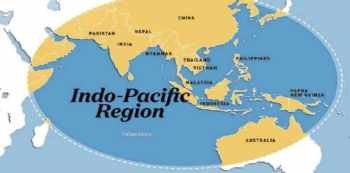
Peace and Stability in Indo- Pacific- Centrality and Role of Indo-Pacific Rim Nations HORIMOTO Takenori
FOIP and Quad with their implications
Japan and the US have adopted the Free and Open Indo-Pacific, or FOIP, as a regional strategy and have sought to give it body through the Quadrilateral Strategic Approach, or Quad, a framework for security cooperation among four major democracies: Japan, India, the US, Australia.
India also uses the Indo-Pacific as a strategic regional concept, but meanwhile India has been maintaining its strategic autonomy at the policy level, as can be seen in its posture toward FOIP—a stance of being involved but also maintaining a certain distance. PM Modi has used the word inclusive four times in his Keynote Address at Shangri La Dialogue on 1st June 2018. India’s FOIP could be FOIIP in the strict sense of the term. Notwithstanding, Quad of the four countries has been upgraded to the ministerial meeting for the first time in September 2019.
China Factor and its Negative Responses to Quad
International politics in the Indo-Pacific region as of now ultimately boil down to the issue of how to deal with China, which seems to be working to replace the US as the regional hegemon and establish a Sino-centric international order.
With the rise of China’s power and the relative decline in that of the US in the region, the US is no longer capable of holding China down as it could before. In this context, FOIP and the Quad can serve as effective approaches.
The Quad framework could be one of major responses to China’s Belt and Road Initiative (BRI). From Beijing’s perspective, they are nothing other than a means of containing China. In 2007, when such Australia-India-Japan-US moves were first surfaced, the Chinese showed a strong negative reaction. They viewed such frameworks, whether quadrilateral or trilateral (involving the US and two of the other three countries) as being aimed at encircling them [Garver and Wang 2010].
And their response to the 2017 Quad session was the same. One Chinese expert wrote that the four-way talks were meant to contain China and warned that they would hinder regional development [Lian 2017]. Another declared that the FOIP strategy, aimed at blocking the Belt and Road Initiative, was doomed to fail [Liang 2017]. Critics also asserted that the Quad countries were establishing an Asian version of the North Atlantic Treaty Organization.
In a press conference on November 13, 2017, Geng Shuang, deputy director of the Chinese Foreign Ministry’s Information Department, expressed concern, noting that such multilateral initiatives should promote cooperation among countries concerned and not be turned into exclusionary frameworks.
The Trump Administration Goes Along with the Strategy
Two distinctive features of the recent Quad consultations are (1) Japan’s role as the main mover behind the talks and (2) India’s full-fledged participation. The US appears to have been more of a supporter than a leader. Meanwhile, Australia has also supported the Quad process, as seems only natural in view of its alliances with Japan and the US.
One issue, though, is the degree of commitment to FOIP on the part of the “America first” Trump administration. Under President Barack Obama, the US was promoting the Trans-Pacific Partnership (TPP) as the mainstay of its economic policy toward Asia, paired with a “rebalance to Asia” as its overall strategic policy toward the region.
But Trump has taken the US out of the TPP and has abandoned the Asian rebalance policy. T. J. Pempel of the University of California has summed up Trump’s first 12 months as a period of “absenteeism from Asia” [Pempel 2017].
When Trump made his tour of Asian nations in November 2017, since he had no Asian policy of his own, going along with Japan’s FOIP initiative was his only option available. Even before Trump’s visit, however, US administration officials have been discussing quadrilateral cooperation. For example, in an address on October 18, Secretary of State Rex Tillerson spoke of extending the trilateral engagement among the US, India, and Japan to include Australia.
And National Security Advisor H. R. McMaster is said to have started frequently using the term “Indo-Pacific” shortly before President Trump’s Asian tour[1]. Then, in the National Security Strategy released by the White House in December 2017, the US clearly expressed its wariness toward China and Russia and desire to promote quadrilateral cooperation, declaring, “China seeks to displace the US in the Indo-Pacific region, expand the reaches of its state-driven economic model, and reorder the region in its favor,” and stating, “We welcome India’s emergence as a leading global power and stronger strategic and defense partner. We will seek to increase quadrilateral cooperation with Japan, Australia, and India” [White House 2017: 25, 46].
In a pre-Trump-era work, Sheila Smith, an American expert on Japan, noted the importance of both China and Japan for the US by writing, “The biggest challenge for U.S. policymakers will be developing a cooperative relationship with Beijing while not undermining the US’ close alliance with Tokyo” [Smith 2015 : 260]. In this respect the Quad consultation framework at the diplomatic level is probably the most suitable approach for Washington at this point.
International political scientist John Mearsheimer wrote that for the US, which has a rich history of acting as an “offshore balancer,” the ideal strategy for dealing with China is to leave the task of containing it almost entirely up to the countries of the region, remaining in the background as much as possible. The Quad process may be seen as a reflection of this sort of thinking.
Finally, the US has adopted Asia Reassuarance Initiative Act (ARIA) in December 2018. ARIA has the objective of requiring the Trump Administration “to develop a long-term strategic vision and a comprehensive, multifaceted, and principled United States policy for the Indo-Pacific region…” Its efficacy is yet to be seen.
India’s Foreign policy mandala
Presently it would be safely assumed that India has a clear strategic objective to become a major power of the world. At the moment, the US is the only superpower. China chases it as does India, although one or two lengths behind China. No other country in the world appears likely to aspire to be a superpower.
India has basic attributes of various magnitudes and a geopolitical position sufficient for its place as a major power. During the Cold War period, India has been deficient in its national power measured by economy and defense. Therefore, it seemed only a daydream that it might someday become a major power. Now, in 2018, India ranked seventh in terms of national GDP[2] and fourth in terms of defense expenditures[3]. It is particularly interesting that in 2013, the eighth position has been occupied by Japan, with India ninth. The positions of the two countries have been reversed.
India’s foreign policy could be represented in the mandala (matrix). The Mandala has been surfacing gradually in the 2000s and taking its apparent shape in the 2010s, particularly after the assumption of the Modi government.
To achieve such an objective, India is unfolding various measures of its external policy at a hierarchical level: global, regional, and sub-regional. Each level has its specific and different objectives and corresponding measures. Perhaps such differences make outsiders wonder at the contents of India’s foreign policy, unlike during the Cold War period. No structural analysis of India’s foreign policy has been reported in the relevant literature.
At the global level, various main features of India’s foreign policy are represented, although the other two levels below are underpinning the global level. At the apex level, India cooperates with China and Russia vis-à-vis the US and other countries to establish multi-polarization of the international system. Such an orientation connotes India’s revisionist thinking. India’s ultimate objective—China’s also––is to acquire the capability of international order building. The US after the end of the Second World War, with its extraordinary national power, has led the founding of political institutions such as the UN and economic institutions such as the World Bank and IMF.
At a regional level (Asia, Western Pacific, Middle East, Africa, and the Indian Ocean), India is striving to attain a dominant position and display its relative presence through joining hands with the US, Japan and others while facing China.
At the moment, the regional level is India’s main battle field.
At a sub-regional level (South Asia), India has become a de facto major power in
consolidating its dominant position. It does not hesitate to cooperate with the US and others in matters directly or indirectly related to China, but it would fundamentally prefer to act independently, particularly in the Indian Ocean.
India’s Foreign Policy Matrix (Mandala)
| Level | Present objectives (*) and means (―) | Future Objectives |
| Global | *Multi-Polarization
(Revisionist orientation vis-à-vis US–The West–Japan) ―Cooperation with China & Russia (BRICS, SCO) ―UNSC seat ―Maintaining nuclear weapons ―Strengthening diplomatic infrastructure becoming a rich country with military capability ―Strategic partnership |
☞Global Power for Int’l. Order building capability
|
| Regional (East & West)
|
Asia & Western Pacific
*Relative dominance in Asia & Realization of Sea Power vis-à-vis China ―Cooperation with US and Japan in Asia–Pacific ―Boosting political and Economic Act East, Cooperation with ASEAN (RCEP) West: Middle East, East Africa & Indian Ocean For Establishing predominance in the West ―Counter to China–Pakistan axis and the Necklace of Pearls, One Belt & One Road ―Promotion of cooperation in the Indian Ocean ―Observation of the Middle East (Saudi Arabia, Indian Overseas with its home remittance, Secure energy resources |
☞Dominant power
☞Presence in Western Pacific
|
| Sub-regional
(S. Asia) |
*Establishing hegemony
―Coping with the China–Pakistan axis ―Economic integration of South Asia |
☞Maintenance of
hegemony |
Japan-India Cooperation in the Indo-Pacific
The rise of China has become a major driver of Japan-India rapprochement. Because the China factor seems unlikely to disappear in the coming years, the strong possibility exists that close Japan-India relations will continue. In terms of military power too, broadly speaking, Japan and India together roughly equal China, and Japan and India with the US added outweigh Chinese influence.
In other words, even beyond the personal relationship between leaders Abe and Modi (although the personal relationship between top leaders is important in terms of bilateral diplomatic relations), the bilateral relationship structure looks set to continue for some decades to come. Additionally, we might not rule out the possibility that continued tension between India and Pakistan nudges India to opt for maintaining close relations with Japan in terms of quadrilateral relations among China, Pakistan, India, and Japan.
Probably, the power gap separating India and China can be expected to decrease gradually. Thereafter, China, instead of direct confrontation with India, might choose to enhance its all-weather diplomatic relations with Pakistan to limit India’s influence to South Asia or to obstruct India’s expansion of international influence in the Indo-Pacific region. China’s support to Pakistan would keep Indo-Pakistan tensions intensified or continued: tension by proxy.
To cope with such circumstances, India might augment its relations with Japan as an important countermeasure. For Japan too, its close cooperation with India is desirable against the backdrop of declining US power in Asia vis-à-vis China. Enhancing Japan-India ties would certainly advantage Japan as a country with little close bilateral ties with any country other than the US. For India too, there are merits in bolstering its relationship with Japan. The pivotal issue in the years ahead will be how the two countries utilize their bilateral relationship against the backdrop of power shift in Asia.
One of the more prominent trends through the 2010s was that bilateral relations evolved from a purely bilateral relationship and assumed importance within a broader, multilateral context. The emergence of the Indo-Pacific as a cross-regional concept may be cited as yet another factor and one that interlinks with these trends.
India aims ultimately to become a great power in its own right, but at the current stage its only options involve cooperation with other countries. For Japan, meanwhile, the alliance with the US has served as the linchpin of its foreign policy, but the foundation of dependence on Washington is becoming less solid. It is in this context that the relationship between Tokyo and New Delhi has been continuing to grow closer and stronger.
For India, Russia previously acted as a quasi-ally, providing support for New Delhi’s foreign policy in the post–Cold War period, but since the mid-2010s Moscow has been shifting visibly toward Beijing. In addition, China and Pakistan have been moving fast toward closer ties, both with the development of the CPEC and with the deterioration of relations between Washington and Islamabad. So, even though India is taking a cautious attitude toward the FOIP strategy, it sees Japan as a welcome partner.
Conclusion
To summarize my conclusions here, although the future direction of Japan-India ties will undoubtedly develop through their responses to China, it is also necessary to creatively build a forward-looking regional framework while keeping future developments in mind beyond the Quad. In this context, India’s withdrawal from the RCEP could be an unfortunate development if it really happens. Indo-Pacific needs a variety of reginal architecture for peaceful and stable developments for which joining together of security and economy would be indispensable.
【Reference】
Garver, John, and Fei-Ling Wang [2010] “China’s Encirclement Struggle.” Asian Security, vol. 6, no. 3 (September 20).
Horimoto, Takenroi [2014], “Ambivalent Relations of India and China: Cooperation and Caution,” Journal of Cotemporary China Studies, Vol. 3. No.2, October.
―[2016] “Japan-India Rapprochement and Its Future Issues,” Japan Digital Library Japan’s Diplomacy Series, Japan Institute of International Affairs, March. http://id.nii.ac.jp/1658/00001027
―[2017] ”Explaining India’s Foreign Policy: From Dream to Realization of Major Power”
International Relations of the Asia-Pacific (OUP), Volume 17, Issue 3, September 1, 2017. https://academic.oup.com/irap/article/doi/10.1093/irap/lcx011/4104432/Explaining-Indias-Foreign-Policy-From-Dream-to?guestAccessKey=bb647b88-fbcb-46f6-94c0-455475178a43
―[2018] ”Debate: The Indo-Pacific Region Needs a Strategy to Both Hedge, and Engage, China,” The Wire, July 21, 2018. https://thewire.in/security/foip-debate-two-sided-strategy-of-engagement-with-china-is-indispensable
―[2018] “Orthodoxy and Heresy in Japan’s Foreign Policy,”Website of Values, Foreign Policy and Universality, August 28, 2018
http://www.foreignpolicy.org.in/home/?s=Horimoto
Lian Dengui [2017] “Four-Way Talks Meant to Contain China Miss Regional Development Demand.” Global Times, October 31. http://www.globaltimes.cn/content/1072877.shtml.
Liang Fang [2017] “Indo-Pacific Strategy Will Likely Share the Same Fate as Rebalance to Asia-Pacific.” Global Times, December 3. http://www.globaltimes.cn/content/1078470.shtml.
Mearsheimer,John [2014] The Tragedy of Great Power Politics. New York: W.W. N
orton & Co.
Pempel, T.J.Pempel, [2017], “Trump’s democratic destruction and Asian absenteeism,” East Asia Forum, December 30.
https://www.eastasiaforum.org/2017/12/30/trumps-democratic-destruction-and-asian-absenteeism/
Smith, Sheila A. [2015], Intimate Rivals Japanese Domestic Politics and A Rising China, Cambridge University Press.
White House [2017] National Security Strategy of the United States of America. December..
https://ge.usembassy.gov/2017-national-security-strategy-united-states-america-president/
[1]Japan Times, November 4, 2017.
[2]World Bank, World Development Indicators database, Gross Domestic Product 2018.
databank.worldbank.org/data/download/GDP.pdf
[3]SIPRI Fact Sheet April 2019: Trends in world military expenditure, 2018, p.2.
https://www.sipri.org/publications/2019/sipri-fact-sheets/trends-world-military-expenditure-2018