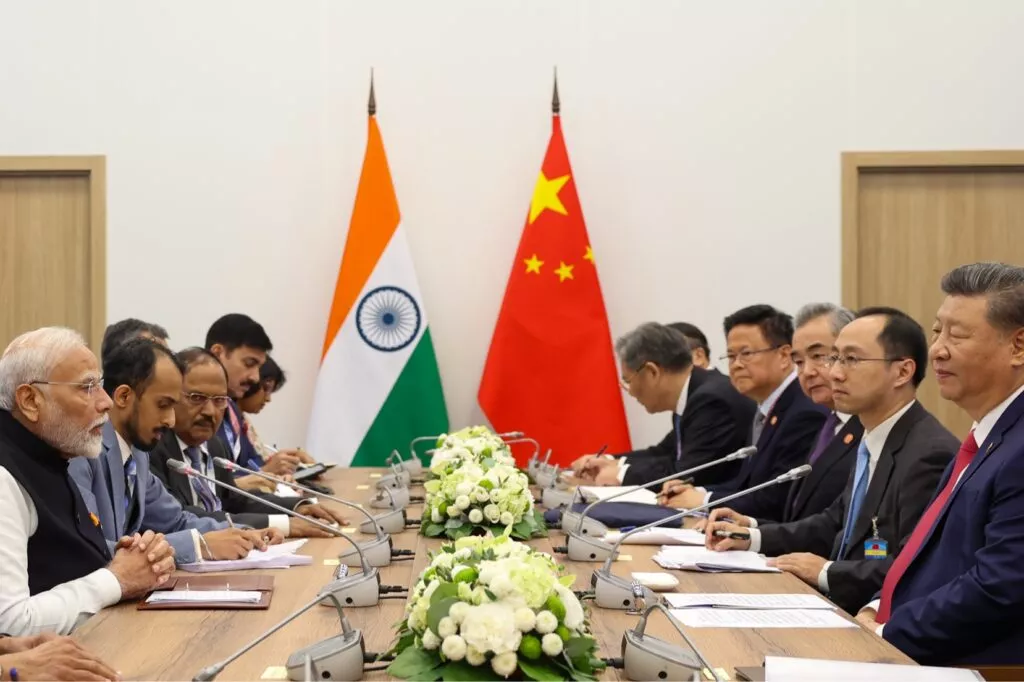
Most analysts around the world, today, agree upon the fact that this is the Asian century, and that both India and China are amidst the process of emerging as two of the most dominant powers in the region. They also are in agreement with the fact that much of the future orientations in the Asian space, in terms of politics, economy and military affairs are either directly or indirectly related to the nature of bilateral relations that India and China would share in the forthcoming decades. However, what every analyst is not in agreement with, is the determinant which would mark the trajectory of that development, and also on the priorities which would be selectively enlisted by each of the two nations towards that direction. The popular discourse on India China bilateral relations at present is found to be heavily weighed down by issues related to national security, foreign policy, military strategy and economic engagement, outlining the interpretations and often misinterpretations of the central governmental power structures of the both the countries on various issues of concern, and serving as the necessary backdrop for any academic study in the relevant field of international relations.
The prevalent approach thus stated above, however, is a top-down approach, which takes into consideration the state as the main actor and incorporates the viewpoint of the centre/mainland into the main narrative, thereby often missing out on the critical role of non-state regional and sub-regional forces in the India China engagement discourse. The study here underscores the need to re-think the future of India China bilateral engagement by viewing it against a multi-layered, dynamic, socio-cultural-politicoeconomic matrix of regional and sub-regional sub-structures, and capturing the complex interplay of national, regional and sub-regional forces therein. It draws attention to the sub-altern people and communities, at the regional and sub-regional level, which have the potential of serving as crucial determinants in defining the future orientation of India China relations, but perhaps have been denied adequate attention. One such space, thus identified, is the peripheral region of northeast India, that of southwest China, and further down, the southeast of Asia along with its rich resources, which could help it emerge as a zone for future engagement between India and China, thereby transcending the conservative approach and challenging the prevalent bias of viewing the mainland as the chief generator and moderator of initiatives over the periphery. Taking into account Chinese dynastic historical records and archaeological evidences which testify to the presence of ancient Sino-Indian connectivities through the said peripheral corridor around the 2 nd century BCE, and in support of J. Ann Tickner’s observation that any critical enquiry must consider “what’s not there”, the study here addresses the need to engage in the investigation of those areas of silences and omissions in the current popular narrative of India China relations, which, if voiced, might eventually lead to a possible cooperation between the countries in the Asia-Pacific neighborhood. Northeast India is a strategic checkpoint within the larger Asian geo-political framework, and could be viewed as crucial determinant in redefining India’s engagement with Southeast Asia, vis-à-vis China.
Current initiatives by the Union government of India suggest that northeast India, from the 1990s and more so, post 2000 has emerged as the new core area of policy making for the central government, determining the trajectory of India’s foreign policy formulations, but for the policy to be successfully implemented and in order to reap the desired benefits, there is an urgent need to reorient the perception, attitude and approach of the Indian mainland towards its northeast, while simultaneously recognizing and acknowledging the challenges that a multi-ethnic socio-cultural geopolitical space possibly poses, with all of its complexities. The canvas in the context of both northeast India and southwest China is vast, variegated and rather unexplored, often exhibiting features of shared socio-cultural values, common traditional heritage, similar problems of history of politics, and psychological orientations of their multi-ethnic people. The narrative on India China future linkages could therefore be re-framed through collaborative research and intellectual inputs from academicians, bureaucrats, policy makers, and civil society people, set against a comparative India-China framework, with the objective of identifying innovative ways of exploring northeast India and southwest China as part of the emerging discourse and dialogue on India China bilateral relations. The following have thus been outlined here as few of the initial measures as prerequisites for formulating a northeast-India centric vision for India China future bilateral ties; first, to interrogate and re-orient the colonial perception of the northeast and foster comprehensive understanding of the region and her people, second, to re-frame the identity of the northeast from being perceived as the periphery of India into an emerging centre for south, east and southeast Asia, third, to initiate a bottom-up approach through active involvement of regional and sub-regional government and non-governmental organizations, civil society, local community members in the policy dialogue, fourth, to identify avenues of sustainable economic development, by taking into account the specifics of the region, and its pragmatic application in promoting long term regional peace and development. If India’s engagement with all of its South and Southeast Asian neighbours vis-àvis China needs to be broadened, deepened and diversified, there is no better option than creating innovative ways of actively involving the less explored socio-cultural and geopolitical space of Northeast India, and to re-frame its identity, not any longer as the periphery of India, but more so its emergence as the centre for south and southeast Asia.