By J R Mukherjee –
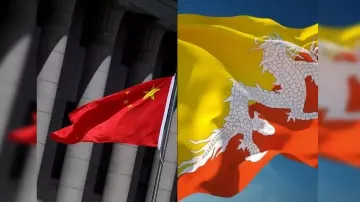
India it appears was in for a rude shock at the signing of a memorandum of understanding (MoU) on Thursday between Bhutan and China on “three-step roadmap for expediting the boundary negotiations. Bhutan and China had agreed on the “three-step roadmap” to help expedite the ongoing boundary negotiations. The MOU signifies a major change in relations between the Kingdom of Bhutan and the People’s Republic of China that have been historically tense; whereas relations with India have been friendly till date. Bhutan’s border with Tibet has never been officially recognised and demarcated. Bhutan has always had a boundary dispute with the PRC since they came into being in 1949.Mao Zedong had in fact declared in the original 1939 version of, ‘The Chinese Revolution and the Communist Party’ that “the correct boundaries of China would include Burma, Ladakh, Sikkim, Bhutan and Nepal”. In his Five Fingers of Tibet policy, he also referred to Bhutan as a part of Tibet and therefore China. From 1949 onwards, incursions by Chinese soldiers and Tibetan herdsmen provoked tensions in Bhutan. Bhutan then imposed a cross-border trade embargo, closed the border and established military ties with India. During the 1962 Sino-Indian War, Bhutanese authorities permitted Indian troop movements through Bhutanese territory. According to official statements by the King of Bhutan to the National Assembly, there are four disputed areas between Bhutan and China. The disputed area in Doklam covers 89 sq kms including the Western tri – junction, while the disputed areas in Sarithang, Dramana, Sinchulumpa and Gieu cover about 180 sq km most of which have already been illegally occupied by China. In North Central Bhutan the dispute relates to two border valleys — Pasamlung and Jakarlung.
In East Bhutan the dispute relates to the entire area adjacent to the Tawang Tract known as theSakteng Sanctuaryand includes the Eastern trijunction. Bhutan became a close ally of the British during the Anglo-Tibet war thatled to the signing of the Treaty of Punakha in 1910 and was a prelude to the Treaty of 1949 signed between independent India and Bhutan. For Bhutan, the Treaty came as an assurance from India that its sovereignty will not be challenged bythe ‘Big Power’ to its south. This was critical to her as China, was then carrying out threatening advances towards Ladakh, Tibet, Sikkim, Nepal and Bhutan, following the ‘Palm & Five Fingers’ theory of Mao. Under article 2 of this treaty, the Bhutan had to undertake to ‘be guided by the advice of Government of India in its external relations and defence’. Hence, Bhutan had to give up its right to have an independent Foreign Policy. In military relations, a 2000 strong Indian Military Training Team is based in Bhutan. The Royal Bhutanese Army does not have a navy as it is landlocked and neither does it have an Air Force; air cover is provided by the Indian Air Force. The Sino-Indian War of 1962 was a setback for Indo-Bhutan relations. Bhutan was jolted to the reality of the weak position of India vis-a-vis China. 1962 created the suspicion that if India was unable to protect itself, how it could protect Bhutan. Since then Bhutan began to expand its horizons to other parts of the world. Another incident that made Bhutan wary was the merger of Sikkim with India in 1974, During the Janta Government rule India India ceded to Bhutan’s request for establishing bilateral relations with China by sending a diplomatic note to the Chinese embassy in India in 1981. Since then Sino-Bhutan relations have been mainly dominated by boundary negotiations and several rounds of negotiations have been held till now. During the 1980s Bhutan continued to open up-to the world while still maintaining friendly relations with India. By now, liberal interpretation of Article 2 of the Treaty of 1949 was already an established custom between the two neighbours. After the pro-democracy movement took roots in Bhutan, several changes came into Bhutan’s national consciousness. The process of debate and discussion on Bhutan’s foreign and security policy started in right earnest. In the national assembly, representatives started pushing for settling of border dispute and normalising relationship with China. India-Bhutan relations were revised in 2007 with the establishment of democracy and with a new Treaty. Bhutan India relations are now like that of equals; with Bhutan being freed from accepting India’s ‘guidance’ in its external affairs. As democracy started taking root, special ties with India have been questioned by many in Bhutan. For India, Bhutan has remaineda traditional ally and a buffer for its territorial security in the eastern theatre. The present Indian Prime Minister Narendra Modi chose Bhutan as his first foreign destination, placing regional cooperation before global co-operation. He had inaugurated the Supreme Court Complex in Bhutan and also promised help to Bhutan in various sectors.In January 21, 2021 India sent free doses of the Covid-19 vaccine to Bhutan. China, has always strived to maintain a domineering position vis-à-vis Bhutan. China refused to even recognize Bhutan’s status as an independent nation in order to assert its suzerainty over Bhutan and has kept the border dispute alive. Bhutan however realizes that it cannot afford to ignore recent Chinese overtures without creating animosity between the two. Thus, Bhutan has started turning towards China.
Besides strategic interests, Bhutan has justified economic interests in opening up-to China, Beijing is exporting farming and telecommunication equipment and has also offered to invest in projects related to health and education services. In 1998, China and Bhutan signed a bilateral agreement for maintaining peace on the border. In the agreement, China affirmed its respect for Bhutan’s sovereignty and territorial integrity and both sides sought to build ties based on the Five Principles of Peaceful Co-existence. However, China’s building of roads on what Bhutan asserts to be Bhutanese territory, allegedly in violation of the 1998 agreement, provoked tensions. On 11 August 2016 during the 24th round of boundary talks both sides expressed their readiness to strengthen co-operation in various fields and hope of settling the boundary issues. On June 29, 2017, Bhutan protested to China against the construction of a road in the disputed territory of Doklam that the Chinese claimed. A stand-off between China and India occurred from mid-June 2017 onwards in the area after the Indian army blocked the Chinese construction of a road in what Bhutan and India consider Bhutanese territory. Both India and China deployed large numbers of troops in the area for 73 days. Bhutan then rejected Beijing’s claim that Doklam belongs to China. The stand-off was resolved thereafter diplomatically – however after some time the Chinese simply coerced Bhutan and diverted their activity to another part of the Doklam and continued their construction and intrusion activities.
They have even constructed a village on Doklam. The Chinese have recently during the Galwan incident in Ladakh also reactivated their claims to the Sakteng sanctuary in Eastern Bhutan and the areas adjacent to the Tawang Tract in Arunachal and have also increased their intrusions across the Arunachal and other borders. India needs to be deeply concerned over all these activities related to Bhutan as China appears to have coerced Bhutan intothis pact which would give them control over their entire claimed area in Western and Eastern Bhutan in exchange for relinquishing their claims in North Central Bhutan and economic assistance. This would give them tremendous military advantage to the Chinese in the eventuality of hostilities with India to overcome India’s defences which deny access to the Chicken’s Neck (Siliguri Corridor) and to capture the Tawang Tracts. Further such a pact would also indicate India’s loss of leverage with Bhutan as also deterioration of relations with Bhutan who have always been considered to be friendly to India. All these aspects adversely affect India’s National Security. India therefore needs to advise Bhutan not to agree to any conditions that the PRC may lay down that adversely affect India’s security.