
FINAL REPORT- PEACE AND STABILITY IN INDO- PACIFIC REGION
- SUMMARY
- TITLE OF SEMINAR – PEACE AND STABILITY IN INDO- PACIFIC REGION.
- DATE AND VENUE – Jan 11th 2020 ; Tollygunje Club.
- LIST OF SPEAKERS – DR RONEN ROY
-GEN S ROYCHOWDHURY, PATRON, CENERS-K
-ACM ARUP RAHA, PRESIDENT CENERS-K
-MINISTER NAOKI KUMAGAI, EMBASSY OF JAPAN
-GEN (Dr-phD) V K SINGH, MoS, GOVT OF INDIA
-Dr (PhD) Shino Watanabe,sOPHIA, uNIVERSITY.
-dr(PhD) BISWAJIT DHAR, JNU, NEW DELHI
-Dr(PhD) PRABIR DE, RIS ( MEA), NEW DELHI
-VAdm P K CHATTERJEE, CENERS-K
-Dr(PhD) TAKENORI HORIMOTO, GIFU UNIVERSITY
-Dr(PhD)B GHOSHAL, SECY GEN SIOS, NEW DELHI
-Dr(PhD) Subramanian Swamy,HON’BLE MP(RS)
-MAJ GEN ARUN ROYE, VICE PRESIDENT, CENERS-K
-LT GEN J R MUKHERJEE, Vp(OPS), pRESIDENT
-BRIG N S MUKHERJEE, SECRETARY, CENERS-K
NOTE:- -Please see Brochure attached.
- No- PARTICIPANTS/ AUDIENCE – 175 to 190 Approximately
- SUMMARY OF PRESENTATIONS – Audio and video is enclosed. May be edited in Japanese language as required
-also see appendix a
- main findings – see appendix b
summary contiunued
- url – url given below. Material will be uploaded once approved
-See Appendix c (PHOTOS ATTACHED)
- evaluation and impact of the event
This was the first major Seminar on the subject of Peace and Stability in the Indo- Pacific Region. Moreover, the fact that the Japanese Consulate was actively involved in the project, lent itself to greater exposure. A lot of interest was generated due to the presence of Ministers in Government of India, the Hon’ble straight speaking Member of Parliament, the Minister Political from Embassy of Japan in India, expert academia both from Japan and India and professionals in Kolkata. The interest could be made out by the fact that soon after the beginning, the rush inside the auditorium was overflowing. If one were to evaluate the Seminar out of 10, it would easily cross the figure of 8 and bordering on the higher numeric.
The Subject chosen was of great interest to students and faculty of various Universities in Kolkata. Whereas the centrality of S E Asia and South Asia was indicated as an accepted fact. Japan as a nation was projected as a leading nation in the Indo- Pacific, and would be in a position to guide and mentor the rest towards a stable, free and peaceful Region.
- LIST OF ARTICLES / URLs NEWS PAPER REPORTS REFERRING TO THE EVENT
- https://nenow.in/north-east-news/northeast-key to indo-pacific.html
- https://nenow.in/neighbour/china/india-should-not-write-off-bri-says-swamy.html
- Itinerary of PARTICIPANTS FROM JAPAN INCLUDING MEETINGS
- mINISTER kUMAGAI – Arrival in Kolkata from Delhi – Afternoon of 10th Jan 2020.
– Stay in Cottage in Tollygunje Club.
– Meet Hon’ble Miniter V K Singh, Dr Subramanian Swamy
– Meet CENERS-K officials and academics of Universities.
– Give Keynote address.
– Depart late evening back to Delhi – 11 th Jan 2020.
- Dr (PhD)WATANABE- Arrive Kolkata from Tokyo via Delhi- 10th Jan 2020.
– – Stay in Cottage in Tollygunje Club.
– Meet Hon’ble Miniter V K Singh, Dr Subramanian Swamy,MP
– Meet CENERS-K officials and academics of Universities.
– Give address on issue of Belt and Road initiative.
– Attend official reception at residence of HE Masayuki Taga.
– Depart at noon back to Tokyo via Delhi – 12 th Jan 2020.
- Dr (PhD)HORIMOTO- Arrive Kolkata from Tokyo via Delhi- 10th Jan 2020.
– Stay in Cottage in Tollygunje Club.
– Meet Hon’ble Miniter V K Singh, Dr Subramanian Swamy, MP
– Meet CENERS-K officials and academics of Universities.
– Give address on issue of Belt and Road initiative.
– Attend official reception at residence of HE Masayuki Taga.
– Depart at noon back to Tokyo via Delhi – 12 th Jan 2020.
- ARGUMENTS MADE BY EACH JAPANESE PARTICIPANTS
- mINISTER kUMAGAI- Japan is focused on India’s NE region, and South East Asia as well as South Asia as a whole and its development.
– India is an indispensible strategic partner of Japan in the promotion of peace Security and prosperity of the indo Pacific Region .
– Japan is seriously concerned with China’s stand in South China Sea. Japan holds that regional disputes should be settled peacefully.
– Japan – India Cooperatin in Nfrastructure b uild up will assist to connect South East Asia, South Asia, and even Africa and the Middle East Countries.
– Japan and India are involved in joint development projects in Bangladesh and Myanmar in the Physical and Social infrastructures.
– Evaluation – 9 in a scale of 10
- Dr( PhD) Watanabe – Japan’s relation with China has been improving since the visit of HE Me Abe’s the PM of Japan, visit to China in Ocr 2018.
– The improvement in relations have not shown any tangible achievements.
– Xi’s challenge remains how to make BRI sustainable and successful, whioch gets emphasized in the light of ongoing US- China trade disputes and its economic slowdown.
– PM abe’s challenge remains in implementing a free and open Indo- Pacific ( FOIP), especially co-existence of FOIP and BRI.
– Another area of concern is President Trump’s policy towards Japan.
Evaluation – 9 in a scale of 10
- Dr (PhD) Horimoto – USA taking a new stance, vis-à-vis India subsequent to its evolving policies towards China.
– India’s withdrawal from RCEP is a major setback to all nations. India needs to create capacity.
– regional mechanisms sjold take a step by step approach based on consensus as each each country has to adhere to its own domestic agenda.
– A regional grouping is best to maintain balance in the Region. India should continue with its Far East Initiative
– Too much is made of Chinese assertiveness and US decline in the Region.
– Evaluation – 9 in a scale of 10
- Points to Improve – This was the first project with CENERS-k. Considering this, the Seminar was indeed well received by the Audience.
– All participants were asked to give points to improve. We are yet to have a response.
– It may be better to give more time to out of country speakers as they have a lot of knowledge which is not easily available to the audience.
- Settlement report – All Monies received for the project have been expended. CENERS-K shared the total expenditure as stated in the TOR.
APPENDIX A
SUMMARY- PRESS RELEASE 08 JAN 2020 AND INTRODUCTION TO CENERS-K
CENERS-K is starting 2020 with a major Seminar on the Indo- Pacific being the flavour of of nations in the Eastern Hemisphere.. Before we provide details of the Seminar, we would like to introduce CENERS-K to the public through your medium.
The Research Centre for Eastern and North Eastern Regional Studies, Kolkata (CENERS-K, in short),established in 2007-08, as an independent thinking Body of Researchers, who have a sustaining interest in the Eastern, North Eastern States of India and our contiguous neighbours. They are interested in the study of Turbulence, Development, Peace and Security in the Eastern Hemisphere. The area of interest covers all of Asia, in general, and South and South East Asia, littoral countries of Indian Ocean and Bay of Bengal, in particular. Within India, the area of focus is Eastern, North Eastern States, and U.T of Andaman and Nicobar Islands. CENERS-K is a non funded, not for profit and tax exempt organisation. It is a registered as a Think Tank by NITI AYOG and Nett Assessment Cell at New Delhi.
- CENERS-K has organized a number of events related to Development, National and International Security, Policy Analysis, to include Energy, Environment, Ecology, Global Warming and Water security aspects, at Kolkata and NER. It has arranged events in conjunction with Delhi based Think Tanks such as DPG, USI, CSA at Chennai, HQ Eastern Command, and prominent Chambers of Commerce, at Kolkata. It has also held Seminars in the North East under the aegis of MHA and MEA (ICWA), and, NE State Govts on request from respective CMs. Foreign delegations from, ASEAN nations, Bangladesh, China, EU, Japan and USA seek us out for round table interactions when they are in Kolkata. We are affiliated to RSiS in Singapore, BIPSS in Bangladesh, as also Itihaas Sammilani in Dhaka.
- Governors, Central Ministers, CMs of State Govts and Hon’ble MsP at the Centre, have spoken on various issues, like Indo- China Border issues, Maoism and Democracy at the crossroads etc etc. We have also had Foreign speakers on contemporary issues. Needless to mention that, all our events have had considerable response. Our website ceners-k.com is under refurbishment , but accessible to know basic facts. Our last six events are uploaded on Youtube at ceners<space> k. Our journal –The Calcutta Journal of Global Affairs ( CJGA) is at http://globaljournalceners.org.
OBJECTIVES
- To stimulate public interest in Geo Politics, Geo Economics and Geo Strategy, in context of The Regional and South Asian Security.
- B. To provide forum for Research, Discussions, Debate on current Turbulence and Threat (T2).
- C. To enthuse Military, Maritime Socio-Political, Energy, Economic, Environment, Ecology and Water (E4W)
- D. Sectoral Studies and Analyses of Demography and Disaster Management Capabilities (D2) within The Region.
- Application of Development, Progress,& Policies formulated on Education, Science & Technology, IT and Electronics in The Region.
- Rural Upliftment ,Human Development and Economic Security as part of all studies.
RESEARCH EMPHASIS
- Alternative framework, of ‘conflict evasion’ and for ‘conflict resolution ’ bto mitigate Turbulence; in turn creating conditions for Development, which, is the sole guiding principle for ultimate Peace and Security in this mostly underdeveloped Region.
- Promote Official interest in development of Strategic Thought on T2, D2 and E4W.
- C. Ways and means to assist Official agencies in child welfare and upliftment of women.
- D. Provide openings to needy students for individual research by making available facilities available in/to CENERS-K.
SEMINAR-11 Jan 2020 at Tollygunje Club Auditorium
- The theme of the Seminar is Peace and Stability in the Indo- Pacific Region. We approached a few rim nations to participate as speakers. Japan has responded by sending two academics on the main theme as also a representative of the Embassy of Japan, in New Delhi. We attach a self explanatory Brochure for your perusal which provides the Concept Note as also the detailed Programme.
- Under the Obama Administration, East Asia was an important component of United States’ foreign economic policy, having been anchored on the President’s strategy of “Pivot to East Asia”.Critical to this engagement was the first mega regional free trade agreement that the Administration had crafted with 11 other Pacific Rim countries, namely, the Trans Pacific Partnership (TPP). However, one of the first acts of the Trump Administration was to withdraw from this agreement. The significance of United States’ withdrawal for the shaping of the economic architecture in the Indo-Pacific region will be analysed in the Seminar.
- The importance of the Indo-Pacific region stems from various factors. Most importantly, the huge population it encompasses and the global trade that it enables. Indo-Pacific region controls the funnels through which crude oil and cargo flow into the Indian Ocean and Western Pacific namely the choke points of Malacca, Hormuz and Bab el Mandeb. Shifting focus to the Eastern Indo-Pacific; China by its territorial claims in East China Sea and South China Sea has shattered the myth of its peaceful rise. Any alteration of regional dominance could impact energy security which is the Achilles heel for China as well as Japan. While insignificant reserves of fossil fuel in East China Sea is indicative of historical rivalry and big power play, South China Sea with its lucrative hydrocarbon reserves is unfolding into a complex scenario the severity of which is likely to increase as China becomes militarily and economically stronger.
- Under the prevailing geostrategic environment and security situation what diplomatic, economic and military recourse lie before Japan to deal with hybrid warfare in the Grey Zone . Further, what could be Japan’s contingency plans for ‘a weakening American resolve’ to dominate East Indo-Pacific? One of the more prominent trends through the 2010s was that bilateral relations with India evolved from a purely bilateral relationship and assumed importance within a broader, multilateral context. The combination of the relative decline of US power and the rapid ascension of China is among the causes that contributed to such transformation. The emergence of the Indo-Pacific as a cross-regional concept may be cited as yet another factor and one that interlinks with these trends.
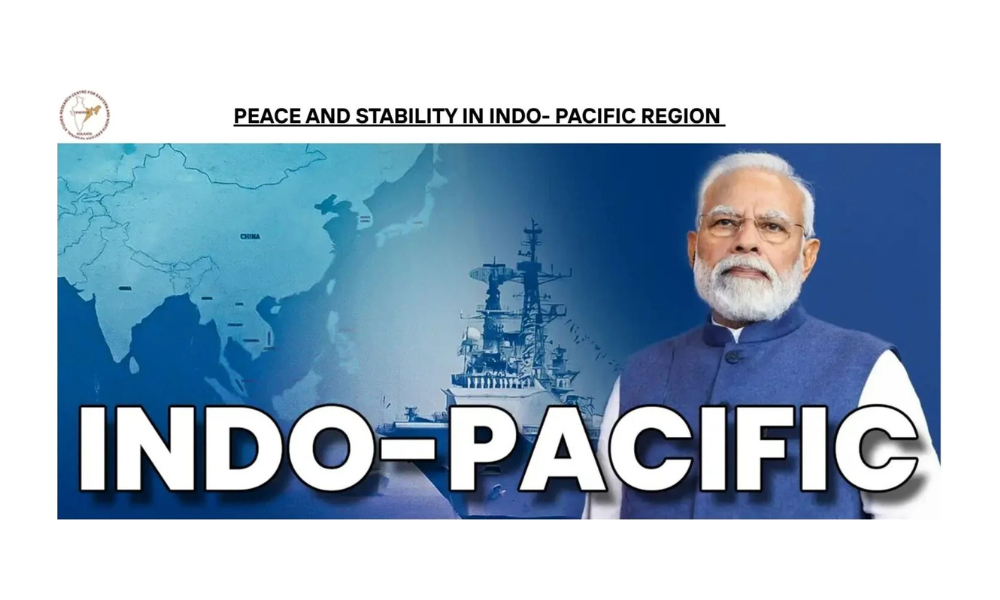
- While Indian leaders and officials have been using the term Indo-Pacific for some time now, it was left to Prime Minister Narendra Modi to articulate the vision more precisely. Delivering the keynote address at the Shangri-La Dialogue in Singapore in 2018, and more recently at the same conclave in Thailand, Modi placed this region at the heart of India’s engagement with the world. India’s engagement with the region, which encompasses many of the world’s most dynamic economies, will be undergirded by a positive impulse which seeks to enhance trade and cooperation.
- We have seen regional initiatives in the form of China led BRI and Free and open Indo- Pacific by the Rim nations. The region is likely to attract growing attention politically, economically and strategically. The idea is to peacefully co-exist in Indo-Pacific, notwithstanding irritants in national relationships.
SUMMARY OF PRESENTATIONS – SELECTED ABSTRACTS OF EMINENT SPEAKERS
- Dr ( PhD) Shino Watanabe
Sino-Japanese relations have been improving since Prime Minister Shino Abe visited Beijing in October 2018, amid tense relations between the United States and China. Abe and Chinese President Xi Jinping decided to carve out “a new era of Japan-China relations” at the summit meeting in Osaka in June 2019. In the Indo-Pacific region, we have seen the rise of regional initiatives, namely “Belt and Road Initiative (BRI)” and “Free and Open Indo-Pacific (FOIP).” Responding to these initiatives, ASEAN countries also adopted the “ASEAN Outlook on the Indo-Pacific” at the ASEAN Senior Officials Meeting held in Bangkok in June 2019. The region is likely to attract growing attention politically, economically, and strategically. Both leaders, however, face internal and external challenges to promote their initiatives. First, this paper explains the state of Sino-Japanese relations. Then, it examines how the two initiatives evolve and highlight major challenges and opportunities of these initiatives. Lastly, it explores how they can coexist in the Indo-Pacific.
- Dr ( PhD) Biswajit Dhar Under the Obama Administration, East Asia was an important component of United States’ foreign economic policy, having been anchored on the President’s strategy of “Pivot to East Asia”. Critical to this engagement was the first mega regional free trade agreement that the Administration had crafted with 11 other Pacific Rim countries, namely, the Trans Pacific Partnership (TPP). However, one of the first acts of the Trump Administration was to withdraw from this agreement. The significance of United States’ withdrawal for the shaping of the economic architecture in the Indo-Pacific region will impact the Region.
- Dr( PhD) Prabir De
In 1992, India joined ASEAN as a sectoral partner, at a time when India was relatively a closed economy, and India started its journey to globalisation through LEP Liberalised Economic Policy). Gradually, the LEP, which was in force for more than two decades, has been transformed into the Act East Policy (AEP) with ASEAN at its core, and the north-eastern region of India has become a key component of India’s growing economic and strategic partnership with East and Southeast Asia. Some of the important developments of the policy relate to improving economic relations with ASEAN countries, China, Japan and Korea. Although the policy has undergone a major change in recent years, ASEAN has remained as the core of India’s growing interaction with Southeast and East Asia. Meanwhile, India has decided to quit from the Regional Comprehensive Economic Partnership (RCEP).
The term Indo-Pacific, as it is evolving, reflects the growing salience of India’s economic and security profile, extending beyond the Indian Ocean into the western Pacific and Africa.[1] Besides economic relations, India’s security partnerships with countries in the Indo-Pacific such as the US, Japan, Australia and several ASEAN countries, have expanded significantly in recent years. In that sense, Indo-Pacific is the best option for India to march ahead in the next decade while aiming towards a US$ 5 trillion economy by 2025.
- Dr (PhD) Takenori Horimoto
Japanese people apparently share an affinity with India for several reasons: its history as the cradle of Buddhism, economic factors, and international politics. Based on such affinities, Japan-India relations grew steadily closer and stronger through the Meiji era and thereafter. This trend grew even more pronounced in the post-Cold War period. If the 1990s marked an exploratory phase, then the 2000s were a transitional phase while the 2010s have brought a huge leap forward. One of the more prominent trends through the 2010s was that bilateral relations evolved from a purely bilateral relationship and assumed importance within a broader, multilateral context. The combination of the relative decline of US power and the rapid ascension of China and India are among the causes that contributed to such transformation. The emergence of the Indo-Pacific as a cross-regional concept may be cited as yet another factor and one that interlinks with these trends.
I will present a general review of Japan-India relations in recent years together with an analysis and study of trends of countries on the concept of the Indo-Pacific, India’s striving for major-power status, and the quadrilateral framework between India, Japan, the US, India, and Australia (“Quad”). To summarize my conclusions here, although the future direction of Japan-India ties will undoubtedly develop through their responses to China, it is also necessary to creatively build a forward-looking regional framework while keeping future developments in mind beyond the Quad.
14.V Adm P K Chatterjee
The importance of the Indo-Pacific region stems from various factors. Most importantly, the huge population it encompasses and the global trade that it enables. Indo-Pacific region controls the funnels through which crude oil and cargo flow into the Indian Ocean and Western pacific namely the choke points of Malacca, Hormuz and Bab el Mandeb. Shifting focus to the Eastern Indo-Pacific; China by its territorial claims in East China Sea and South China Sea has shattered the myth of its peaceful rise. Any alteration of regional dominance could impact energy security which is the Achilles heel for China as well as Japan. While insignificant reserves of fossil fuel in East China Sea is indicative of historical rivalry and big power play, South China sea with its lucrative hydrocarbon reserves is unfolding into a complex scenario the severity of which is likely to increase as China becomes militarily and economically stronger. Under the prevailing geostrategic environment and security situation what diplomatic, economic and military recourse lie before Japan to deal with hybrid warfare in the Gray Zone . Further, what could be Japan’s contingency plans for ‘a weaning American resolve’ to dominate East Indo-Pacific?
- Dr (PhD) Baladas Ghoshal While Indian leaders and officials have been using the term Indo-Pacific for some time now, it was left to Prime Minister Narendra Modi to articulate the vision more precisely. Delivering the keynote address at the Shangri-La Dialogue in Singapore in 2018.Modi placed this region at the heart of India’s engagement with the world. India’s engagement with the region, which encompasses many of the world’s most dynamic economies, will be undergirded by a positive impulse which seeks to enhance trade and cooperation. India joining the RCEP (Regional Comprehensive Economic Partnership) would have ensured that process and enabled New Delhi to be part of the regional value chains. The RCEP brings together the 10 countries of ASEAN in South East Asia, along with Japan, South Korea, Australia, New Zealand, and China and until last week — India. These 16 countries account for over a third of world GDP and trade, and are collectively growing at a rate that is double the rest of the world. The Indian economy is large, but the rest of the RCEP is eight times its size. It is by far the most attractive market in the world today, and will be for the next 20 years. India was negotiating since 2012 with the ASEAN countries for concessions on the service and investments sectors where India has a comparative advantage in relation to goods where ASEAN has reaped greater benefits from its FTA with India. There is also some concern in New Delhi that with lower tariffs under RCEP, Indian market will be flooded with Chinese goods in a situation where it has already a huge balance of trade with Beijing. Indian negotiators have worked hard to ensure a long enough on-ramp to ease Indian industry and farming into a free trade zone. Although the details of the negotiations are still unknown, there are reports that there were sufficient safeguards against Chinese goods flooding the market and long delays built into the potential import of many products. Without India in RCEP, Indo-Pacific will again revert to Asia-Pacific turning its back towards New Delhi.
- ACM Arup Raha The strategic centre of gravity of the world has shifted to Asia, not only in terms of military power; balancing or rebalancing of such power but also a transformational change in economic power equation. This area includes Indo- Pacific, ie, littorals of IOR, SCS & ECS. The Indo -Pacific region hosts more than 50 percent of world population. Tranquility & economic growth in this region will benefit the entire world.
The current geo-political scenario has the potential for major conflicts in Indo -Pacific.India’s position of influence in IOR, and as a Net Security Provider, makes it’s rolesignificant ‘The Malacca & ‘Hormuz Dilemma’ for China & India, respectively as far as SLOCs are concerned is a geographical fact and cannot be sidelined. Andaman Nicobar Command is ensuring strategic presence in the vicinity of Malacca, Sunda & Lombok straits, and a strategic cohabiting of ‘String of Pearls’ & Sagar theories from the Chinese & Indian perspective. Importance of Japan in the region & convergence of strategic interests of Japan & India. makes for bilateral & multilateral naval exercises amongst the rim countries & stakeholders like the US , as well as relevance of other Strategic Initiatives in the region.
APPENDIX B
MAIN POINTS BY SELECTED SPEAKERS
INAUGURAL SESSION
Dr Ronen Roy, President, Tollygunje Club in Welcome Address said civil society needs to understand the shifts in global issues which call for awareness generation initiatives. In a democracy, he argued, public opinion matters in policy formulation.
General S Roychoudhury, Patron, CENERS-K said India should focus on the India centric aspect of the Indo-Pacific initiative in terms of how peace and stability in the region can promote its overall well being as a nation.
ACM Arup Raha, President, CENERS-K stated that more than 60% of the global population lives in the Indo-Pacific region – ensuring peace, stability & cooperation in this region would positively impact global growth. China’s non acceptance of UN laws on the sea, he felt, is reflection of its growing aspiration in the region. With centre of gravity shifting to Asia, he considered, this becomes a cause of concern. India, he suggested, should work on building good maritime relations with other countries in the region. India, Japan, USA, and Australia, he considered, should enter into a military dialogue.
Naoki Kumagai, Minister for Political Affairs, Embassy of Japan in India remarked that India is an indispensable strategic partner of Japan in the promotion of peace, security & prosperity in the Indo-Pacific. Japan, he emphasized that holds the view that regional disputes should be settled peacefully. Japan, he affirmed is seriously concerned with China’s stand on the South China Sea. Japan –India cooperation in infrastructure, he believed, will help to connect South Asia, South East Asia, Africa and Middle East countries. India & Japan, he stated, are involved in joint development projects in Bangladesh & Myanmar in creating both physical and social infrastructure.
General VK Singh, Minister of State, Government of India commented that India favours free, open, inclusive, stable and secure environment in the Indo-Pacific. He conveyed that Indo-Pacific should not be considered as a geo-political bloc. People at large need to look at the area on a Map – looking outwards. India, he emphasised should focus on the security & growth for all in the region.It is not a specific area but stretches from eastern shores of Africa to the western shores of USA. Hence it is region as awhole. Further he stated that India acknowledges centrality of ASEAN in the Indo-Pacific initiative. Both India and China, he believed, have enough space for growth in the world and they need not necessary always look at each other as competitors. Co-operation in maritime activities, he considered, will be of mutual beneficial for all the countries in the Indo-Pacific. Since the region is rich in natural resources, he felt, technological cooperation can lead to win-win situation for all countries in the Indo-Pacific.
SESSION I – POLITICAL AND ECONOMIC ASPECTS
Prof (Ms) Shino Watanabe, Global Studies, Sophia University, Japan stated that Sino-Japan relation has been improving since Prime Minister Abe’s visit to Beijing in October 2018. However this good momentum, she felt, did not achieve a tangible outcome. The main challenge for China, she considered, remains the economic slowdown and how to make Belt and Road Initiative (BRI) sustainable. As for PM Abe’s challenge, she believed, was to implement of Free Open Indo-Pacific (FOIP) and co-existence of FOIP and BRI. Another area of concern, she regarded for PM Abe was President Trump’s policy towards Japan.
Prof Biswajit Dhar, JNU, New Delhi, said that US trade policy in the new millennium on the Indo-Pacific have been distinct under three Presidencies: Competitive liberalisation under Bush (2001-2009); rebalancing act under Obama (2009-2017) & withdrawal under Trump (2017-present). Under Bush administration, he stated, the main objective was to persuade countries in the region to be open and join global trade institutions such as the WTO and also initiate bilateral trade and investment agreement framework with these countries. During Obama’s presidency, he added, focus was given on the Trans Pacific Partner (TPP) agreement with 12 countries as well as the parallel evolvement of Regional Comprehensive Economic Partnership (RCEP). However, under Trump, he said, TPP was abandoned and RCEP was continued with. Indian economy, he felt, has not responded to become a strong economy in the region. He also remarked that South East Asian economies are more mature than India. Thus, he claimed, focus should be on reviewing the Indian economy and speeding it to compete with other economies of the region. We should keep in mind the large Expatriate Chinese population in the Region.
Prof Prabir De, RIS, New Delhi, in his deliberation maintained that given India’s presence in Indian Ocean maritime cooperation should be its first move. On economic cooperation, he asserted that, East Asia Summit should be the starting point and others may be invited later. Focus should be cooperation other than liberalisation. India and Japan partnership, he maintained, should drive the Indo-Pacific. He further added that Act East must evolve into Act Indo-Pacific.
SESSION II STRATEGIC AND SECURITY ASPECTS
V Admiral PK Chatterjee, Member, CENERS-K, said that Indo-Pacific consists of 38 countries or 62% of world’s GDP, 46% of world’s merchandise trade. He emphasised on the need for maritime connectivity in the region. He felt, energy security is an area of concern for China and China-Japan stand on East China Sea hinges on control of hydrocarbons, control of shipping routes. Talking about South China Sea, he remarked that China refuses to abide by EEZ, mostly to tap hydrocarbon deposits. He also mentioned about creation of artificial islands by China for militarisation of South China Sea. Japan, he felt, cannot afford to give away Senkaku Islands. He believed this may have domino effect on other islands. For Sub regional balance, he proposed for a mini QUAD alliance involving countries such as Australia, Philippines, Japan, Vietnam, USA and India. He also suggested that relations between Republic of Korea – Japan needs to be strengthened. He also called for enhancing defensive & offensive cyber capability of Japan for which it needs to increase its defence budget.
Prof Takenori Horimoto, Gifu Women’s University, Japan mentioned median age of India is much lower than that of China and Japan which is an advantage. USA, he remarked is taking a new stance on India subsequent to the evolving policies on China. India’s withdrawal from RCEP, he felt, is a setback for China. Regional mechanisms, he added, should take step by step approach based on consensus as each country has its own domestic agenda. Co-operations between Japan & India, he considered, is important for building a new East Asia and promotes the Far East Initiative of India.
Dr Baladas Ghoshal, Former Head of SE Asia Studies, JNU & Secretary General, Society of Indian Ocean Studies, New Delhi, believed role of foreign capital is important in the integration of Indo-Pacific. South East Asian countries, he considered, look up to China as an opportunity and not only as a threat. ASEAN centrality, he mentioned, promoted Chinese interests. Divergent issues, he felt, needs to be taken into account for the concept of Indo-Pacific and it should be turned into a vision in terms of way of life. He believed a nation has to depend on itself and its own power.
VALEDICTORY SESSION
Dr Subramanian Swamy, Member of Parliament (Rajya Sabha) said China should consider diverting its Belt and Road Initiative (BRI) via Kolkata or Mumbai ports instead of passing through Pakistan occupied Kashmir (PoK) which India is opposed to. He claimed that the senior leadership of China were well disposed to the suggestion when he discussed it with them during his visit to the country. BRI, he said, is a wonderful concept, but it has affected India as the present proposal passes through the PoK. Dr Swamy suggested that instead of passing through PoK, the BRI corridor can enter India from Kunming in southwestern China and from Kolkata Port it can take the sea route through the Bay of Bengal. Otherwise, it can enter India from Uttarakhand’s Pithoragarh bypassing Kailash Manasarovar in Tibet and reach Mumbai Port through western India, he said. BRI, Dr Swamy said, has large advantages that India must enjoy and if the Chinese are willing to accommodate this and not go through parts of Kashmir, India will be in a position to gain in terms of international trade and bilateral relations. India has retraced its path from the RCEP as it has a negative balance of trade with the countries in the forum.
Maj Gen Arun Roye, Vice President, CENERS-K in his address stated that Japan and India need to collaborate to prevent the assertive aspirations of China.
Lt Gen J R Mukherjee, Vice President (Operations), CENERS-K, He stressed that India did a mistake by not joining the RCEP. In his concluding remarks thanked the dignitaries and organisers for successful completion of the programme.
Brig NS Mukherjee, Secretary, CENERS-K offered a formal Vote of Thanks.
[1] Refer, Indian Prime Minister Modi’s speech at Shangri La Dialogue, delivered on 1 June 2018 in Singapore, available at https://www.mea.gov.in/Speeches-Statements.htm?dtl/29943/Prime+Ministers+Keynote+Address+at+Shangri+La+Dialogue+June+01+2018